

When industrial applications require pipes to change direction without sacrificing strength or dependability, typical pipe construction processes may not always be the best option. This is where hot induction bending becomes a practical and economical solution. It permits pipes to be bent precisely while retaining structural integrity and dimensional precision.
Hot induction bending is commonly used to produce precise and smooth pipe bends in a variety of applications, including oil and gas pipelines, power plants, and large-scale building projects. The technology, also known as induction pipe bending, is appreciated for its ability to produce high-quality bends with fewer welds and connections.
What Is "Hot Induction Bending"?
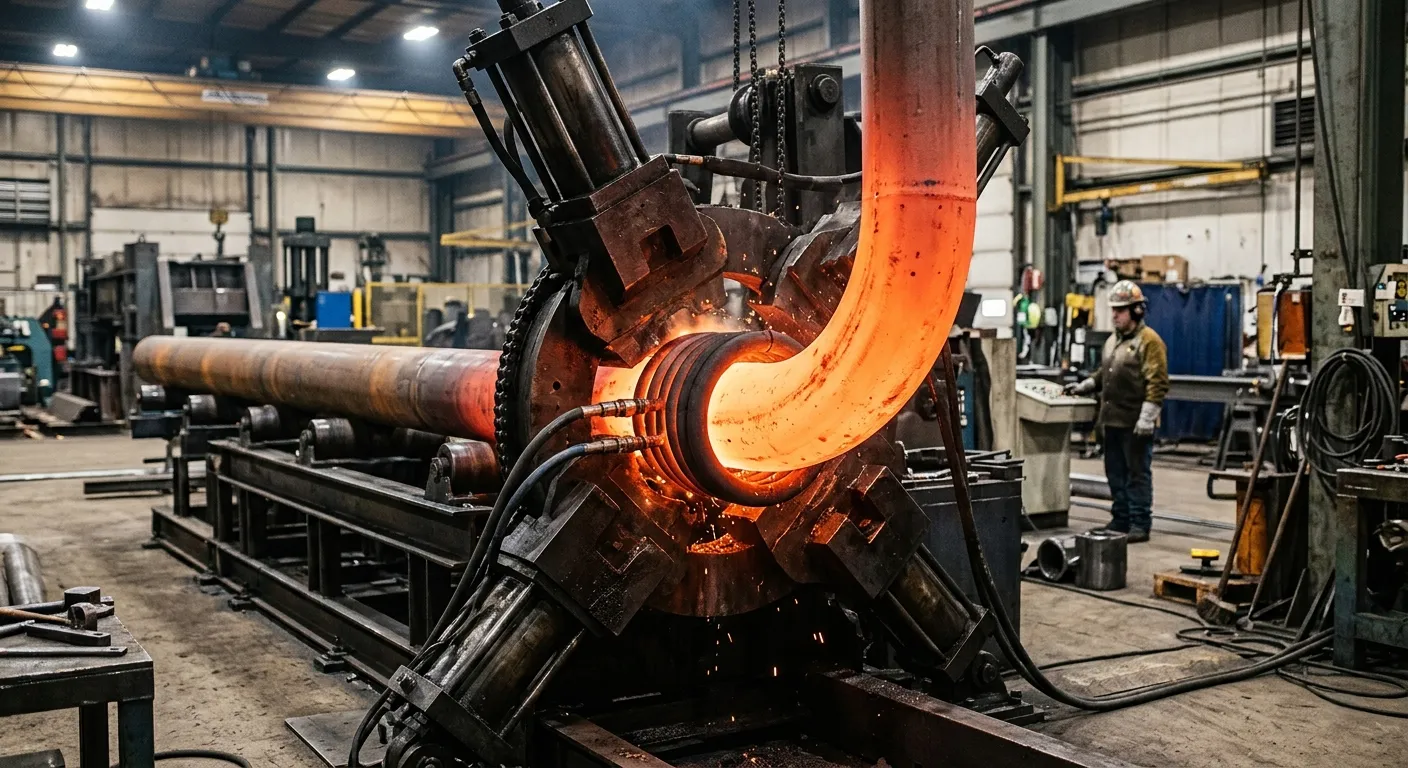
Hot induction bending is a controlled pipe-forming procedure that uses heat and mechanical force to bend a pipe to the desired angle or radius. An induction coil heats a specific section of the pipe rather than the entire pipe.
When the pipe reaches the desired temperature, controlled pressure forces the heated segment around a bending radius. As the pipe passes through the induction coil, the heated portion bends, while the surrounding material remains relatively cool. This controlled technique contributes to smooth and consistent bends.
The procedure can be utilized with a variety of pipe sizes, wall thicknesses, and materials, according to the project's specifications.
How does the Induction Pipe Bending Process Work?
To produce a precise bend, a series of carefully controlled stages are taken.
1. Pipe preparation
The pipe is initially inspected and prepared in accordance with the required requirements. Its material, diameter, wall thickness, and intended bend radius are all taken into account before production begins.
2. Localized Heating
An induction coil warms a tiny length of pipe. Induction heating generates regulated and constant heat, allowing the operator to achieve the desired temperature without heating the entire pipe.
3. Controlled Bending
Once the heated segment has reached the desired temperature, mechanical force progressively pushes the pipe around the needed radius. The bending speed and pressure are precisely adjusted to obtain the required shape.
4. Cooling & Inspection
After bending, the pipe is chilled in controlled conditions. The final bend is next checked for dimensional accuracy, surface quality, wall thickness, and other project specifications.
Key Advantages of Hot Induction Bending
One of the most significant advantages of this method is its ability to make precise, smooth bends.
Better structural integrity
Because induction bending may provide a continuous bend without the need for several welded sections, it can reduce the number of joints in a piping system. Fewer joints can lead to increased reliability and easier maintenance.
Accurate bend radius
The method enables producers to create bends with precise angles and radiuses. This is especially beneficial when piping needs to fit into tight or difficult areas.
Reduced welding requirements
Traditional piping design may necessitate multiple fittings and welds to achieve a desired direction. Induction pipe bending can decrease the need for additional fittings, hence simplifying the overall piping layout.
Efficient Material Use
A well-designed induction bend can reduce the number of individual components needed for a piping system. This could help reduce material handling, production, and installation requirements.
Smooth flow characteristics:
Smooth bends can promote better fluid flow than systems with several acute transitions and fittings. This makes the process helpful in applications that need the efficient transport of liquids or gasses.
Applications for Hot Induction Bending
Hot induction bending is widely utilized in a variety of industries due to its versatility and dependability.
Oil and Gas Industry
Pipelines frequently have to navigate around equipment, buildings, and changes in direction. Induction bends are frequently utilized to optimize pipeline layouts while preserving strength and dependability.
Power Plants
Power plants have vast networks of steam, water, and other process piping. Accurate bends allow these devices to fit within complex plant layouts.
Petrochemical Facilities
Petrochemical plants require piping systems that can withstand harsh operating conditions. Hot induction bending can produce precision-shaped components for process and transportation lines.
Construction & Infrastructure
Large construction and infrastructure projects may necessitate unique pipe bends for structural, utility, and mechanical purposes. The capacity to create bends to particular specifications makes the technique appropriate for a variety of project needs.
Why Choose Professional Induction Bending Services?
The quality of a finished bend is determined by accurate temperature control, bending speed, pressure, material selection, and inspection. Working with an experienced supplier ensures that bends are built to the needed requirements.
Before manufacturing begins, professional manufacturers can advise on appropriate bend radii, pipe materials, dimensions, and application specifications. This can assist avoid fabrication issues and improve project performance.
Conclusion
Hot induction bending is a dependable way for creating accurate and long-lasting pipe bends for demanding industrial applications. The technique benefits from the combination of controlled heating and precise mechanical bending, including minimized welding, exact measurements, smooth bends, and effective material utilization.
Whether employed in oil and gas, power generation, petrochemicals, or construction, hot induction bending and induction pipe bending can be an effective solution for complex piping requirements. Choosing a dependable engineering partner guarantees that the finished bends match quality, performance, and dimensional requirements.
























Sign in to leave a comment.