

What’s the article about? Know and understand how RAG enables manufacturers to transform enterprise knowledge into secure, AI-powered insights through faster information retrieval and intelligent workflow automation.
Imagine asking your company’s AI assistant:
“Which machine maintenance SOP applies to Line 3?”
Rather than looking through a number of folders, PDFs, emails, or ERP records, the AI instantly provides the latest approved document, along with the source attached. That’s the power of RAG or Retrieval-Augmented Generation.
Especially for the Tier-2 manufacturers, the information is often scattered across ERP systems, quality manuals, and maintenance records, along with supplier documents and Excel files. RAG bridges the gap between enterprise knowledge and AI. So, instead of relying only on what an AI model was trained on, RAG retrieves the latest business information before generating a response. This makes enterprise AI more accurate and trustworthy.
Let’s start with understanding the basics of RAG and how it works.
What Is Retrieval-Augmented Generation (RAG)?
To understand RAG, one must be fully aware of LLMs, or Large Language Models. What are those? You can say that LLMs are advanced deep-learning systems that are trained to understand, summarise, translate, and generate human-like answers. Google’s Gemini, Anthropic’s Claude, and OpenAI’s GPT series are all examples of LLMs.
Now, RAG is an AI framework that combines LLMs with your organisation’s knowledge base. It improves the answers that the LLM provides. It is safe to say that RAG fills the gap between your knowledge library and the aspect (LLM) that will generate a response.
How RAG Works In Enterprise AI?
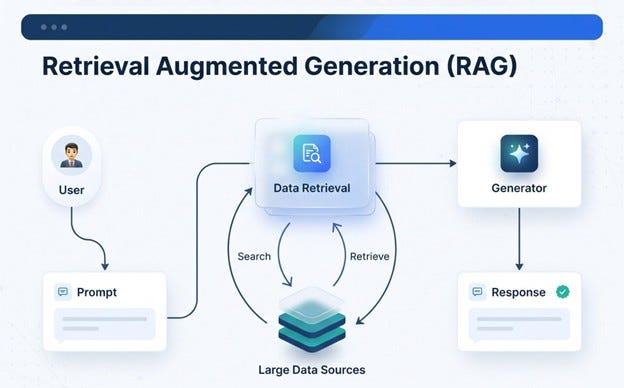
One can understand the working of RAG within 4 simple steps. This includes:
1. Putting Up A Prompt
Let’s say you are asking a question to the AI that, “Show the latest quality inspection checklist.”
2. Rag Retrieves Data
RAG will now connect to the knowledge library and search for ERP reports, PDFs, SharePoint, even access CRM, and other documents in the repositories that either have the search term or are relevant to the asked query.
3. AI Generates A Response
RAG will now help the LLM generate a response after successfully retrieving the information to answer accurately with context.
4. User Receives Verified Output
RAG functions so well that even after making a fast decision, your response will be as pertinent as it can be.
In hindsight, a successful RAG pipeline involves more than connecting an AI model to documents. It includes the following flow:
Unlike other standard AI chatbots, RAG reduces delusions by grounding responses in your company’s own data. A well-designed RAG architecture is one that ensures that responses are accurate, secure, and easy to access.
Why Do Manufacturers Need RAG?
A few of many manufacturers already have a lot of valuable information, but it’s spread across multiple systems. Some of the sources include:
● CRM data
● ERP software
● Machine maintenance records
● Supplier documents
● Quality inspection reports
● Production SOPs
● Compliance records
If you ever need information on, let’s say, the latest lubricant schedule, a RAG-powered assistant will retrieve the correct document within seconds instead of requiring manual searches. This makes RAG for internal knowledge base and RAG for enterprise knowledge management especially valuable for growing manufacturers.
RAG vs Fine-Tuning: Which Is Better?
Before drawing the differences, let’s understand what the two terms imply. While RAG can be your open-book test equivalent, Fine-Tuning is like going to a class to learn a specific skill.
When you ask a question, the system will search the relevant file, find the facts, and pass them to the AI to write an answer. That’s RAG for you. On the other hand, Fine-Tuning retrains the AI on a specific dataset to adjust its tonality, stylisation, and subject-matter knowledge.
The difference between the two is as follows:
Retrieval-Augmented Generation (RAG)
Fine-Tuning
Uses live business data
Learns from static training data
Easy to update
Requires retraining for new information
Ideal for enterprise knowledge
Best for specialised language or tasks
Maintains source references
Doesn’t automatically cite business documents
RAG implementation is said to be one of the fastest and most scalable choices because the company’s documents change regularly, especially in the manufacturing sector.
What are the Best RAG Use Cases in Enterprises?
Manufacturing companies are adopting enterprise RAG solutions across multiple departments. Some of the use cases are as follows:
● RAG for Customer Support: AI can respond instantly to product and service inquiries using technical documents.
● RAG for Internal Knowledge Base: Help employees find SOPs, manuals, and maintenance instructions quickly.
● RAG for Compliance and Audit Data: In just seconds, you can retrieve inspection records and compliance documents.
● RAG for CRM Data Access: Give sales and service teams immediate access to customer history.
● AI Workflow Automation: Use enterprise knowledge to automate approvals, documentation, and agentic workflows.
Such applications of RAG not only help companies improve productivity, but also reduce manual effort across departments.
How to Implement RAG Successfully?
Honestly, a successful RAG system design begins with clean and connected enterprise data. Key implementation steps include:
● Identify and define the business use cases.
● Start organising enterprise documents and data sources.
● Creation of secure document indexing.
● Developing scalable retrieval pipelines.
● Connecting the RAG system to the enterprise LLMs.
● Testing, monitoring, and constantly improving results.
Therefore, for the manufacturers beginning with one department, let’s say, maintenance, quality, or procurement, the result will be faster business value and less time consumption.
Why Choose Iconflux for Enterprise RAG Solutions?
RAG is not just deploying an LLM. At Iconflux, we design enterprise RAG solutions that seamlessly integrate within your existing systems, like ERP, CRM, document repositories, and manufacturing databases, to create secure and AI-ready knowledge ecosystems.
To provide a broad overview, our RAG services include end-to-end architecture design, intelligent document processing, secure enterprise search, and AI workflow automation that connects knowledge to business actions.
So, whether you’re planning RAG for finance, customer support, or factory operations, we will help you build scalable solutions that will absolutely fit within your existing infrastructure.
Transform Enterprise Knowledge into Business Intelligence
Talk to our RAG Expert

It’s not the data that’s required in larger amounts, but the access to it. The better the access, the better the knowledge base. With Retrieval-Augmented Generation, businesses will be able to unlock the value of existing knowledge, reduce search time, improve decision-making, and enable AI systems that employees would actually find reliable.
So, are you ready to build secure, scalable enterprise AI? Connect with us and implement a RAG solution that converts disconnected data into actionable intelligence.
FAQs
1. What is RAG in artificial intelligence (AI)?
A: RAG, or Retrieval-Augmented Generation, is an AI structure that extracts information from your business data before giving it to an LM to generate a response.
2. How does the RAG system work?
A: RAG system searches available enterprise documents for relevant information. It then uses it to provide accurate, context-aware responses.
3. What’s the difference between RAG and Fine-Tuning?
A: While RAG uses live business data, Fine-Tuning reskills an AI model with new datasets.
4. Where is RAG used in businesses?
A: RAG can be applied in customer support, internal knowledge bases, legalities, procurement, CRM, and enterprise knowledge management.
5. How can Iconflux help with RAG implementation?
A: Iconflux creates secure enterprise RAG solutions that integrate with your existing systems, enhancing knowledge access and AI-driven workflows.
Source Link




























Sign in to leave a comment.