

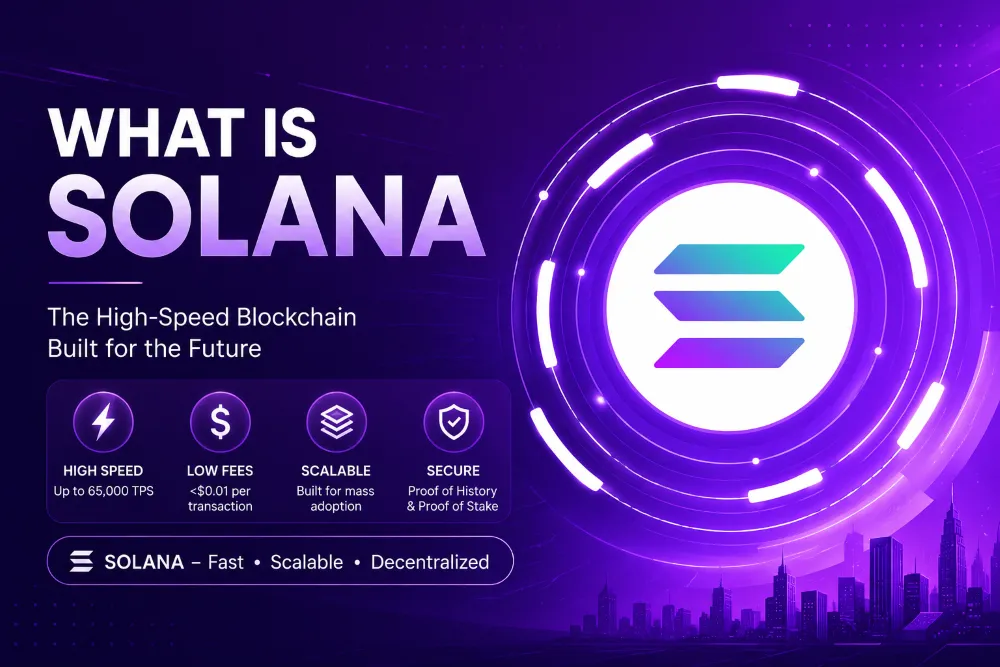
Blockchain technology has evolved rapidly over the last decade. While Bitcoin introduced decentralized digital money and Ethereum expanded blockchain capabilities through smart contracts, Solana emerged with a different mission: solving the speed and scalability challenges that limit many blockchain networks.
Today, Solana is one of the fastest and most cost-effective blockchains in the industry, supporting decentralized finance (DeFi), NFTs, gaming, payments, and Web3 applications. Whether you are a beginner, investor, developer, or entrepreneur looking to create solana token projects, understanding Solana is essential.
Key Takeaways
- Solana is one of the fastest blockchain networks available.
- Average transaction fees are typically less than one cent.
- SOL is the native cryptocurrency of the network.
- Solana supports DeFi, NFTs, gaming, payments, and Web3 applications.
- The blockchain uses Proof of History and Proof of Stake for efficiency.
- Developers can build scalable decentralized applications without relying on Layer-2 networks.
Quick Answer: What Is Solana?
Solana is a high-performance blockchain platform that uses a unique combination of Proof of History (PoH) and Proof of Stake (PoS) to process transactions quickly and affordably. It can handle thousands of transactions per second while maintaining extremely low fees, making it suitable for DeFi platforms, NFT marketplaces, blockchain gaming, and Web3 applications.
Solana at a Glance
| Feature | Solana |
|---|---|
| Launch Year | 2020 |
| Founder | Anatoly Yakovenko |
| Native Token | SOL |
| Consensus Mechanism | Proof of History + Proof of Stake |
| Average Transaction Fee | Less than $0.01 |
| Transaction Speed | Up to 65,000 TPS |
| Smart Contract Support | Yes |
| Layer-2 Requirement | No |
What Is Solana?
Solana is a decentralized blockchain designed to provide high throughput, low transaction costs, and excellent scalability. Founded by Anatoly Yakovenko in 2017 and officially launched in 2020, Solana aims to make blockchain technology practical for mass adoption.
The network enables developers to build decentralized applications, launch tokens, create NFT collections, and develop complex financial platforms without experiencing the congestion often seen on older blockchain networks.
Unlike many competing blockchains, Solana can process transactions directly on its main chain at scale without requiring additional scaling solutions.
Who Created Solana?
Solana was created by Anatoly Yakovenko, a former Qualcomm engineer with extensive experience in distributed systems and communication protocols.
Yakovenko introduced the concept of Proof of History to solve one of blockchain's biggest challenges: maintaining an accurate and verifiable sequence of events without requiring constant communication between validators.
His vision helped establish Solana as one of the most innovative blockchain networks in the industry.
Why Is Solana So Popular?
Several factors have contributed to Solana's rapid growth:
- Extremely fast transaction processing
- Low network fees
- Strong DeFi ecosystem
- Growing NFT marketplace adoption
- Blockchain gaming support
- Efficient staking mechanisms
- Developer-friendly infrastructure
These advantages have attracted thousands of projects and millions of users worldwide.
How Does Solana Work?
Solana achieves its performance through multiple innovations working together.
What Is Proof of History (PoH)?
Proof of History is Solana's cryptographic timestamping system. It creates a verifiable sequence of events before transactions are validated.
This allows validators to trust transaction ordering without repeatedly communicating with one another, significantly increasing processing speed.
What Is Proof of Stake (PoS)?
Proof of Stake is the mechanism Solana uses to validate transactions and secure the network.
Validators stake SOL tokens to participate in block validation. In return, they receive rewards for helping maintain network security.
Compared to traditional mining systems, Proof of Stake is significantly more energy efficient.
Sealevel Parallel Processing
Unlike many blockchains that process transactions sequentially, Solana uses Sealevel to execute multiple smart contracts simultaneously.
This parallel processing architecture enables substantially higher throughput and improved scalability.
Gulf Stream Transaction Forwarding
Gulf Stream reduces transaction confirmation times by forwarding transactions directly to upcoming validators before blocks are finalized.
This innovation helps achieve Solana's near-instant transaction confirmation speeds.
Tower BFT Consensus
Tower BFT enhances network efficiency by leveraging Solana's Proof of History mechanism to reduce communication overhead among validators.
This allows consensus to be reached more quickly and efficiently.
Solana vs Ethereum vs Bitcoin
| Feature | Solana | Ethereum | Bitcoin |
| TPS | Up to 65,000 | 15–30 | ~7 |
| Average Fee | <$0.01 | Variable | Variable |
| Consensus | PoH + PoS | PoS | PoW |
| Smart Contracts | Yes | Yes | Limited |
| Block Time | ~400ms | ~12 Seconds | ~10 Minutes |
While an Ethereum token ecosystem remains larger and more established, Solana often offers faster performance and lower costs for many applications.
What Is the SOL Token?
SOL is the native cryptocurrency of the Solana blockchain.
It serves three primary functions:
Transaction Fees
Every transaction executed on Solana requires a small amount of SOL.
Staking
Users can stake SOL to help secure the network and earn rewards.
Governance Participation
SOL holders indirectly influence network decisions through validator voting mechanisms.
What Is Solana Used For?
Decentralized Finance (DeFi)
Solana powers lending platforms, decentralized exchanges, liquidity protocols, and yield farming applications.
NFTs
Artists and creators use Solana to mint and trade NFTs at significantly lower costs compared to many alternative blockchains.
Blockchain Gaming
Gaming applications benefit from Solana's speed and low latency, creating smoother user experiences.
Payments
Stablecoins and payment systems utilize Solana for fast and inexpensive transfers.
Web3 Applications
Developers use Solana to build decentralized social platforms, DAO infrastructure, and next-generation digital services.
How Does Solana Staking Work?
Staking allows SOL holders to delegate tokens to validators.
The process generally involves:
- Selecting a validator.
- Delegating SOL tokens.
- Earning staking rewards.
- Contributing to network security.
Staking helps strengthen the network while providing passive rewards to participants.
Solana Tokenomics
The SOL token supply is distributed across multiple categories including:
- Community allocation
- Foundation reserves
- Team allocation
- Seed investors
- Strategic investors
- Validator participants
The network follows a decreasing inflation schedule designed to encourage long-term sustainability
Advantages of Solana
High Transaction Speed
Solana can process thousands of transactions every second.
Extremely Low Fees
Transaction costs are typically less than one cent.
No Layer-2 Dependency
Scaling occurs directly on the main blockchain.
Strong Developer Ecosystem
Developers have access to extensive tools, SDKs, and documentation.
Energy Efficiency
Proof of Stake significantly reduces energy consumption compared to Proof of Work systems.
Challenges and Limitations
Network Outages
Solana has experienced service interruptions in the past.
Centralization Concerns
Validator requirements are higher than some competing networks.
Regulatory Uncertainty
Like all blockchain ecosystems, Solana must adapt to evolving global regulations.
Solana Statistics in 2026
- Thousands of active blockchain projects
- Large and growing developer ecosystem
- Significant NFT marketplace activity
- Expanding DeFi infrastructure
- Global validator participation
Can You Create a Token on Solana?
Yes. Businesses, startups, and entrepreneurs frequently create solana token projects for fundraising, gaming ecosystems, loyalty programs, DeFi applications, and community initiatives.
If you are planning to launch your own digital asset, learning how to create crypto token solutions on Solana can provide lower fees and faster transaction processing compared to many alternatives.
Before launching a project, it is also important to understand the cost to create crypto token platforms, including development, smart contract creation, security audits, deployment, and ongoing maintenance expenses.
Future of Solana
Solana continues to attract developers, investors, and enterprises due to its performance-focused architecture.
As blockchain adoption expands, Solana's ability to deliver fast transactions and low fees positions it as a strong contender for powering the next generation of decentralized applications.
Final Thoughts
Solana has established itself as one of the most advanced blockchain networks available today. Through its combination of Proof of History, Proof of Stake, parallel transaction processing, and low-cost infrastructure, it provides a practical foundation for modern blockchain applications.
Whether you are interested in DeFi, NFTs, gaming, payments, or Web3 development, Solana offers an ecosystem designed for speed, affordability, and scalability. For developers exploring alternatives to an Ethereum token ecosystem or businesses looking to create solana token projects, Solana remains one of the most compelling blockchain platforms in 2026.


















Sign in to leave a comment.