
E-commerce has changed a lot over the years. Businesses today want websites that are fast, flexible, and easy to update. Because of this, many companies are exploring modern solutions like headless commerce.
However, traditional e-commerce platforms are still widely used and work well for many businesses, particularly those that prioritise ease of use and integrated features over customisation and flexibility. Understanding the difference between headless and traditional e-commerce helps you decide which approach fits your business needs, budget, and growth plans. This guide explains both models in simple terms and highlights their key differences.
What Is Traditional E-commerce?
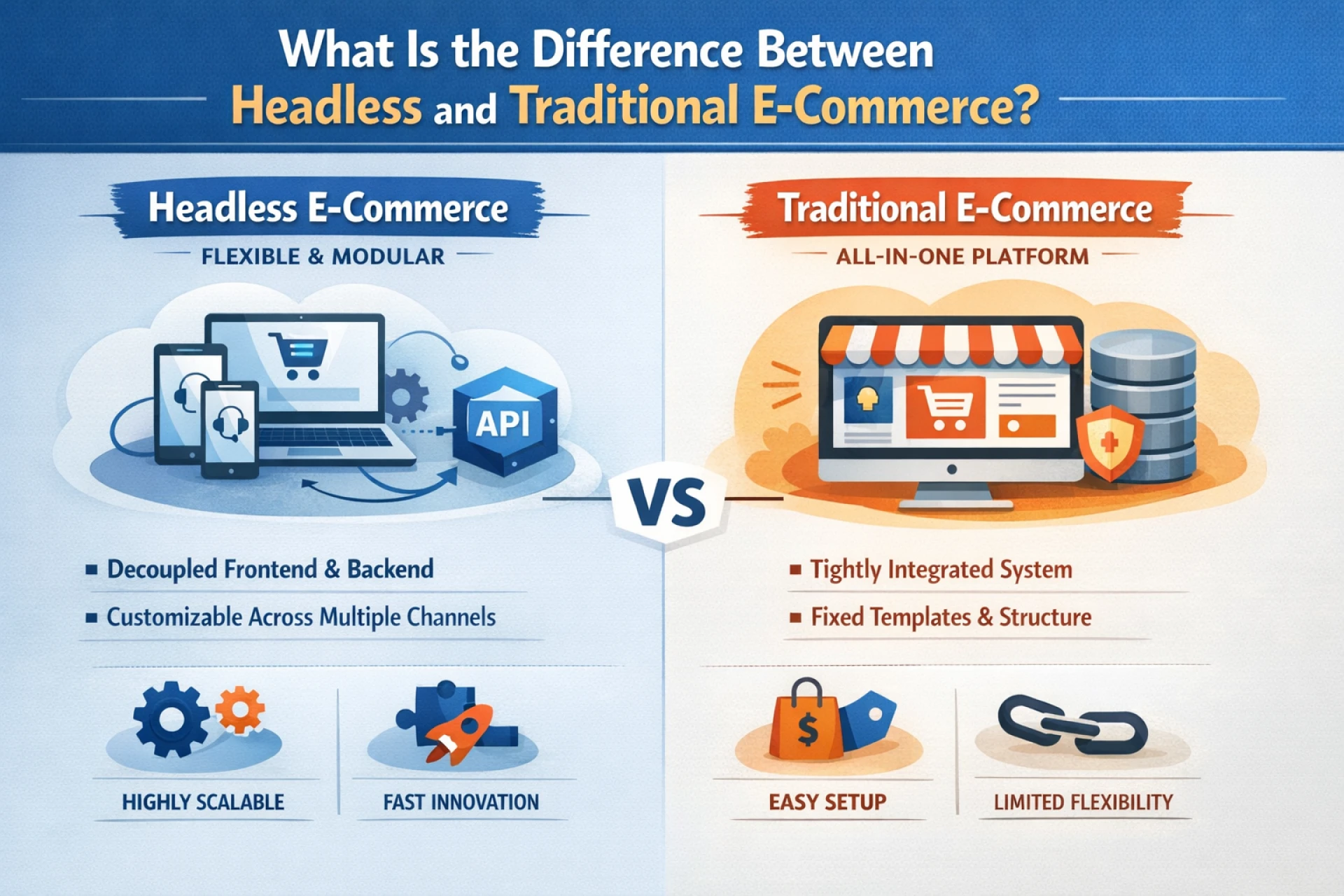
Traditional e-commerce uses a monolithic architecture, which means the front end, what customers see, and the back end, where the data and logic are managed, are tightly connected in a single system.
In this setup, everything works together as one package. If you use a traditional platform, the design, product catalogue, checkout process, and database are all part of the same system.
How Traditional E-commerce Works
In a traditional ecommerce system, the front end and back end are connected within one platform. The front end shows the website design, product pages, and checkout experience to customers. The back end manages product data, orders, payments, and store operations.
When a customer visits the website, the request goes directly to the platform’s server. The system retrieves product information, images, and pricing from the database. This data is then displayed on the website interface that the customer interacts with.
Benefits of Traditional E-commerce
Traditional platforms are popular because they are simple and quick to set up.
Key advantages include the following:
- Easier setup and deployment
- Lower development cost
- Built-in tools for product management, checkout, and payments
- Suitable for small to medium businesses
Limitations of Traditional E-commerce
Despite its simplicity, traditional e-commerce can have limitations.
- Less flexibility in customizing the user experience
- Design changes may affect the entire system
- Harder to scale across multiple channels like mobile apps or smart devices
- Slower development when adding new features
What Is Headless E-commerce?
Headless e-commerce separates the front end from the back end. Instead of working as a single system, both parts operate independently and communicate through APIs.
This means developers can design any type of user experience on the front end while the back end manages product data, orders, and other business functions.
In simple terms, the “head” (the front end) is removed from the main commerce engine. According to recent headless commerce stats, many businesses are adopting this approach to gain more flexibility and improve the overall customer experience across digital channels.
How Headless E-commerce Works
In a headless e-commerce system, the front end and back end operate as separate parts of the platform. The front end focuses on the design and user experience that customers see when they visit the website or app. The back end manages product information, inventory, orders, and payment processes.
Both layers communicate through APIs, which allow the front end to request data from the back end whenever needed. For example, when a customer opens a product page, the front end asks the back end for product details, images, and pricing. The back end sends this data, and the front end displays it instantly.
Advantages of Headless E-commerce
- Full control over website design and user experience
- Faster updates and feature development
- Ability to sell across multiple channels such as websites, mobile apps, and smart devices
- Improved performance with modern front-end frameworks
Challenges of Headless E-commerce
While powerful, headless commerce also comes with some challenges.
- Higher development cost
- Requires skilled developers
- Longer setup time
- More complex system management
Headless vs Traditional E-commerce: Key Differences
Headless and traditional e-commerce platforms differ mainly in how their systems are structured and how they deliver customer experiences. While traditional platforms keep the front end and back end tightly connected, headless commerce separates these layers to allow more flexibility. Understanding these differences helps businesses choose the right solution for their needs.
Architecture
Traditional e-commerce platforms use a single system where the front end and back end are closely connected. This means the website design, product management, checkout process, and database operate within the same platform. Any change made to the front end may require updates in the back end as well.
Headless e-commerce separates these two layers so they can function independently. The front end focuses only on the customer experience, while the back end manages business logic and data. APIs connect both parts so they can exchange information without being tightly linked.
Flexibility
Traditional platforms offer limited flexibility because design and functionality depend on the built-in structure of the platform. Customising the website often requires working within the system’s predefined templates and features. This can make it harder to create unique user experiences.
Headless commerce gives developers complete freedom to design the front end. Businesses can create highly customised shopfronts that match their brand and customer expectations. This approach allows teams to experiment with new layouts and features more easily.
Development and Updates
In traditional e-commerce systems, updates or design changes often require modifications across the entire platform. This can slow down development and make it harder to release new features quickly. Development teams may need to test the whole system before launching updates.
Headless e-commerce allows front-end and back-end teams to work independently. Developers can improve the user interface without changing the core commerce engine. This speeds up development and makes it easier to introduce new features.
Multi-Channel Experience
Traditional e-commerce platforms mainly focus on delivering experiences through a single website. Expanding to other platforms like mobile apps or smart devices may require additional development or integrations, which can involve significant time and resources to ensure a seamless user experience across all channels. This can make omnichannel strategies more complex.
Headless commerce supports multiple digital channels more easily. The same back end can deliver product data to websites, mobile apps, social platforms, and other digital touchpoints. This allows businesses to create consistent experiences across different platforms.
Scalability
Traditional e-commerce systems may become harder to scale as businesses grow and require more customisation. Adding new features or handling higher traffic can sometimes slow down the platform. Businesses may need significant upgrades to support expansion.
Headless e-commerce is designed to scale more efficiently. Because the front end and back end are separate, businesses can upgrade or expand one part without affecting the other. This makes it easier to support growth and adapt to changing customer demands.
When Should You Choose Traditional E-commerce?
Traditional e-commerce is ideal for businesses that want a simple and quick way to launch an online store. Since everything is managed within one platform, it requires fewer technical resources and is easier to maintain, making it suitable for small businesses or entrepreneurs who may not have extensive technical expertise or resources.
You should consider traditional e-commerce when:
- You want to launch an online store quickly
- Your business has a limited development budget
- You have a small team with limited technical expertise
- You do not need heavy customization or complex features
- Your primary sales channel is a single website
For many small and mid-sized businesses, traditional e-commerce provides a reliable and cost-effective way to start selling online.
When Should You Choose Headless E-commerce?
Headless e-commerce is a beneficial choice for businesses that need more flexibility and control over their online store. Since the front end and back end are separate, it allows companies to create unique customer experiences and update their design without affecting the core system.
You should consider headless e-commerce when:
- You need a highly customized website design
- Your business sells across multiple channels like websites and mobile apps
- You want faster updates and feature development
- Your store expects high traffic and rapid growth
- You have a skilled development team to manage the system
Headless commerce, which separates the front-end user experience from the back-end processing, works best for businesses that want to deliver advanced digital experiences and scale their online store in the future.
Conclusion
Both headless and traditional e-commerce platforms have their strengths. Traditional e-commerce provides a simple and cost-effective way to launch an online store, while headless commerce offers greater flexibility and innovation for modern digital experiences.
If your business needs quick deployment and minimal customisation, traditional e-commerce can work well. But if you want to deliver unique customer experiences across multiple channels, headless commerce may be the better choice.
Understanding these differences helps businesses select the right technology to support their growth in the evolving e-commerce landscape.












Sign in to leave a comment.