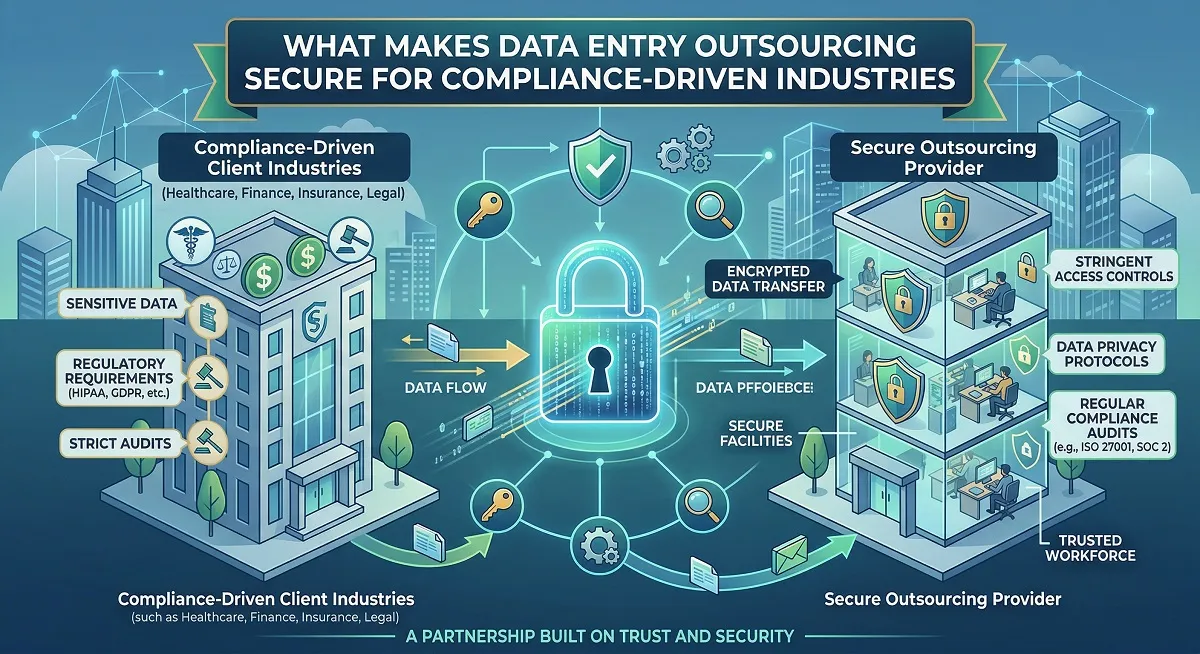

Traditional data entry processes create major obstacles for enterprises operating under robust regulatory standards. The utilization of spreadsheets and legacy tools for data entry processes results in major human errors. Data inaccuracies and incomplete documentation become inevitable for enterprises that depend on traditional data entry and management approaches. The manual data entry measures make it challenging for industries to maintain consistent, secure, and updated records amid varying regulations. This increases the risk of compliance failures and legal consequences.
Data entry outsourcing is ideal for industries looking to overcome the traditional data collection and management approaches. However, various industries hesitate to outsource data entry projects due to raising security events. The reason behind the hesitation to share customer or operational information with external partners is the fear of data thefts and unauthorized access. Professional data entry outsourcing firms leverage robust frameworks for secure client information management. These frameworks are more valuable than the security measures followed by internal departments in enterprises.
Data Entry Outsourcing: How It Helps Industries
Enterprises that outsource data entry services can delegate data capture, processing, and management responsibilities to a group of dedicated workforce. The professionals manage database updates, document digitization, form processing, invoice management, and transcription tasks through advanced technological solutions. Enterprises can leverage the expertise of professionals who manage data workflows through standardized processes and validation mechanisms. This helps enterprises reduce operational expenses while maintaining data precision across systems.
Sectors with robust regulatory requirements experience unique challenges when organizing sensitive datasets. Different from generic business operations, the following sectors must balance effectiveness with compliance, making the choice of a data entry company significant.
1. Healthcare
Healthcare institutions process diverse volumes of patient information, from eligibility validation to claims submission. Medical service providers that outsource data entry services can work with professionals trained in health terminology, billing codes, and electronic health record systems. The external partners organize:
- Medical billing and coding for insurance reimbursement.
- Claims submission and denial management workflows.
- Patient data entry across diverse platforms.
- Documentation for regulatory reporting standards.
By leveraging smart data entry solutions, healthcare institutions can maintain the security of Protected Health Information through encryption and role access control mechanisms. Data entry experts implement quality controls that reduce coding errors and speed up billing processes, enabling medical workforce to focus on patient care rather than administrative tasks.
2. Telecommunications
Enterprises that come under the telecommunication sector organize subscriber databases, service records, and billing information for diverse customer accounts. By outsourcing data entry services, telecom firms can delegate service activation record management, network utilization data capture, and regulatory compliance documentation to external workforce. This ensures precise data processing for telecom firms, leading to greater service excellence and customer satisfaction.
3. Energy and Utilities
The energy and utility service providers monitor consumption patterns, infrastructure maintenance, and sustainability metrics. Data entry services providers help energy firms with the modernization of sustainability reporting and analyzing utility consumption data tracking. The data entry experts capture and record meter readings, service requests, infrastructure inspections, and environmental compliance records. Managing these functions with external support enables utility firms to focus on grid operations and service delivery improvements.
4. Education and EdTech
Educational institutions and learning platforms manage student records, enrollment data, course management, and assessment tracking. The stakeholders in edtech firms depend on data and analytics for decision-making. These companies benefit from outsourcing back office operations, enabling rapid business decisioning and improved user experiences.
How Data Entry Outsourcing Firms Ensure Security in 2026
Security mechanisms in 2026 have advanced beyond generic password protection and firewall mechanisms. The outsourced data entry services providers leverage diverse protective layers designed for compliance-driven environments.
Advanced Data Encryption Standards
Data protection depends on encryption mechanisms that render concealed information to unauthorized users. Professional data entry services providers incorporate AES-256 encryption, a symmetric algorithm that processes data using cryptographic mechanisms. This standard mechanism protects information whether archived in databases or transferred between systems.
Secure transmission depends on protocols including Transport Layer Security for web-based transfers, File Transfer Protocols for file exchanges, and Private Network tunnels for network access. Encryption mechanisms ensure that the data at rest remains encrypted in storage systems, while data in transit receives protection during transition between sources.
Role-Based Access Control and Zero Trust Architecture
The access management mechanisms restrict system permissions depending on job functions rather than providing broad access to all users. Access control mechanisms allocate permissions to defined roles, such as data entry manager or quality auditor, and users inherit those permissions through role mechanisms. The implementation of least privilege access ensures that the workforce receives the allocated data access required for their tasks.
Zero Trust Architecture establishes a validation environment. Whether users connect from inside or outside the network, the system necessitates continuous authentication. The multi-factor authentication, device health verification, and behavioral analysis are performed throughout each session rather than just at the login stage. This eliminates theft or breach of credential datasets.
Compliance with Global Data Protection Regulations
Outsourced data entry firms maintain compliance with data protection regulations through robust consent and data minimization procedures. These measures ensure that data entry experts acquire, record, and manage granular datasets. Through compliance audits and reviews, experts remove unnecessary datasets or limit data access based on operational and regulatory requirements. This enables enterprises to maintain compliance with industrial regulations and eliminate legal risks.
Industry Certifications and Security Frameworks
The demonstration of industrial security certifications ensures that a data entry company follows structured processes for data management. Data entry firms with Type II audit certificates possess expertise around data security, availability, processing integrity, confidentiality, and privacy. These certifications require extensive verification and regular reassessment.
Continuous Monitoring and Data Governance
Through continuous monitoring mechanisms, data experts discover anomalies across data repositories before they transform into breaches. The audit log mechanisms observe every data access event, documenting user credentials, timestamp, and actions executed. Smart vulnerability assessments highlight threats in data infrastructure, while penetration testing simulates attack situations to validate data protection levels.
Considerations in Data Entry Outsourcing for Industry Leaders
The selection of an ideal data entry outsourcing partner necessitates extensive evaluation beyond generic capabilities. Industry leaders must evaluate various aspects before committing to outsource data entry services.
1. Vendor Selection and Due Diligence
Due diligence acts as a continuous process rather than a generic checkpoint. Validate certifications, regulatory control, and financial status before engagement. Periodic audits and compliance certifications highlight that vendors maintain contractual and legal standards throughout the data entry processes. Enterprises that fail to validate vendor compliance struggle during regulatory evaluations when asked to deliver evidence of administration.
2. Regulatory Compliance and Legal Considerations
The service agreements for data entry outsourcing must explicitly determine risk sharing between parties. Contracts should comprise:
- Non-disclosure agreements and confidentiality conditions.
- Indemnification provisions and liability caps.
- Service level agreements with clear performance standards.
- Audit terms and performance review provisions.
- Data management measures aligned with compliance requirements.
International data transfers necessitate additional evaluation regarding jurisdictional data protection laws and potential foreign government access.
3. Technology Infrastructure and Integration
Modern data entry services leverage character recognition algorithms for document digitization, intelligent validation systems, and automated workflows. Enterprises should assess whether outsourcing providers integrate data entry solutions with existing CRM and ERP systems through API connectors. This integration reduces manual data entry effort and errors while improving process precision.
4. Turnaround Time and Service-Level Agreements
Service level agreements determine expected service delivery, response times, and measures when agreements fail. Transparent metrics around uptime, resolution time, and precision benchmarks ensure accountability. Data entry service providers should offer scalable resources that adjust team size depending on project volume fluctuations without compromising delivery time limits.
Final Words
Data entry outsourcing provides compliance-driven sectors a viable path to improved precision and regulatory adherence. Professional outsourcing firms offer enterprise-grade security infrastructure that is more reliable than internal capabilities. The effectiveness of data entry outsourcing lies in selecting partners with reliable certifications, transparent protocols, and proven compliance achievements. Enterprises that execute extensive due diligence acquire operational effectiveness without compromising data protection. Outsourcing data entry services transform administrative burdens into market benefits while maintaining robust security standards.























Sign in to leave a comment.