

From where we stand today, AI-assisted software development has not caused mass developer unemployment, but it has quietly redrawn the shape of the hiring market.
According to the Bureau of Labor Statistics, global software developer employment is projected to grow by 17.9 percent between 2023 and 2033, adding roughly 72,000 net new jobs annually in the US alone. This growth is expected even as AI coding tools reduce routine coding and associated time.
While the macro picture remains healthy, the team-level math has broken down. A skilled and experienced US senior developer now costs more than $200K annually. Average time-to-hire sits at 42 days, and the median to close a senior AI engineer has stretched to 89 days. Engineering leaders are absorbing that pressure by routing headcount budget into IT staff augmentation, resulting in a $1037 million market as of 2025. The buyers who are augmenting, however, look nothing like they did two years ago.
Key Takeaways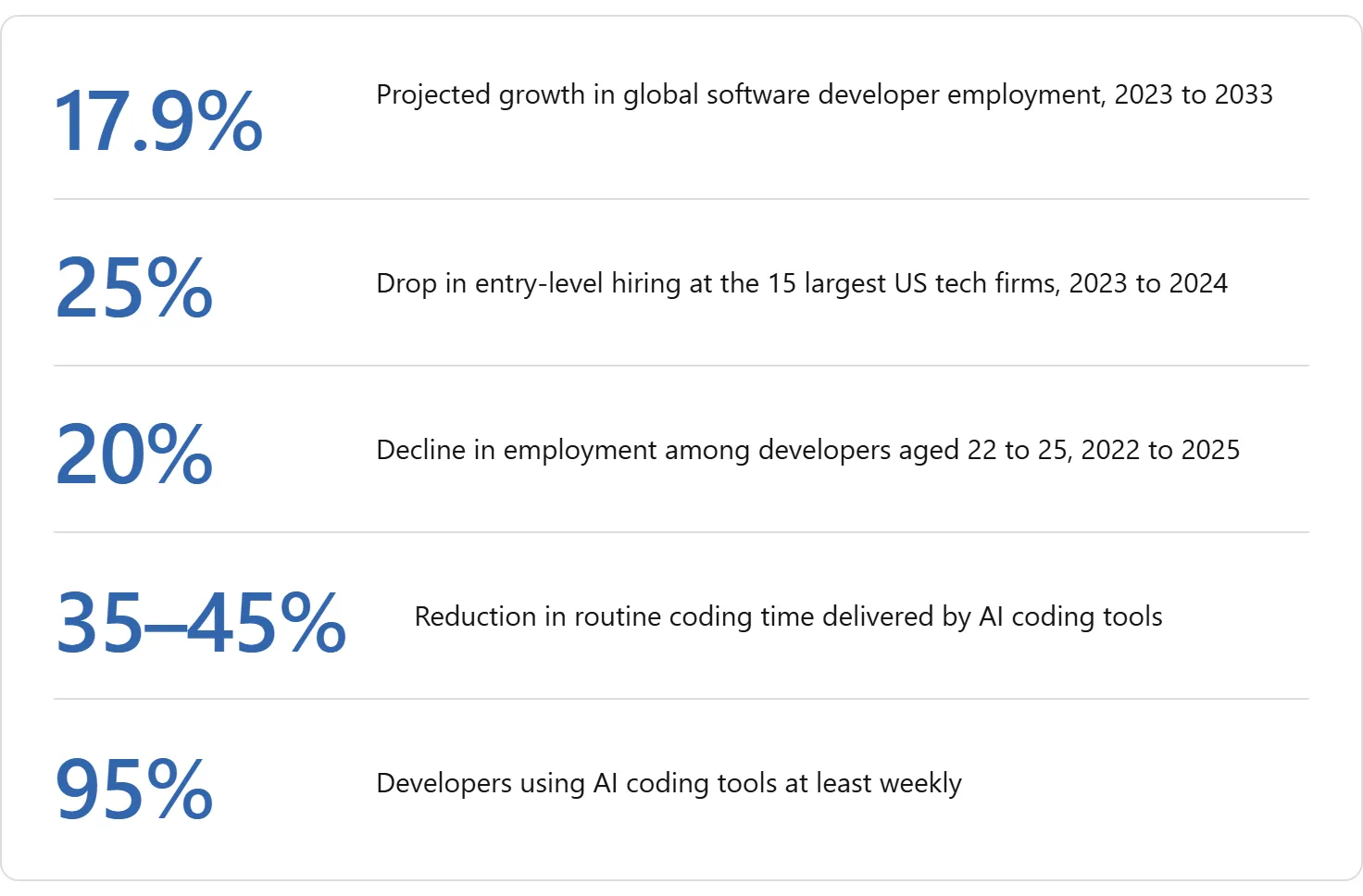
How Has the Full-Time Hiring Math Changed?
Let us crunch some numbers to see how AI-enhanced workflows are driving shifts in employment within software engineering transformation.
1. Entry-level hiring at the 15 largest US tech firms fell 25% from 2023 to 2024 (SignalFire)
Traditionally, a junior full-time hire was a net-negative asset for the first 6–12 months. Firms often subsidize this early investment period, expecting to reclaim their investment in years 2 through 4.
But, AI-assisted workflows can now reach a junior-level competency instantly and at near-zero marginal cost. Consequently, companies are no longer willing to pay a premium for the human learning curve when an LLM can perform 20–40% of those entry-level functions (documentation, boilerplate code, unit tests) on Day 1.
2. Employment among developers aged 22–25 dropped nearly 20% between 2022 and 2025 (Stack Overflow)
The math behind career pathing has also broken because AI-powered software development has automated the stepping-stone tasks (like writing unit tests and basic refactoring) that historically justified a junior developer’s salary. This creates a Seniority Gap Risk; while firms save on payroll in the short term, they are effectively liquidating their future leadership.
Concurrently, from a balance sheet perspective, the Total Cost of Ownership (TCO) for a junior developer is now perceived as high-risk compared to the predictability of compute spend. And the numbers suggest an increasing preference toward "AI + Senior" workflows that deliver a 3x–5x productivity gain per dollar spent.
The cumulative effect: The cheap-bench, mass-hiring practice that has influenced enterprise IT operations for decades no longer works.
Where Staff Augmentation Fits in The Picture?
As leaders are caught between two non-negotiables, of shipping faster and spending less, traditional hiring fails at both. Where modern AI-first software development ships faster, it still hasn't met the expense reduction target. Pure outsourcing fails on a third front: code ownership and velocity visibility.
Staff augmentation fits that gap.
Organizations can hire developers externally through a staff augmentation firm to secure pre-vetted software developers. These professionals integrate directly into the client's existing tools, sprints, and code reviews. This model also eliminates the need for 6–9 month commitments or the burden of benefits overhead. Furthermore, it removes the standard termination risks associated with full-time hires.
Moreover, the pressure point is sharpest for AI-adjacent skills. This has shifted the buying conversation from "five React developers" to "two AI-fluent React seniors who can deliver the equivalent output.”
How AI Coding Tools Impact Staff Augmentation?
The developer market is still expanding. But the unit being sold per engagement has changed across three main dimensions.
Smaller Teams, Senior-Heavy Mix
Job postings that require experience with AI coding tools have skyrocketed. At the same time, those for pure implementation roles have declined considerably (over 60% for junior devs) over the same period.
Where a client previously hired five junior-to-mid-level developers, they now employ two senior AI-fluent engineers and expect comparable throughput. Hence, the total contract value per engagement is flat or down, but the number of engagements is up.
From Hours to Outcomes
Time-and-materials, the bread and butter of an IT staff augmentation service, is unwinding. Performance-based and value-based models are gaining traction in 2026, with payments tied to actual KPIs (rather than working hours), such as delivery speed, defect rates, automation efficiency, or revenue impact. The driver is unit economics. If AI cuts routine coding time by 35-45%, clients can challenge any vendor who is still billing 160 hours/month per developer.
Another trend that accompanies AI developer productivity is a hybrid engagement model, replacing pure-FTE retainers. A 6–9 month migration can shift fixed monthly team fees to a hybrid model where AI-powered workflows handle data validation, reducing manual workload across a five-member team while maintaining the same level of service.
New Screening Line: AI Fluency
A Pragmatic Engineer survey of 900+ engineers found 95% use AI tools at least weekly. 75% use AI-powered workflows for at least half of their work, and 56% complete the majority of their engineering work with AI. This tells nothing except that AI fluency is no longer a differentiator; it is a baseline.
Clients now verify it with practical screening: hands-on tasks that mirror real project work, evaluating how candidates prompt, verify, and integrate AI output. Profile sheets listing years of Java or AWS no longer carry the weight they did. Demonstrated discipline with Claude Code, Cursor, or GitHub Copilot inside governed workflows does.
TCO, Not Rate, is the New Aspect
CTOs and CFOs evaluating staff augmentation services in 2026 must anchor decisions on the total cost of delivery, not the hourly rate of hiring. Several costs that did not exist five years ago now sit in the model:
- AI tooling licenses per engineer for tools like Claude Code, Cursor, or Copilot max plans
- Review overhead that comes with unreviewed AI-generated code carries a higher bug density, and review time may rise by 12% when developers do not verify output adequately
- AI governance costs incurred to secure prompt handling, IP protection, audit trails, and managed access controls
- Management overhead of 5–8% for coordinating distributed augmented teams
Developer hiring rates still vary widely, with offshore juniors starting at around $25/hour to onshore specialists at $200+/hour.
This shift is particularly consequential for staff augmentation service providers. Because their classic large-bench, fresher-heavy model is the most exposed to AI compression among global delivery models.
The New Augmentation Equation
AI coding tools have not killed staff augmentation. They have rewritten its unit economics; fewer engineers per engagement, senior-weighted, AI-fluent, and increasingly billed against actual outcomes rather than hours. The vendors who won in 2026 are the ones who adjusted to this before clients forced them to.
For buyers, the headline is simpler. Augmentation rates still matter at the edges, but the leverage now lives in TCO, governance, and AI maturity. The right IT staff augmentation partner today is one that helps ship the same roadmap with a smaller, sharper team; not one that fills more chairs at a lower hourly rate.
Frequently Asked Questions
How are AI coding tools changing IT staff augmentation pricing?
The time-and-materials model is being replaced by hybrid and outcome-based pricing models for staff augmentation. Performance-based pricing ties a portion of vendor fees to delivery KPIs such as features shipped, defect rates, or automation efficiency. Per-seat billing is shrinking as clients expect AI-fluent engineers to deliver 2–3x the output of pre-AI counterparts.
Are junior developers still being hired through staff augmentation?
Less than before. Entry-level hiring has typically fallen. Demand has shifted to AI-fluent mid-level and senior engineers. Some firms, like IBM and Intuit, are deliberately hiring more AI-native juniors, but they remain the exception.
What should I look for in an AI-fluent staff augmentation vendor?
Demonstrated tool fluency with Claude Code, Cursor, or Copilot in real delivery. Governance maturity covering prompt handling, IP protection, and code review discipline. Specialist depth in your stack and vertical. Willingness to anchor part of the contract to outcomes. Evidence of shipping with AI inside governed workflows matters more than credentials alone.
Is staff augmentation still cheaper than full-time hiring once AI tools are factored in?
For most engagements under 12 months, yes. A US senior FTE costs roughly $ 200 K all-in, while comparable offshore/nearshore augmented seniors cost $83K–$145K annually. AI tooling adds $1,200–$2,400/year per engineer either way. The bigger driver of value is now speed-to-commit and exit flexibility, not pure rate arbitrage.
How do I evaluate AI governance in a staff augmentation vendor?
Ask about access controls to production and data systems, approved tools and environments, comprehensive logging and audit trails for model and data activity, and protocols for handling sensitive data within AI workflows. Strong vendors document these in their delivery methodology rather than treating them as ad hoc.























Sign in to leave a comment.