
Introduction
San Antonio roads have a personality of their own. Between the punishing summer heat that cracks asphalt and the flash-flood season that opens up potholes overnight, your vehicle's suspension takes a constant beating.
And yet, most drivers don't give their front end alignment a second thought until something starts to feel unmistakably wrong. The car drifts. The tires look worn on one side.
The steering wheel is tilted even on a perfectly straight road. These are not minor quirks. They are your vehicle communicating something important.
A front-end alignment is more than a routine checkbox on your maintenance list. It is the foundation of safe, efficient, and cost-effective driving.
When your wheels are angled even slightly off from where they should be, everything suffers: your fuel economy, your tires, your handling, and ultimately your safety.
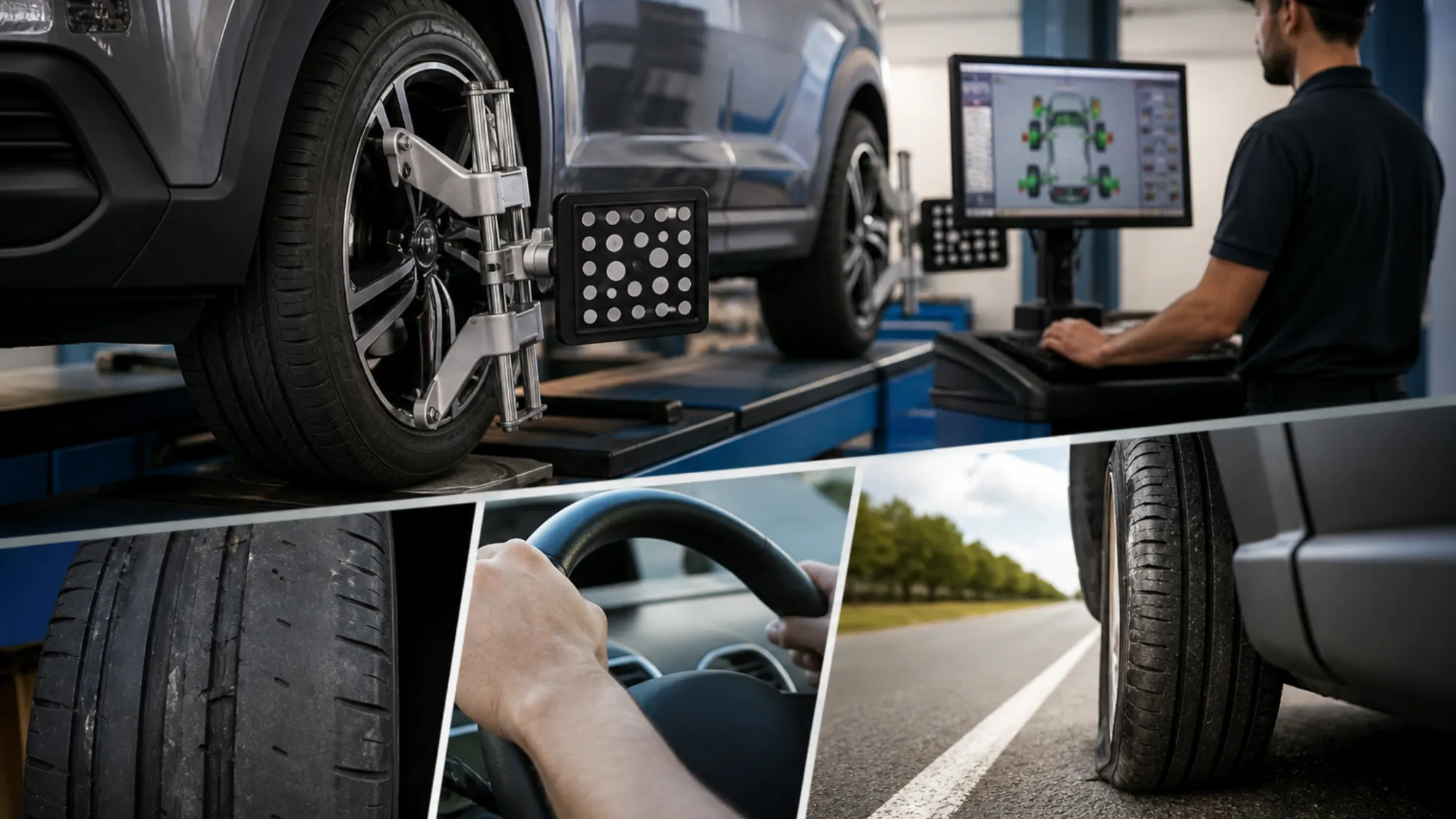
This guide breaks down everything you need to know about wheel alignment, from the very first warning signs to understanding what happens on the alignment rack and exactly what you should expect to pay.
What Actually Is a Wheel Alignment?
Here is what surprises most people: alignment has nothing to do with the tires or wheels themselves. It is actually an adjustment to your car's suspension, the system of parts underneath that connects your wheels to the rest of the vehicle.
Over time, these components shift slightly out of position. It could be from a hard pothole hit, a curb you clipped while parking, or simply years of regular driving. When that happens, your tires no longer sit at the exact angles your car was designed for.
They start fighting against each other instead of working together, and the effects show up in ways most drivers do not immediately connect to alignment.
How to Tell If Your Wheels Are Misaligned
You do not need to be a mechanic to spot alignment problems. Your car gives off some pretty clear signals; you just need to know what to look for.
The Warning Signs
• Your car pulls to one side: Let go of the steering wheel briefly on a flat, empty road. If your car drifts left or right without any input from you, alignment is almost certainly the issue.
• Your steering wheel looks crooked: When driving in a perfectly straight line, glance down at your steering wheel. If the logo is tilted even slightly, the geometry underneath is off.
• The steering wheel vibrates: A shaky steering wheel, especially when you pick up speed, is often blamed on tire balance, but misalignment is a frequent cause too.
• Your tires are wearing unevenly: Take a look at your tires from the front. If one side of the tread looks more worn than the other, your wheels are not sitting at the right angle.
• Tires squeal on normal turns: That chirping sound when you turn slowly through a parking lot or intersection often means the tire is dragging rather than rolling the way it should.
What Uneven Tire Wear Is Telling You
Your tires are actually one of the easiest ways to diagnose alignment problems without any equipment. If you notice the tread is smooth on one side and sharp or ridged on the other, that pattern points to a toe setting problem, one of the most common alignment issues.
Wear concentrated on just the inner or outer edge of the tire usually means the tire is tilting too far in one direction.
These are not just cosmetic concerns. Uneven wear shortens the life of a tire significantly, and replacing tires is far more expensive than the alignment that could have prevented the damage.
Which Type of Alignment Does Your Vehicle Need?
There are three main types of alignment, and the right one depends on what kind of vehicle you drive.
• Front-end alignment: This only adjusts the two front wheels. It is best suited for older vehicles with a simple, fixed rear axle. Not recommended for most modern cars.
• Four-wheel alignment: This is the standard for most vehicles on the road today. All four wheels are measured and adjusted to ensure the front and rear are working in sync. If you drive a sedan, SUV, crossover, or truck with independent rear suspension, this is likely what your vehicle needs.
• Thrust alignment: Used for vehicles where the rear cannot be independently adjusted. The front wheels are aligned to match the direction the rear axle is pointing. This prevents that awkward "dog-tracking" feeling where the car seems to travel slightly sideways.
Not sure which applies to your car? Any shop that does alignment work can tell you in seconds based on your make and model. When searching for a trustworthy
When searching for a trustworthy brake and tire shop near me look for one that uses computerized alignment equipment and provides a printed report before and after the service. That transparency is a good sign of professional, accountable work.
What Does a Wheel Alignment Cost in San Antonio?
This is where most people are pleasantly surprised. Alignment is genuinely one of the more affordable services you can do for your car, especially when you consider what ignoring it ends up costing.
| Alignment Type | Typical Cost |
| Front-End Alignment | $50 – $75 |
| Thrust Alignment | $75 – $100 |
| Four-Wheel Alignment | $100 – $175 |
| Lifetime Package | $150 – $300 (one-time) |
To put that in perspective: a single replacement tire can easily run $150 to $300 or more. If bad alignment causes your tires to wear out months ahead of schedule, the cost of that alignment looks very small by comparison.
Add in the fuel savings from a car that is no longer working against itself, and the math becomes even clearer.
Is a Lifetime Alignment Package Worth It?
If you plan to keep your car for several years or you drive a lot of miles, a lifetime package is absolutely worth considering. You pay once and get unlimited alignment checks for as long as you own the vehicle.
Always ask about a wheel alignment warranty when choosing a shop - the better ones stand behind their work and will re-check your alignment for free if something feels off after the service.
Why San Antonio Drivers Should Stay on Top of This
Between the heat, the flooding, and the road construction that seems to be a permanent fixture on half the major roads in the city, San Antonio is genuinely tough on vehicle suspensions.
Hitting a single deep pothole at highway speed can be enough to knock your alignment out on the spot. It does not always cause immediate drama, sometimes the effect is gradual - but the damage adds up.
Road safety and alignment are more connected than most people realize. A car that pulls to one side or feels loose in the steering requires more mental effort to control, especially in an emergency. That split second where your hands need to react predictably matters a lot.
Regular alignment checks at least once a year, or after any significant road impact, keep your vehicle responding the way you expect it to.
A good rule of thumb: whenever you get new tires installed or notice any of the symptoms described in this guide, schedule an alignment check at the same time. It is a small habit that protects a big investment.
Drive Smooth Again with a Reliable Front End Alignment
Wheel alignment is one of those maintenance items that is easy to put off because the signs are subtle at first. A slight pull. A bit of vibration. Tires are wearing down a little faster than expected.
But those small signs compound over time into real costs, in tires, in fuel, and eventually in suspension components that wear out before their time.
If any of this sounds familiar, it is worth booking a checkup sooner rather than later. Scheduling a professional car alignment San Antonio, TX service does not take long and the cost is genuinely modest compared to what it prevents.
Your car will drive better, your tires will last longer, and you will spend less time second-guessing what that pull or vibration actually means.
















Sign in to leave a comment.