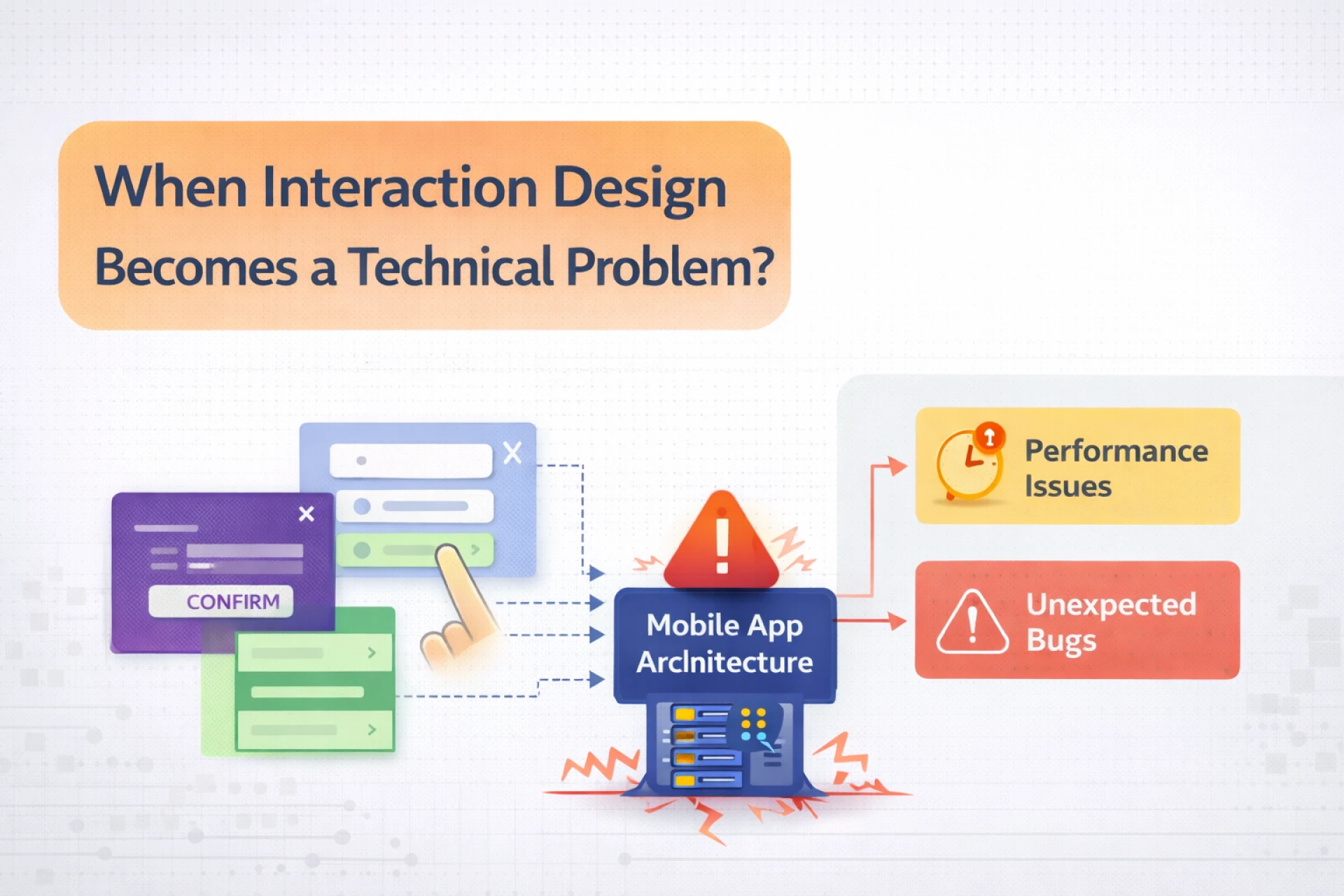

For a long time, I believed interaction design ended where engineering began.
Design decided what should happen. Engineering decided how it should happen. The boundary felt clean. Comfortable. Almost contractual.
That belief lasted right up until the day a “small interaction change” took three engineers, two sprints, and a growing sense of dread to ship.
Nothing about the interaction looked complex. It was smooth. Intuitive. Even elegant on the surface. Yet beneath it, the system strained in ways no one had predicted.
That was when I realized something important.
At a certain point, interaction design stops being a design problem.
It becomes a technical one.
The Illusion of Simple Interactions
Most interaction ideas sound harmless when described.
“A swipe should feel continuous.”
“The screen should respond instantly.”
“This action should be reversible.”
None of these feel technical. They sound like polish. Like UX refinement.
But every one of those ideas carries hidden requirements. Continuous feedback means real-time state updates. Instant response means strict performance budgets. Reversibility means architecture that can undo decisions safely.
The interaction may look simple. The system required to support it rarely is.
Where the Boundary Quietly Disappears
In early products, the boundary between design and engineering holds.
Interactions are straightforward. Buttons trigger actions. Screens load data. State moves forward predictably.
As products mature, interaction patterns change.
Users expect gestures instead of buttons.
They expect transitions instead of reloads.
They expect recovery instead of error messages.
Each expectation pushes logic deeper into the system.
At some point, the interaction is no longer just presenting state.
It is creating state.
That is when design decisions begin shaping architecture directly.
When “Feel” Depends on System Behavior
Designers often talk about how an interaction should feel.
Responsive. Forgiving. Calm. Predictable.
Those feelings are not visual.
They are emergent properties of timing, state management, concurrency, and recovery. If the system hesitates, the interaction feels broken. If state updates arrive out of order, the interaction feels unreliable.
No amount of visual refinement can fix that.
The feeling users describe is the system expressing itself.
Interaction Design Introduces Continuous State
Traditional interfaces work in steps.
User acts.
System responds.
Interaction ends.
Modern interactions rarely end cleanly.
A swipe continues while the system updates.
A drag previews outcomes before commitment.
A gesture can be canceled mid-flow.
Now the system must represent intermediate states that were never needed before.
Listening.
Dragging.
Previewing.
Reverting.
If the architecture only understands “before” and “after,” these interactions expose its limits immediately.
Why Performance Suddenly Becomes Design-Critical
When interactions are direct and continuous, performance is no longer a background concern.
A delay of a few hundred milliseconds during a button tap might be acceptable. The same delay during a gesture feels broken.
Dropped frames don’t just look bad. They break the illusion of control.
This is often the moment teams working in mobile app development Seattle realize that performance is not an optimization task anymore. It is a design dependency.
The interaction cannot exist without guaranteed responsiveness.
Recovery Turns Into an Interaction Requirement
Older interfaces treated failure as an exception.
An error occurred. A message appeared. The user retried.
Modern interactions assume failure will happen quietly.
Networks drop.
Apps background.
Input changes mid-flow.
Good interaction design now assumes recovery is part of the normal path.
Undo gestures.
State restoration.
Graceful continuation.
These are not UI features. They are architectural commitments. Without them, interactions feel risky and users hesitate.
When Interactions Create Architectural Coupling
Another subtle shift happens when interactions depend on multiple parts of the system at once.
A single gesture might touch UI state, local cache, background sync, analytics, and remote services.
Suddenly, changing an interaction means coordinating across layers that were never meant to move together.
What looked like a design tweak becomes a cross-system change.
This is where teams start saying things like
“We can’t change that interaction, it’s too risky.”
The interaction has become structurally embedded.
Testing Becomes Harder Than Expected
Button-based interactions are easy to test.
Trigger action. Assert result.
Complex interactions require scenario testing.
What happens if the user reverses mid-gesture
What happens if the app backgrounds
What happens if data arrives late
Automated tests struggle here. Manual testing expands. Edge cases multiply.
When interaction design evolves faster than testing strategy, fragility follows.
Why Designers Feel Blocked and Engineers Feel Frustrated
This transition creates tension.
Designers feel constrained by “technical limitations.”
Engineers feel buried under “UX polish.”
Both sides are reacting to the same thing.
The system was not built for the interaction being asked of it.
Without acknowledging that shift, conversations become adversarial instead of constructive.
The Point Where Design Shapes Architecture
Mature teams eventually reach an understanding.
If an interaction requires
– continuous feedback
– reversible actions
– overlapping states
– guaranteed responsiveness
Then the system must be designed around those needs.
Interaction design stops sitting on top of the system.
It becomes one of the forces shaping it.
That is not a failure of separation. It is a sign of product maturity.
What Changes When Teams Accept This
Once teams accept that interaction design is a technical concern, things shift.
Design reviews include engineering constraints early.
Architectural decisions consider future interaction patterns.
Performance and recovery are discussed as UX features.
The system becomes more flexible, not more rigid.
Interactions stop feeling “expensive” to change because the architecture expects them.
The Mistake Teams Make Too Late
The most common mistake is treating interaction complexity as cosmetic.
Teams add gestures. Add transitions. Add smart behaviors.
Then they wonder why the system feels fragile.
The fragility was always there. The interaction just revealed it.
The Quiet Truth About Modern Mobile Apps
Modern mobile apps are no longer collections of screens.
They are continuous experiences.
That continuity blurs the line between design and engineering whether teams like it or not.
When interaction design becomes a technical problem, it is not because design overreached.
It is because the product grew up.
What I Look for Now
I no longer ask only how an interaction looks.
I ask
What state does this create
What happens if it’s interrupted
What must be reversible
What must stay fast no matter what
If the answers are unclear, the interaction isn’t ready.
The Real Lesson I’ve Learned
Interaction design becomes a technical problem when systems are asked to feel human.
Fluid. Forgiving. Responsive.
Those qualities cannot be layered on later.
They have to be built in.
Once I understood that, the frustration faded. Conversations improved. Designs got better. Systems became calmer.
Because when interaction design becomes a technical problem, it is also an opportunity.
An opportunity to build software that doesn’t just work, but feels right under real conditions.
And that is where truly good mobile apps are decided.
























Sign in to leave a comment.