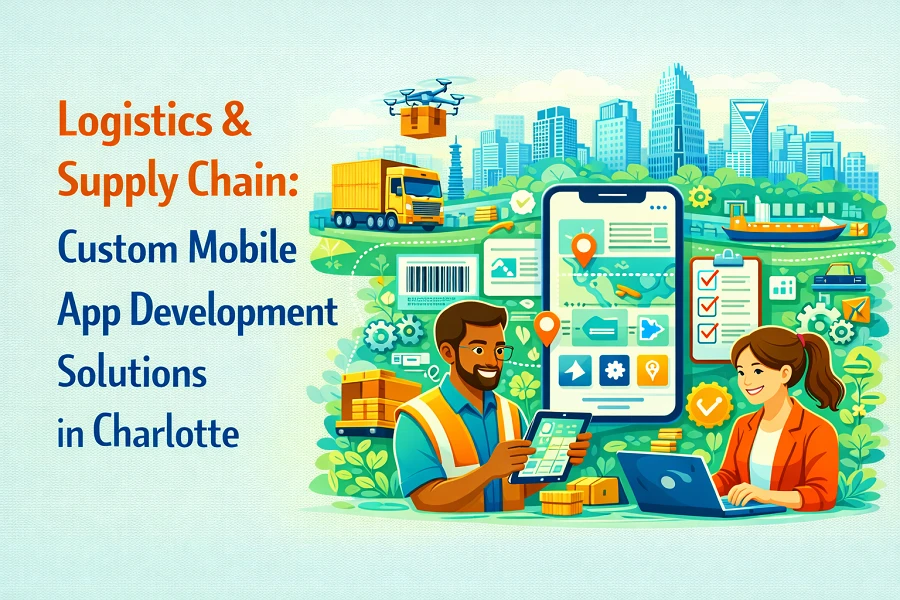

Logistics teams are under more pressure than ever to move faster, track everything in real time, and respond instantly to disruptions. Mobile apps have become a critical layer connecting warehouse operations, drivers, managers, and customers into a single workflow. In Charlotte, where logistics, transportation, and distribution industries continue expanding, startups and enterprises are turning to custom mobile solutions to manage increasingly complex supply chains.
This article looks at how logistics-focused mobile apps are evolving, what developers should understand when building for this sector, and the real technical challenges shaping modern supply chain applications.
Why this matters for developers
Logistics software is no longer limited to desktop dashboards used by operations teams. Mobile applications now act as the primary interface for:
- route optimization
- shipment tracking
- inventory updates
- warehouse coordination
- driver communication
Because logistics involves real-world operations, mobile apps must operate reliably in unpredictable conditions — including poor connectivity, heavy data loads, and time-sensitive workflows. Developers entering this space quickly realize that performance, clarity, and stability matter more than visual complexity.
Shift #1 — Real-time data has become the foundation of logistics apps
Modern logistics platforms rely heavily on real-time updates. Customers expect to see shipment status instantly, while operators need immediate visibility into delays or disruptions.
Key technical considerations include:
- WebSocket or streaming-based data updates
- scalable backend infrastructure
- low-latency APIs
- event-driven architecture
Developers must design systems capable of handling constant data flow without overwhelming devices or draining battery life.
Shift #2 — Offline-first design is essential
Drivers and warehouse teams often work in environments with inconsistent connectivity. Apps that depend entirely on stable internet connections create operational risk.
Successful logistics apps frequently include:
- local data caching
- background synchronization
- conflict resolution when reconnecting
Offline-first architecture ensures that workflows continue even when connectivity drops, reducing delays and user frustration.
Shift #3 — Integration with existing enterprise systems
Most logistics organizations already use legacy systems such as ERP platforms, warehouse management tools, or fleet tracking software. New mobile apps rarely operate in isolation.
Developers must plan for:
- API integrations with multiple systems
- data normalization between different formats
- secure authentication between platforms
Integration complexity often becomes one of the largest challenges during development.
Shift #4 — Location tracking and mapping are core features
GPS tracking forms the backbone of many logistics apps. Real-time location data supports route optimization, delivery confirmation, and performance analysis.
Key technical challenges include:
- balancing tracking accuracy with battery usage
- handling background location permissions
- optimizing map rendering performance
Clear communication about data usage is also important since users may be sensitive to continuous tracking.
Shift #5 — User experience must support fast decision-making
Unlike consumer apps where exploration is common, logistics apps must support rapid actions. Users often interact with the app while working under time pressure.
Effective design patterns include:
- large touch targets for quick interaction
- minimal navigation layers
- clear visual status indicators
- simplified workflows for repetitive tasks
Developers should prioritize speed and clarity over decorative design elements.
What developers should expect when building logistics apps
Developing for logistics introduces unique challenges compared with traditional consumer applications:
- heavy reliance on real-time synchronization
- collaboration with operations teams who may not have technical backgrounds
- need for strong testing across various device types
- handling edge cases caused by physical-world unpredictability
Understanding operational workflows early helps prevent costly redesigns later.
Practical takeaways
- Build with offline capability from the start.
- Focus on reliability over feature volume.
- Design APIs that support frequent updates efficiently.
- Collaborate closely with logistics operators during testing.
- Optimize performance for real-world conditions rather than ideal environments.
Final thoughts
Logistics and supply chain applications continue evolving as businesses demand greater visibility and faster response times. In regions where transportation and distribution industries remain strong, such as those driving mobile app development Charlotte initiatives, custom mobile solutions are becoming essential tools rather than optional enhancements.
For developers, logistics apps offer opportunities to work on complex, real-world challenges where technical decisions directly influence operational efficiency — making thoughtful architecture and user-focused design more important than ever.





























Sign in to leave a comment.