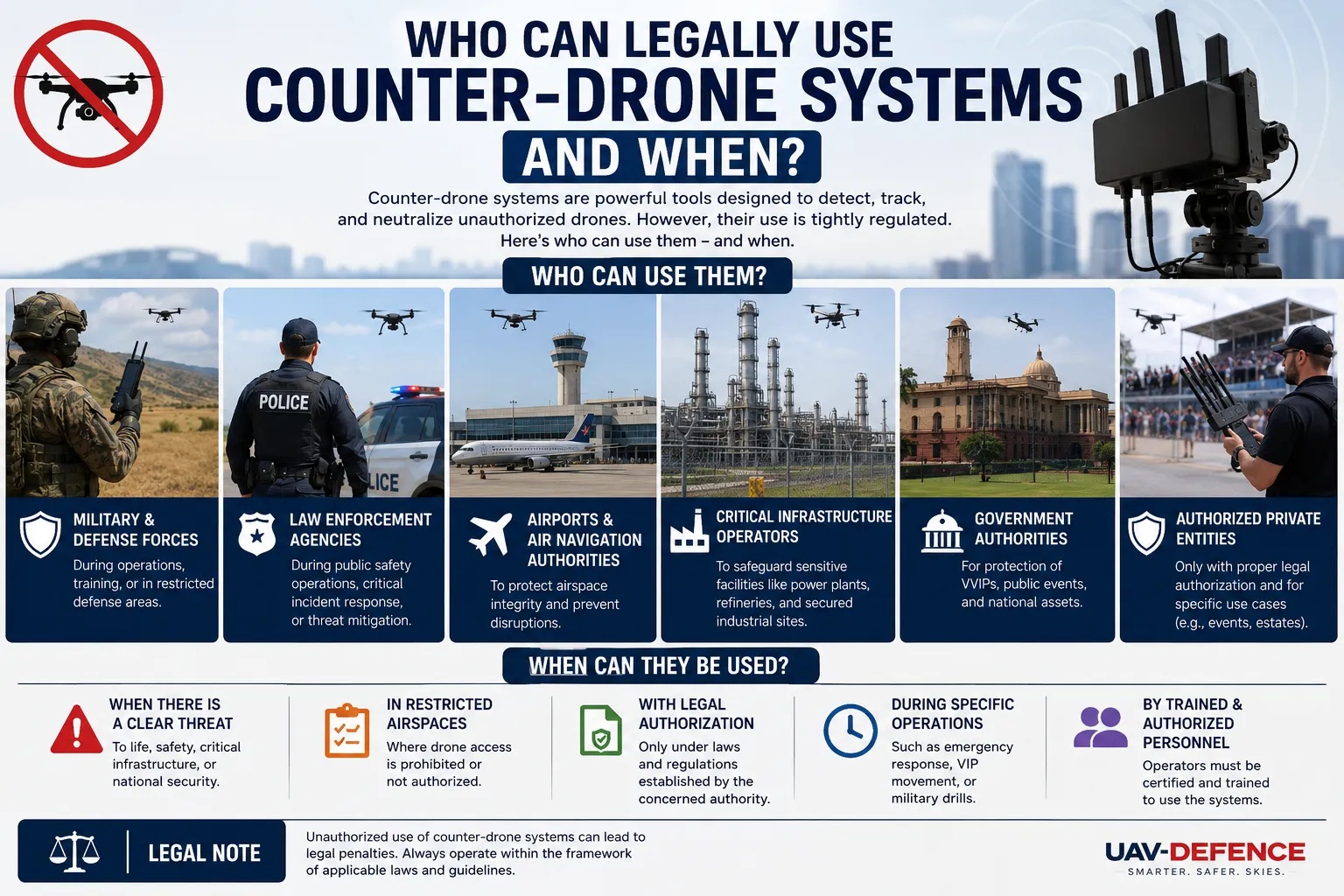

A drone hovering over a prison, an airport runway, or a military base will raise quite a few questions. For instance, who really has the right to launch a drone in such a high-security place? The answer is more restricted than you think. To put it simply, in the UK and US, detecting a drone can be done by anyone, but controlling the drone or even using an RF drone jammer or anti-drone features are limited to the government.
Who Is Allowed To Use Counter-Drone Systems
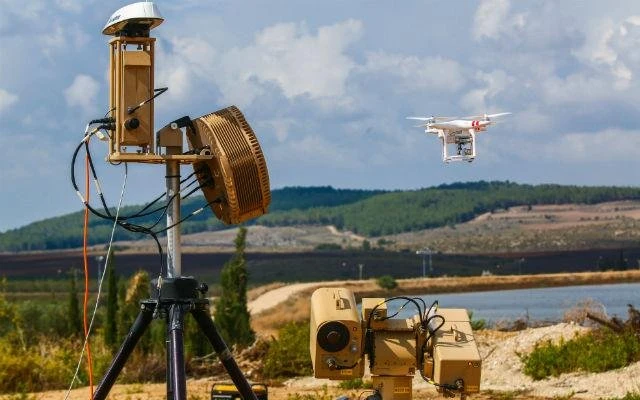
UAS countermeasures divide into two distinct legal categories: detection and mitigation. Detection monitors the spectrum, whereas mitigation involves jamming, spoofing or disabling workarounds.
United Kingdom Position
Private use in the UK is forbidden. Ofcom does not grant licences for jammers to either individuals or companies, and the Wireless Telegraphy Act 2006 states that it is a criminal offence to interfere with wireless telegraphy. Only a few specially authorised public authorities such as the police, the MoD and prison services, can, under very tightly controlled conditions, be allowed to use jammers.
The UK Counter-Unmanned Aircraft Strategy states that the use of jammers outside the police is restricted and that records should be kept for each deployment. The government is currently working on 2025 legislation that would allow troops to neutralise drones near military bases but, at the same time, it is expected that the use of jammers will remain a Crown-only prerogative.
United States Position
In the United States, the situation is quite similar. The Federal Aviation Administration (FAA), Department of Justice (DOJ), Department of Homeland Security (DHS), and Federal Communications Commission (FCC) have together issued a warning that federal criminal laws are applicable for even detection and mitigation activities. Currently, only the four departments, namely defence, energy, justice, and homeland security, are allowed to perform signal analysis and mitigation in the case of unmanned aerial systems (UAS).
When An RF Drone Jammer Can Be Used Legally
The usage of an RF drone jammer can only be done by certain authorised bodies who have been designated, coordinated with the aviation authorities, and have privacy safeguards in place. Authorised teams work under Crown exemptions that exclude normal telecommunications rules. Their use is restricted to the protection of critical national infrastructure, prisons, major events and defence sites, not private property.
Ending Remarks
The law is clear going into 2026: detection is becoming more and more accessible, while mitigation is not so much. If you are not one of the police, military, prison service or a federally designated agency, then operating an RF drone jammer is one thing you cannot do legally, and any anti-drone customisation services can only be done through those channels. UAV Defence backs this approach by concentrating on compliant, detection-first architectures that keep the authorised users within Ofcom, FCC and ICAO frameworks.
























Sign in to leave a comment.