Elevating Food Safety with Advanced Belt Technology
In the food processing industry, hygiene and safety are not just operational requirements—they are mission-critical. Every component in the production line, from conveyor systems to cutting blades, must meet strict regulations and perform under the highest sanitary standards. As food safety standards grow increasingly stringent worldwide, manufacturers are under constant pressure to upgrade their equipment and minimize contamination risks.
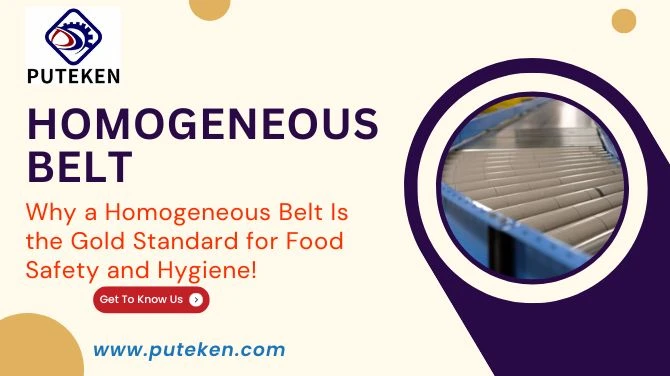
Among the many innovations in food-grade conveying systems, one technology stands out: the Homogeneous Belt. Designed specifically for food handling, this belt eliminates the cracks, seams, and crevices that often harbor bacteria and other contaminants in conventional belt systems. With its seamless, single-material composition, the Homogeneous Belt is rapidly becoming the gold standard for hygienic design, food safety, and ease of cleaning.
At Shanghai Puteken Transmission System Co., Ltd., we specialize in manufacturing cutting-edge conveyor solutions that align with today’s global food safety requirements. Our Homogeneous Belts are engineered to meet HACCP, USDA, FDA, and EU standards, delivering not only compliance but also enhanced durability, automation efficiency, and long-term cost savings.
What Is a Homogeneous Belt?
A Homogeneous Belt—sometimes called a solid belt or monolithic belt—is a conveyor belt made entirely from a single piece of thermoplastic material, without layers, fabrics, or seams.
Unlike traditional modular or fabric belts—where multiple layers may delaminate, absorb fluids, or crack over time—a homogeneous belt offers a solid, non-porous, and bacteria-resistant surface that is especially suited for applications involving direct food contact.
Common Materials Used:
- TPU (Thermoplastic Polyurethane): Offers superior abrasion resistance, flexibility, and chemical tolerance.
- TPE (Thermoplastic Elastomer): A food-safe material with high resilience and anti-microbial properties.
- Polyester-based Compounds: Added strength and heat resistance.
Key Features of a Homogeneous Belt:
- Seamless Construction: No joints or layers that can fray, delaminate, or trap contaminants.
- Ultra-Hygienic: Non-porous surface resists bacterial growth.
- Easy to Clean: Rapid wash-down cycles reduce cleaning time and water usage.
- Wide Temperature Resistance: Typically from -40°C to +110°C, ideal for freezers and cook lines.
- High Dimensional Stability: Withstands tension without stretching or curling.
- Certified for Food Use: Compliant with FDA, EU 1935/2004, NSF, and more.
Why the Homogeneous Belt Is Critical for Food Safety?
Let’s explore in detail how the homogeneous belt sets itself apart in ensuring maximum hygiene, compliance, and safety.
1. Eliminates Bacterial Harborage Points
Traditional conveyor belts with woven fabric or seams create ideal hiding places for bacteria, mold, and food particles. These contaminants are hard to detect and nearly impossible to remove entirely during cleaning. In contrast, homogeneous belts are completely solid and seamless, leaving no spaces or fibers for pathogens to settle in.
Industry Impact:
- Reduces the risk of Listeria, E. coli, and Salmonella outbreaks.
- Prevents biofilm formation on belt surfaces.
- Simplifies compliance with strict regulatory audits.
2. Minimizes Cross-Contamination
Food plants that handle multiple products—from raw meats to ready-to-eat goods—must use systems that prevent cross-contamination. The non-absorbent properties of a homogeneous belt prevent fluids, oils, and powders from soaking into the belt.
This leads to:
- Faster changeovers between product lines
- Safer allergen separation
- Lower cleaning and labor costs
3. Built for CIP (Clean-in-Place) Systems
The design of homogeneous belts makes them ideal for integration into automated wash-down systems. Withstanding hot water, chemical exposure, and high-pressure spray, they enable thorough cleaning without removal from the conveyor—saving time and reducing labor.
Additional Functional Advantages of a Homogeneous Belt
- High Durability & Wear Resistance
The thermoplastic construction of homogeneous belts ensures long service life even in highly abrasive environments. These belts can resist:
- Oil and fat exposure
- High-torque applications
- Blade contact (in cutting lines)
- Precise Tracking & Positioning
Unlike felt or modular belts that can shift or stretch over time, homogeneous belts maintain consistent tracking, especially when paired with guides or positive drives.
This is essential in:
- Slicing operations
- Product weighing and sorting
- High-speed packaging
Improves Operational Efficiency
Because they require fewer replacements, shorter cleaning cycles, and lower water and chemical consumption, homogeneous belts help reduce overall operating costs while increasing uptime.
Common Applications of Homogeneous Belts in the Food Industry
Homogeneous Belts are suitable for nearly every stage of food production. Here’s where they’re most impactful:
Meat and Poultry Processing
Deboning lines
Cold room conveyors
Sanitary cutting tables
Dairy and Cheese Processing
Cheese block handling
Milk container movement
Hygienic packaging systems
Bakery and Confectionery
Dough transfer
Sticky product handling (caramel, chocolate)
Pastry sorting and alignment
Frozen Food Lines
Blast freezer conveyors
Wet-to-dry product transitions
Cold wash-down environments
Pharmaceutical and Nutraceuticals
Tablet production conveyors
Cleanroom product transfer
No-fiber-shedding solutions
Maintenance Tips for Homogeneous Belts
Proper maintenance ensures maximum life from your homogeneous belt.
Cleaning
Use hot water (up to 90–100°C) and approved food-safe chemicals.
Avoid abrasive pads or harsh solvents.
For best results, use automated spraying nozzles and CIP systems.
Storage
Store in a clean, dry area away from UV exposure.
Do not fold or kink belts during storage.
Inspection
Regularly inspect belt edges and the underside for cuts or tear signs.
Monitor tracking and clean drive sprockets to ensure efficiency.
Why Choose Shanghai Puteken for Homogeneous Belt Solutions?
At Shanghai Puteken Transmission System Co., Ltd., we are proud to supply homogeneous belts that represent the next generation of hygienic conveyor technology. Our belts are ISO-certified and fully compliant with international food safety regulations.
Our Value Proposition:
- Food-grade, seamless designs
- Chemical and heat-resistant materials
- Compatibility with positive drive systems
- Custom sizes and surface textures
- Expert consultation and after-sales support
By choosing Shanghai Puteken, you’re not just buying a belt—you’re investing in clean, safe, and efficient food processing.
Redefining Sanitary Conveyor Standards
In a time where sanitation, compliance, and contamination control are top priorities, upgrading to a Homogeneous Belt is more than just a trend—it’s a strategic move toward better quality, safety, and profitability.
Frequently Asked Questions (FAQ)
1. What materials are homogeneous belts made of?
Typically, homogeneous belts are manufactured from TPU (thermoplastic polyurethane), TPE (thermoplastic elastomer), or polyester-based compounds—all of which are food-safe and highly resilient.
2. Are homogeneous belts approved for direct food contact?
Yes. Our belts meet FDA, EU 1935/2004, and USDA standards for direct contact with both dry and wet food products.
3. Can homogeneous belts be used in freezing or high-heat environments?
Absolutely. Our belts operate efficiently in temperatures ranging from -40°C to +110°C, making them suitable for both freezers and heat processing areas.
4. How do I clean a homogeneous belt?
Cleaning is simple. Use hot water, gentle food-grade cleaners, or automated CIP systems. Because there are no seams or cracks, cleaning is faster and more effective.
5. Do homogeneous belts support guided tracking systems?
Yes. Many of our homogeneous belts can be manufactured with V-guides or positive drive sprockets to maintain accurate tracking and prevent slippage or misalignment.
6. What is the expected lifespan of a homogeneous belt in food processing?
Depending on the operation, load, and cleaning frequency, our belts can last 2–5 times longer than fabric or modular belts—making them a more cost-effective long-term solution.
7. Are customizations available for surface texture or profile?
Yes. We offer flat, rough, dotted, diamond, embossed, and custom surface profiles to match your product-handling requirements.

























Sign in to leave a comment.