
Introduction
In today's rapidly changing digital world, businesses are on the lookout for applications that are not just fast and scalable, but also secure and easy to manage. Whether you're dealing with a web platform, enterprise software, or a cloud-based solution, the architecture behind it all is crucial for ensuring top-notch performance and long-term success.
Modern development frameworks like ASP.NET Core applications offer robust tools and the flexibility needed to create high-quality applications. But just using the framework isn't enough—having a solid architectural structure is what really sets applications apart, making them efficient and ready for the future.
What is ASP.NET Core Architecture?
ASP.NET Core architecture is all about how we design and organize the different parts of an application. It lays out the way various layers—like presentation, business logic, and data access—work together.
Having a solid architecture means that the application will be:
- Simple to develop and maintain
- Capable of scaling as it grows
- Adaptable for incorporating new features
Why ASP.NET Core Architecture is Important
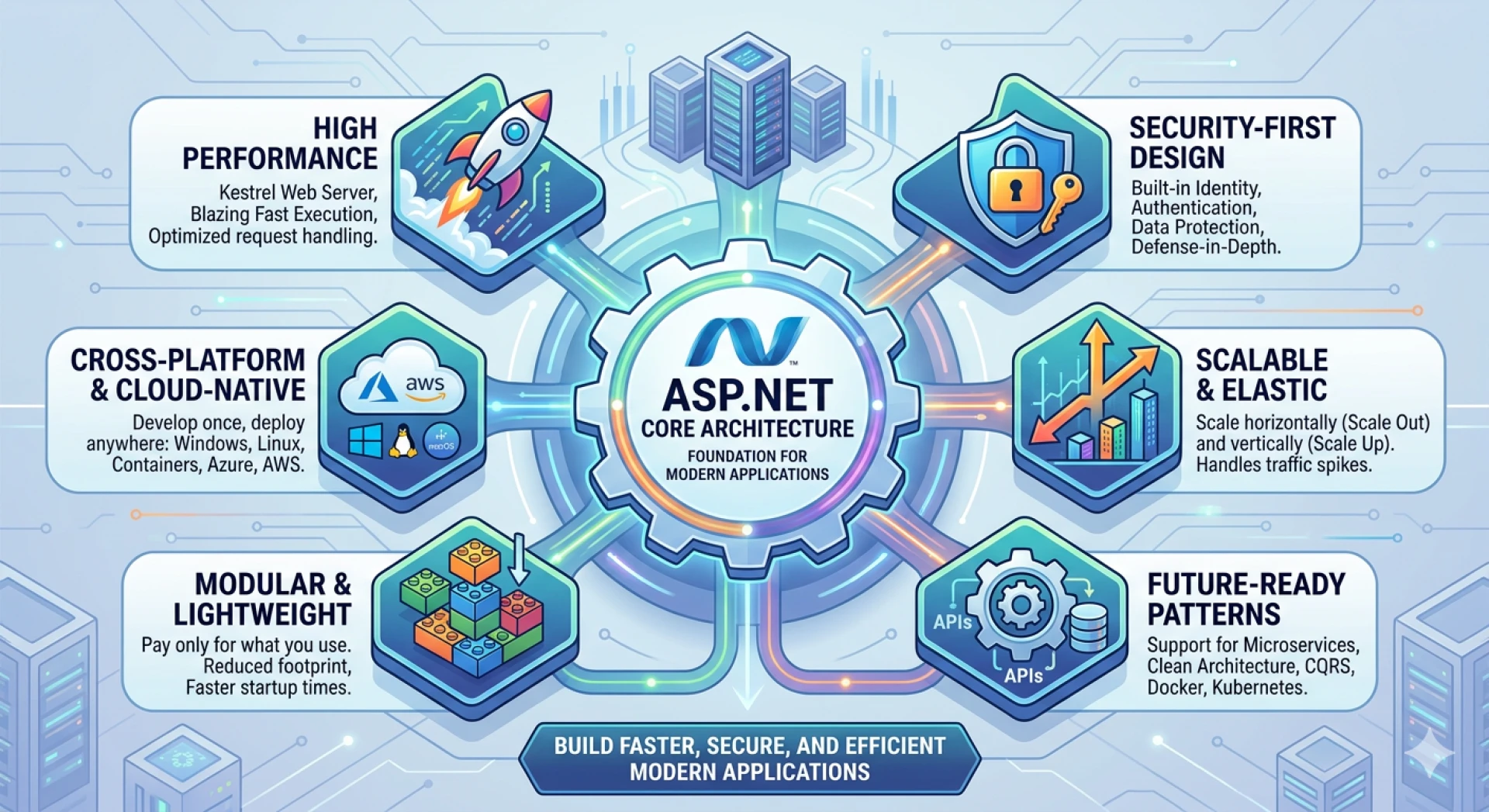
1. Improves Application Performance
A well-thought-out architecture really streamlines how data moves through the application. By cutting down on unnecessary tasks and managing resources more effectively, ASP.NET Core applications can deliver quicker response times.
Plus, a solid architecture supports asynchronous programming and caching, which takes performance to the next level.
2. Enables Scalability
In today's world, modern applications need to keep up with the ever-growing user traffic and data demands. The architecture of ASP.NET Core is designed with scalability in mind, enabling developers to create applications that can expand alongside their business needs.
By leveraging modular structures and microservices, these applications can scale horizontally without compromising performance.
3. Enhances Maintainability
A well-structured architecture keeps different parts of the application separate, which makes it much easier to manage and update.
For instance:
- Changes to the user interface won’t impact the business logic.
- Database updates can be done on their own without affecting other components.
This approach not only cuts down on development time but also makes maintenance a breeze.
4. Improves Security
When it comes to modern applications, security is absolutely crucial. The architecture of ASP.NET Core comes packed with built-in security features, all backed by Microsoft.
Here are some key security advantages:
- Authentication and authorization
- Data protection
- Secure API production
A thoughtfully designed architecture makes sure that security is woven into every layer of the application.
5. Supports Cross-Platform Development
One of the standout features of ASP.NET Core is its ability to run on multiple platforms. Whether you're using Windows, Linux, or macOS, you can deploy your applications with ease. This flexibility opens up opportunities for businesses to connect with a broader audience and minimizes the constraints of infrastructure.
6. Supports Microservices Architecture
Microservices architecture breaks down applications into smaller, self-sufficient services, making them easier to manage.
With ASP.NET Core, building and handling these microservices becomes a breeze, offering benefits like:
- Quicker development cycles
- Independent deployment
- Enhanced fault isolation
This method is particularly well-suited for large-scale and enterprise-level applications.
7. Faster Development and Deployment
When developers have a solid architectural framework in place, they can really boost their efficiency. This allows teams to work on different components separately, which helps speed up the entire development process.
Plus, implementing continuous integration and deployment pipelines becomes a lot smoother.
Difficulties and issues in the development of ASP.NET
1. Complexity for Beginners
ASP.NET is powerful but can be difficult for beginners to learn.
Issues:
- Steep learning curve
- Requires understanding of C#, MVC, APIs
- Complex project structure
2. Cross-Platform Limitations
Older ASP.NET versions (like .NET Framework) are limited to Windows
Issues:
- Not fully cross-platform
- Deployment restrictions
- Infrastructure dependency
3. Debugging and Error Handling
Debugging large ASP.NET applications can be complex.
Issues:
- Difficult to trace errors in a layered architecture
- Complex logs
- Hidden runtime issues
While ASP.NET is a powerful and reliable framework, it comes with its own set of challenges. However, most of these issues can be minimized with:
- Proper architectural design
- Skilled developers
- Best coding practices
- Use of modern tools like ASP.NET Core
By understanding these difficulties, businesses and developers can build secure, scalable, and high-performing applications more effectively.
Benefits for Businesses
Adopting a strong ASP.NET Core architecture helps businesses:
- Build scalable and future-ready applications
- Reduce development and maintenance costs
- Improve system performance and reliability
- Enhance security and data protection
- Deliver better user experiences
These benefits make ASP.NET Core a preferred choice for modern software development applications.
Conclusion
In the modern digital era, application architecture is just as important as the technology used to build it. A well-structured architecture ensures that applications are scalable, secure, and easy to maintain. With the advanced capabilities of ASP.NET Core and strong ecosystem support from Microsoft, businesses can create powerful applications that meet evolving market demands.
Investing in the right architecture is not just a technical decision—it’s a strategic move that drives long-term success, improves efficiency, and delivers exceptional user experiences.
FAQs
1. What is ASP.NET Core Architecture?
ASP.NET Core Architecture refers to the structured design of an application using layers like presentation, business logic, and data access. It ensures applications are scalable, maintainable, and high-performing.
2. Why is ASP.NET Core Architecture important for modern applications?
Modern applications require speed, scalability, and security. ASP.NET Core Architecture provides a framework to build modular, maintainable, and cross-platform applications that meet these demands.
3. How does ASP.NET Core Architecture improve application performance?
By following best practices like clean architecture, asynchronous programming, and caching, ASP.NET Core reduces response times and optimizes resource usage, resulting in faster applications.
4. How does it improve the maintainability of applications?
Separation of concerns in ASP.NET Core Architecture ensures that changes in one layer (like UI or database) do not affect other layers, making applications easier to maintain and update.
5. What are the key components of ASP.NET Core Architecture?
The main components include:
1. Improves Application Performance
2. Enables Scalability
3. Enhances Maintainability
5. Improves Security
6. Why should businesses adopt ASP.NET Core Architecture?
It helps build modern, high-performance, scalable, and secure applications, reduces development and maintenance costs, and ensures a better user experience.































Sign in to leave a comment.