

Publication day can feel like the finish line of a book campaign. Preorders become orders, launch events take place, interviews appear, and the author finally sees the book in readers’ hands.
Then, in many cases, the publicity stops.
This creates an avoidable problem. Most potential readers will not discover a book during its first week. Podcast schedules can extend months into the future. Event opportunities may emerge gradually. A new study, cultural debate, anniversary, or news story may suddenly make the book’s subject relevant again.
Publication day is an important publicity moment, but it does not determine the book’s final reach. A strong campaign evolves after release instead of ending there.
Understand What Changes After Publication
Before publication, publicity usually focuses on anticipation:
- Advance reviews
- Forthcoming-book lists
- Prepublication interviews
- Cover reveals
- Early excerpts
- Trade outreach
- Launch-event announcements
- Advance reader copies
After publication, the book enters a different stage. Journalists can evaluate its arguments. Readers can respond to its ideas. Event organizers can review previous appearances, and authors can identify which subjects generate the most interest.
The campaign should therefore shift from announcing the book to demonstrating its continuing relevance.
Post-launch publicity may focus on:
- Reader responses
- Timely commentary
- New interview topics
- Specialist audiences
- Seasonal angles
- Speaking opportunities
- Awards and recognition
- New research related to the book
- Questions emerging from events and discussions
Reedsy’s collection of book marketing ideas describes book marketing as an ongoing process rather than an activity limited to launch week. This distinction matters because many valuable opportunities develop only after a book has entered public conversation.
Follow Up on Existing Outreach Selectively
Not every unanswered pitch needs another email. An editor may have decided the subject was unsuitable, assigned a similar story elsewhere, or simply lacked space.
However, a focused follow-up may be appropriate when:
- The original pitch was personalized and relevant.
- Enough time has passed since the first message.
- The publication has not discouraged follow-ups.
- The opportunity remains timely.
- You have something meaningful to add.
New information could include:
- A significant review
- An award nomination
- An upcoming event
- New research related to the book
- A relevant policy development
- A strong previous interview
- An unexpected public conversation about the subject
Avoid sending a message that only says, “I wanted to check whether you saw my previous email.”
Instead, restate the idea briefly and explain what has changed:
Since my original message, [Book] has been shortlisted for [Award], and [Author] will be speaking at [Event]. With renewed discussion around [subject], she can also address [specific angle relevant to the outlet].
One useful follow-up is generally more effective than a sequence of reminders with no new information.
Use the Questions Readers Actually Ask
Before publication, authors and publicists must predict what readers, journalists, and interviewers will find interesting. After publication, they can work with real evidence.
Collect questions from:
- Bookstore events
- Library programs
- Book-club discussions
- Podcast interviews
- Conference sessions
- Newsletter replies
- Social media comments
- Reader emails
- Online reviews
- Classroom discussions
Repeated questions can reveal angles that were not obvious during the original campaign.
A historian may discover that audiences are more interested in the experiences of ordinary families than in the book’s central political figure. A novelist may find that book clubs repeatedly debate one character’s moral decision. A business author may learn that readers understand the main framework but struggle to apply one particular step.
These responses can lead to:
- New interview topics
- Contributed articles
- Podcast pitches
- FAQs
- Workshops
- Newsletter features
- Book-club resources
- Follow-up research
Post-publication publicity becomes more relevant when it responds to what audiences are genuinely discussing.
Create New Angles Instead of Repeating the Launch Announcement
“New book available now” has a short lifespan. Once the launch period ends, the book needs additional reasons to enter media conversations.
Possible post-launch angles include:
- A finding that challenges a common assumption
- A practical lesson from the book
- A local or regional connection
- A seasonal application
- An upcoming anniversary
- A policy development
- A cultural debate
- A response to new research
- A classroom or book-club discussion
- A professional takeaway
- A story from the research process
- A creative decision behind the book
- A subject overlooked during the original launch
For example, a book about emergency medicine may become relevant during a discussion about rural hospital closures. A biography could support coverage around the subject’s birthday or the anniversary of a significant event. A novel set at a seaside resort may fit seasonal reading coverage even a year after publication.
The connection must be genuine. If the author cannot contribute useful knowledge, context, or experience to the current subject, mentioning the book will not make the pitch credible.
Continue Pursuing Podcasts
Podcasts can remain valuable long after launch week. Some shows book guests several months in advance, while others respond quickly when a subject becomes timely.
After publication, authors also have more material to demonstrate their strength as guests. A thoughtful previous episode can show prospective hosts that the author communicates clearly, answers questions naturally, and offers more than a rehearsed sales message.
One book may support podcast conversations about:
- The book’s central subject
- The research process
- The author’s professional expertise
- A personal experience connected to the work
- Writing and publishing
- A regional or cultural connection
- A new development in the field
- A controversial or misunderstood issue
- Questions raised by readers
Adjust the pitch for each podcast. A literary show may care about narrative choices, while a professional podcast may want practical lessons or specialist knowledge.
The book should provide context and authority without forcing every response back to a purchase message.
Build an Event Calendar Beyond Launch Week
A single launch party is not a complete events strategy.
Post-publication opportunities may include:
- Bookstore conversations
- Library programs
- Book-club visits
- Literary festivals
- Professional conferences
- University lectures
- Museum programs
- Historical-society events
- Workshops
- Community panels
- School visits
- Virtual discussions
- Industry association events
Match the event format to the book.
A cookbook may support live demonstrations. A children’s author could develop school or library programs. A policy book may suit professional panels or university discussions. A novel with a strong regional setting could work well in conversation with a local historian, journalist, or another author.
Events can also create new reasons for media outreach. A regional newspaper may not cover a book solely because it has been published, but it might cover an author speaking at a local library about a subject affecting the community.
A coordinated literary PR campaign can connect events with regional coverage, podcast appearances, contributed articles, and renewed media outreach instead of treating every appearance as an isolated calendar entry.
Maintain Relationships Created During the Launch
Authors often contact journalists, podcast hosts, booksellers, and event organizers intensively before publication and then disappear after the launch.
Maintaining a professional relationship does not require frequent messages. It requires appropriate follow-through.
After an appearance:
- Thank the host, interviewer, or organizer.
- Share the published work accurately.
- Credit the publication and interviewer.
- Provide requested materials promptly.
- Notify the contact of any important factual correction.
- Avoid immediately asking for another opportunity.
Continue paying attention to their work. If a journalist later seeks sources in the author’s area of expertise, respond only when the author can provide relevant assistance.
Do not add journalists or event organizers to a marketing newsletter without their permission. A previous exchange does not automatically constitute consent to receive promotional emails.
Give Published Coverage a Longer Life
An interview, review, podcast, or contributed article should not be shared once and forgotten.
Strong coverage can be added to:
- The author’s media page
- The book’s website
- Speaker materials
- Newsletters
- Future media pitches
- Award submissions
- Festival applications
- Event proposals
- Retailer editorial sections, where appropriate
When sharing older coverage, lead with the idea rather than the author’s appearance.
Instead of:
In case you missed my interview from last month.
Try:
Why do communities preserve some disasters in public memory while forgetting others? I explored that question in this conversation with [Host].
This framing gives people a reason to engage with the interview after its original publication date.
Avoid repeatedly reposting the same link with identical wording. Extract different questions, observations, short clips, or practical lessons from the conversation.
Reach Specialist Audiences
Broad national coverage may be difficult to sustain, but many books have several smaller audiences that can be approached over time.
A novel about an archaeological excavation might interest:
- Literary publications
- Archaeology podcasts
- Museum communities
- University alumni publications
- Regional media connected to the setting
- Travel and history outlets
- Historical-fiction book clubs
A nonfiction book about workplace communication might be relevant to:
- Management publications
- HR associations
- Business podcasts
- Trade publications
- Professional conferences
- Leadership programs
- University business departments
Specialist outreach requires adaptation. An industry publication may care about the author’s research and evidence, while a local newspaper may focus on the author’s connection to the area.
A smaller but highly relevant audience may produce better results than broad coverage reaching people with little interest in the subject.
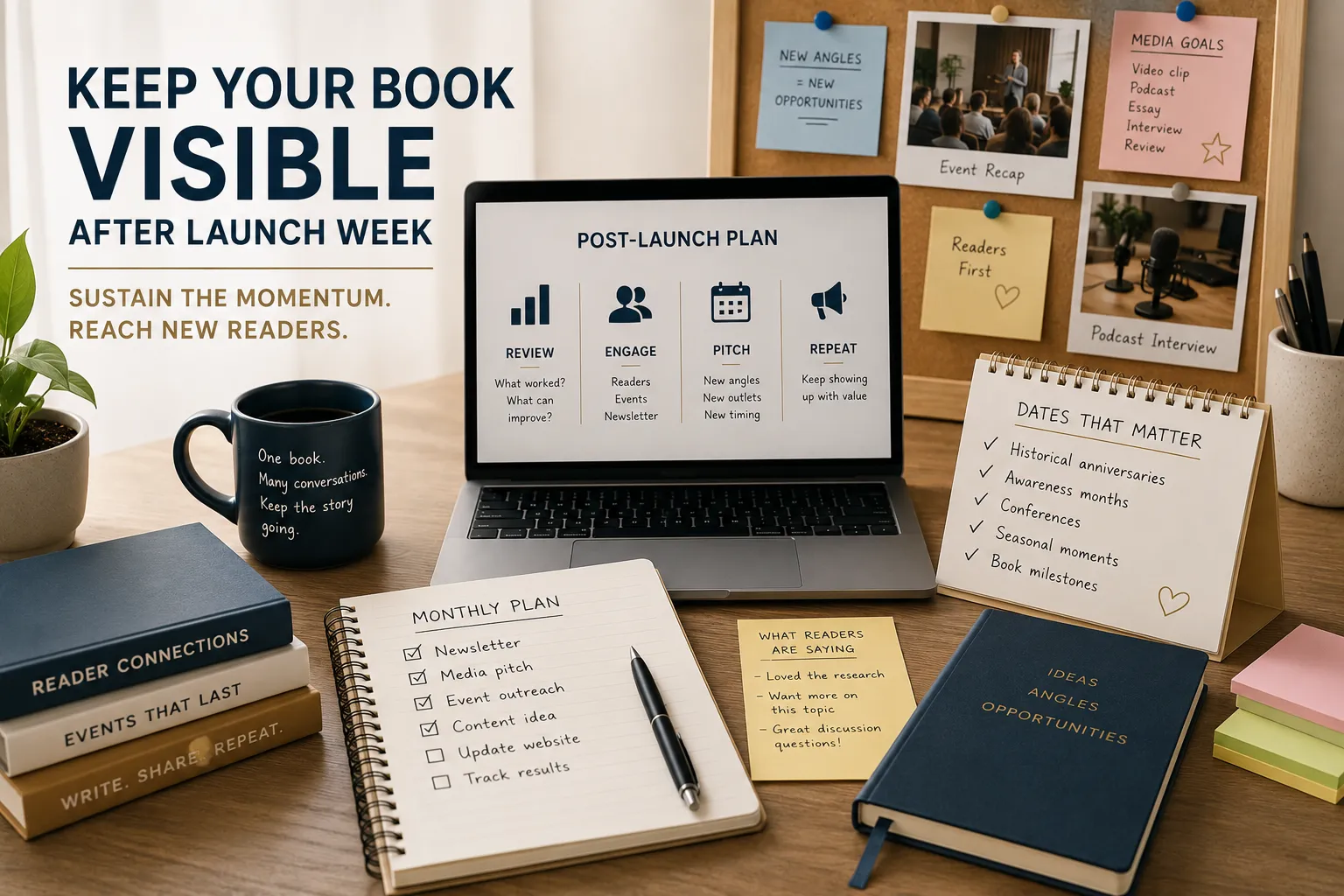
Use Seasonal and Annual Opportunities
Some media opportunities return predictably each year.
Create a calendar that includes:
- Awareness days and months
- Historical anniversaries
- Annual conferences
- Holidays
- Seasonal behavior
- Academic terms
- Industry reporting cycles
- Literary festivals
- Award deadlines
- Recurring public debates
Plan outreach according to the outlet’s schedule. A holiday pitch sent a few days before the holiday will be too late for many print publications, newsletters, and broadcast programs.
Avoid using an anniversary or awareness period as promotional decoration. The author should contribute relevant expertise, an informed perspective, a useful resource, or an original story.
Support the Book’s Discoverability
Publicity can introduce the book to new audiences, but interested readers must still be able to find accurate information about it.
Review:
- The author’s website
- The book page
- Page titles and descriptions
- Retailer listings
- Purchase links
- Library information
- Author biographies
- Social profiles
- Media-kit links
- Event pages
- Available formats
Make sure the title, subtitle, author name, cover, publication details, and purchase options are consistent.
Measure More Than Immediate Sales
Post-launch publicity should not be evaluated only by the number of books sold immediately after an appearance.
Other useful outcomes include:
- Relevant website traffic
- Newsletter subscriptions
- Invitations from other media
- Speaking inquiries
- Requests for expert commentary
- Engagement from professional communities
- Library or book-club interest
- Increased searches for the author
- New retailer reviews
- Relationships with journalists covering the subject
Some opportunities create a brief increase in attention. Others establish the author as a credible source who may be contacted repeatedly.
Record which subjects, formats, and audiences produce meaningful results. This information can guide future outreach and prevent the campaign from continuing with angles that consistently fail to connect.
Decide When to Refresh or Reduce the Campaign
Continuing publicity does not mean pitching the same book intensively forever.
Review the campaign after three, six, and twelve months. Ask:
- Which angles received positive responses?
- Which audiences showed genuine interest?
- Which appearances produced further opportunities?
- Are new developments making the book relevant?
- Does the author have the capacity to continue?
- Is another book or project becoming the priority?
- Are the remaining opportunities worth the time and expense?
The campaign may eventually move from weekly outreach to a lighter schedule based on events, anniversaries, seasonal opportunities, and relevant news.
A book can also experience a new publicity cycle later. An adaptation, award, legal development, viral discussion, new edition, curriculum adoption, or major public debate may create a fresh reason to introduce it to the media.
Publication day concentrates attention, but it does not determine a book’s long-term reach. The strongest post-launch campaigns continue by finding new reasons for the author’s ideas, expertise, and stories to matter, rather than repeatedly announcing that the book exists.






















Sign in to leave a comment.