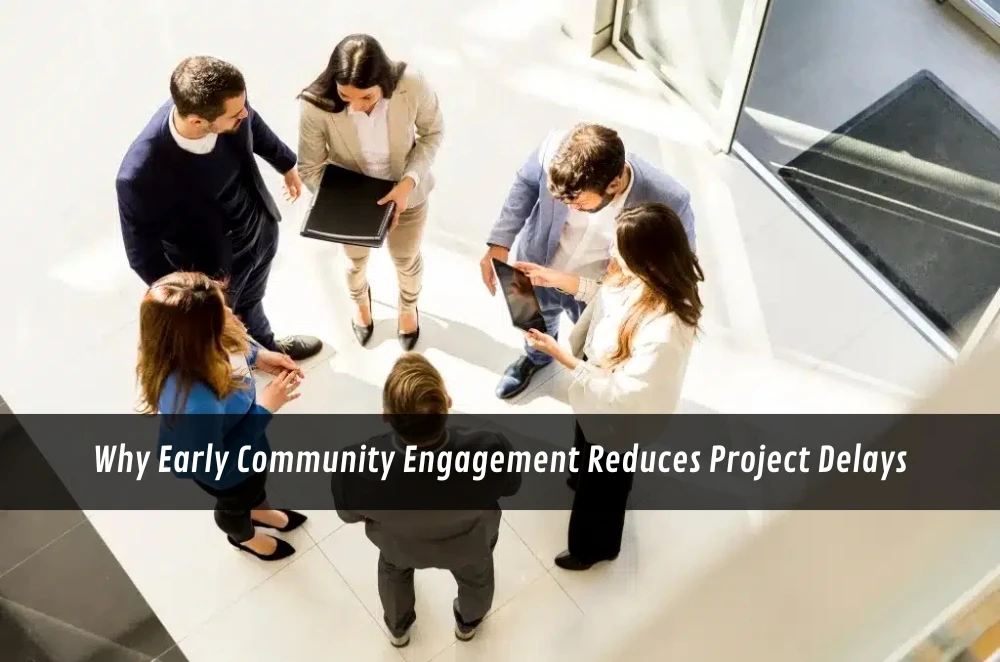

Early engagement sounds simple — talk to people sooner, listen properly, and make decisions with more clarity. But anyone who has ever worked on a major project knows it rarely plays out that neatly. I learned this the hard way on a precinct revitalisation project a few years back. We were confident we understood the community’s concerns. Turns out… we didn’t. And the delay that followed cost months, not weeks.
That experience re-shaped how I approach community participation and, more importantly, how early engagement can prevent costly project setbacks long before they take shape.
Below, I’ll walk through why it matters, how it works, and what happens when it’s done too late — or not at all.
Why project timelines slip without early engagement
Most project delays don’t begin with big public objections. They usually start quietly:
- Misunderstood local priorities
- Assumptions made in isolation
- Missed cultural or environmental sensitivities
- Small groups feel shut out
In my own work, the pattern is always the same. When engagement starts late, teams scramble to reverse-engineer decisions that should have been informed earlier. It’s like trying to retrofit a building after the concrete has already set.
A stronger process begins with participation in the community, because understanding lived experience gives your planning work a foundation that’s both social and technical.
The Australian Institute of Family Studies highlights how deeper participation increases legitimacy and reduces friction around decision-making. When people recognise themselves in a project’s reasoning, they’re far less likely to oppose it — even when compromises are involved.
How early engagement reduces decision-making risk
There’s a moment in every project where the design or planning team must lock in core decisions. That moment can feel either steady or shaky, depending on how well community knowledge has been folded into earlier work.
Early engagement lowers risk because it:
- Identifying constraints before design and procurement locks you in
- Confirms whether your assumptions actually match community reality
- Uncovers hyper-local insights that technical data alone misses
- Avoids the political and reputational cost of blindsiding stakeholders
On one municipal corridor upgrade, our team ran conversations with residents before the traffic modelling phase. It changed the entire brief. We discovered that pedestrian safety — not congestion — was the community’s top priority. That finding influenced everything from lane widths to crossing placement. And crucially, it prevented a backlash later.
The workflow was clunky in places, sure. But the project moved smoothly because the fundamentals were right from the beginning.
What effective early engagement actually looks like
It’s easy to say “engage early,” but what does that translate to in the field?
Here’s what I’ve found separates effective engagement from the box-ticking version:
1. Begin before design hardens
If your engagement starts after drawings are complete, you’re not engaging — you’re informing. At that point, consultation can feel symbolic, and people sense it instantly.
2. Use methods that suit the community
Formal workshops can feel stiff. Sometimes a pop-up stall at a local market yields richer insights. Other times, you need targeted conversations with groups who rarely speak up.
3. Bring constraints into the conversation
Avoid the trap of asking open questions with closed options. Be up front about what can change and what can’t.
4. Follow up early feedback with clear updates
Silence is the fastest path to community distrust. A simple “Here’s what we heard and here’s what we’re doing with it” stabilises expectations.
On a recent stormwater mitigation project, our team used a mix of walk-shops and small-group sessions. The early intel was gold — residents pointed out specific drainage choke points that no technical report had captured. Fixing them early saved the council months of redesign.
Why late engagement leads to conflict (and delays)
When you ask for input too late, two things generally happen.
First, people feel like they’re being handed a finished project disguised as a question. They disengage or become adversarial. Either way, your social licence dips.
Second, late feedback often contradicts decisions already locked into budget, procurement, or regulatory pathways. Changing course is expensive. Not changing course is risky.
In some cases, I’ve seen “late engagement” double as “early resistance.” Residents rally, petitions form, councillors intervene, and suddenly your tidy timeline looks a lot like spaghetti.
Delays happen not because the community is unreasonable, but because the timing of the conversation was wrong.
Embedding engagement into your project planning workflow
Strong early engagement isn’t a separate exercise — it’s part of good project governance. That means weaving it in at the same stage you’re scoping risks, budgets, and approvals.
Here’s a practical structure that works across most infrastructure, development, and precinct-style projects:
- Discovery phase: Start high-level conversations before technical studies begin. Surface patterns early.
- Co-design or feedback loops: Use structured sessions where community input meaningfully alters direction.
- Impact mapping: Turn qualitative feedback into traceable decisions. This is where delays are prevented.
- Publish decision rationale: Nothing kills trust like ambiguity. Show how feedback was considered — even when not adopted.
Throughout this process, many teams develop a community engagement strategy to document the scope, methods, timeframes, and responsibilities. For Medium, you’ll simply insert a link to the host’s internal blog later.
The link between early engagement and cost certainty
Project managers often think of engagement as a “soft” activity. But its impact on cost certainty is anything but soft.
Early engagement can produce:
- More predictable procurement
- Fewer redesigns
- Lower likelihood of political intervention
- Clearer alignment with local planning expectations
In my experience, some of the most painful delays — the kind that blow out budgets and stall momentum — stem from avoidable surprises raised by stakeholders who were consulted too late.
When engagement is early and authentic, the surprises shrink. The unknowns become knowns. And design teams stop guessing.
Strengthening accountability through community voice
When communities feel heard, they tend to endorse project decisions even if they disagree with aspects of the final design. Because they understand the “why,” not just the “what.”
This is where tools that support structured stakeholder involvement become useful. Insert your preferred authority-site link later — for example, something from IAP2, university research, or a planning institute.
Early engagement builds a feedback loop where stakeholders hold the project team accountable to shared goals rather than fixed positions. The contrast is striking when compared with projects that attempt engagement late and defensively.
Final thoughts: engagement early or pay later
Every delay I’ve ever seen linked to community issues had one thing in common: the engagement started too late to influence the core design or planning assumptions.
If there’s one lesson I keep returning to, it’s this:
Early engagement isn’t a courtesy — it’s a risk-management tool. A good one. Possibly the best one we've got.
























Sign in to leave a comment.