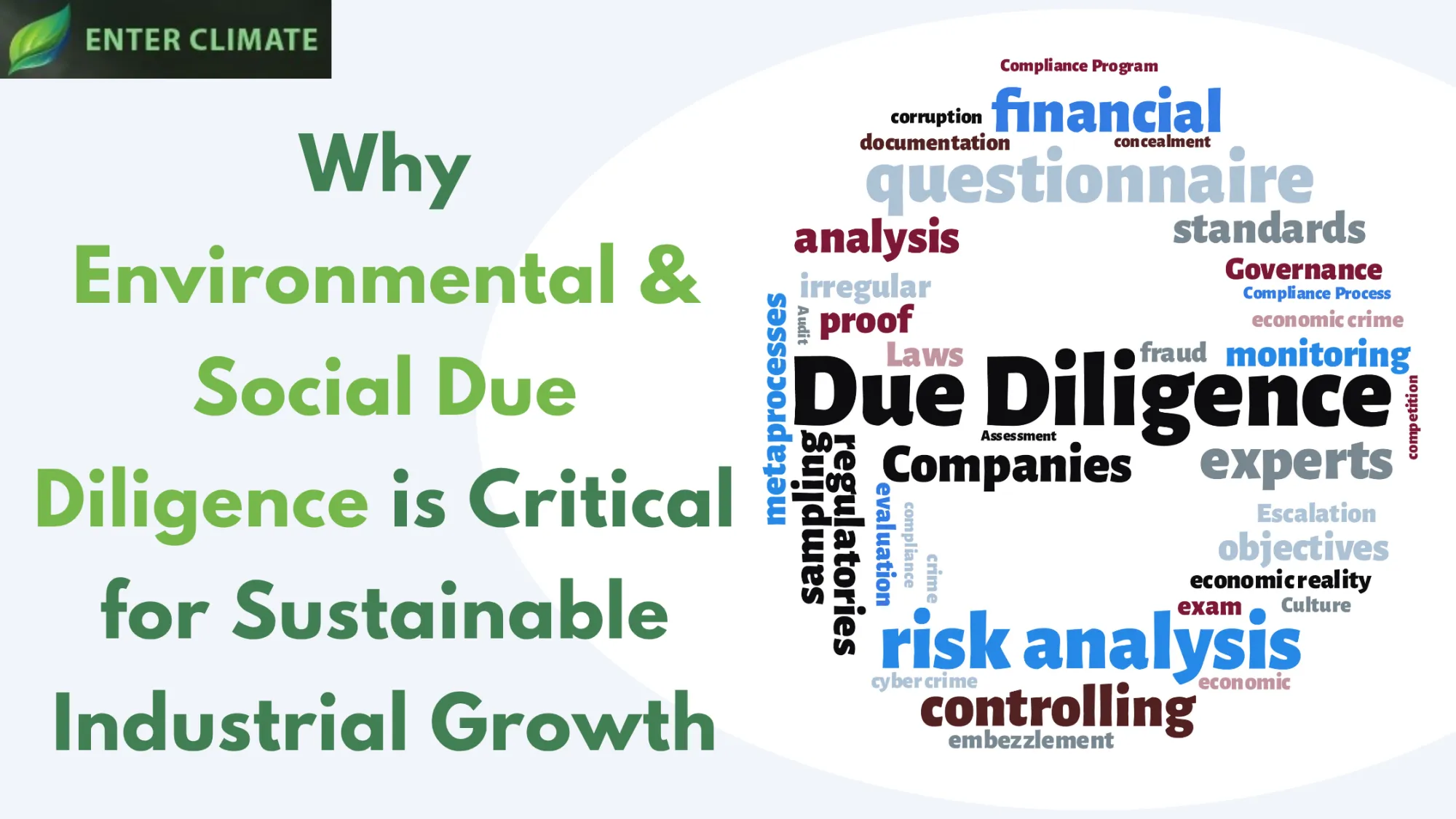

When we think about big industries—factories, power plants, or manufacturing units—we often imagine machines, workers, and production. But there is something equally important that often stays behind the scenes: how these industries affect nature and people.
This is where Environmental & Social Due Diligence becomes very important.
Let’s understand this in a very simple way.
What is Environmental & Social Due Diligence?
Imagine you are building a house. Before building, you check the land, water supply, safety, and your neighbors. In the same way, industries also need to check their impact on the environment and society before starting or expanding.
This checking process is called Environmental & Social Due Diligence.
It helps answer questions like:
- Will this factory harm the air or water?
- Will people living nearby face problems?
- Is the project safe and responsible?
Why is it important for industries?
Industries are growing fast, but growth without care can cause damage. If companies ignore the environment and people, they may face:
- Pollution problems
- Legal penalties
- Loss of trust from communities
This is why companies now focus on sustainable growth—growing in a way that does not harm the future.
Role of Environmental Compliance Monitoring
Once an industry starts, the work doesn’t stop. It must continuously check if it is following environmental rules. This is called Environmental Compliance Monitoring.
Think of it like a regular health check-up.
It ensures:
- Air and water are not polluted
- Waste is managed properly
- Government rules are followed
Without monitoring, even a small mistake can turn into a big environmental issue.
Importance of Hydrogeological Survey Report
Water is one of the most important resources for any industry. But using water without understanding it can cause serious problems like groundwater depletion.
This is where a Hydrogeological survey report becomes useful.
It helps industries understand:
- How much groundwater is available
- Whether water usage is safe
- Impact on nearby wells and farmers
In simple words, it ensures industries use water responsibly and do not harm future water availability.
Social Due Diligence in Pharmaceutical Industry
Industries do not only affect the environment—they also affect people. This is especially important in sectors like medicines.
Social Due Diligence in Pharmaceutical Industry focuses on:
- Worker safety
- Ethical practices
- Community health
- Fair treatment of employees
For example, a pharma company must ensure:
- Safe working conditions for workers
- No harmful waste affecting nearby residents
- Affordable and ethical practices
If companies ignore social responsibility, it can harm both people and their own reputation.
How it supports sustainable growth
When industries follow proper due diligence, they:
- Reduce environmental damage
- Build trust with communities
- Avoid legal risks
- Attract investors
In today’s world, investors and banks prefer companies that are responsible and transparent. So, Environmental & Social Due Diligence is not just about safety—it is also about business success.
A simple example
Imagine two factories:
- Factory A ignores environmental checks and pollutes water.
- Factory B follows Environmental Compliance Monitoring and uses resources carefully.
Over time:
- Factory A faces complaints and penalties.
- Factory B gains trust and grows steadily.
This shows how responsible practices lead to long-term success.
Conclusion
Sustainable industrial growth is not just about producing more—it is about producing responsibly.
By focusing on:
- Environmental & Social Due Diligence
- Environmental Compliance Monitoring
- Hydrogeological survey report
- Social Due Diligence in Pharmaceutical Industry
industries can grow in a way that protects both nature and people.
A better future depends on the choices we make today—and responsible industries play a big role in shaping that future.
Author Profile
Upendra Sharma
Upendra Sharma is an environmental and sustainability professional with deep expertise in Environmental & Social Due Diligence, compliance monitoring, and industrial advisory. He has worked closely with multiple industries, helping them achieve regulatory compliance and sustainable growth. His work focuses on simplifying complex environmental concepts and guiding businesses toward responsible and future-ready operations.



















Sign in to leave a comment.