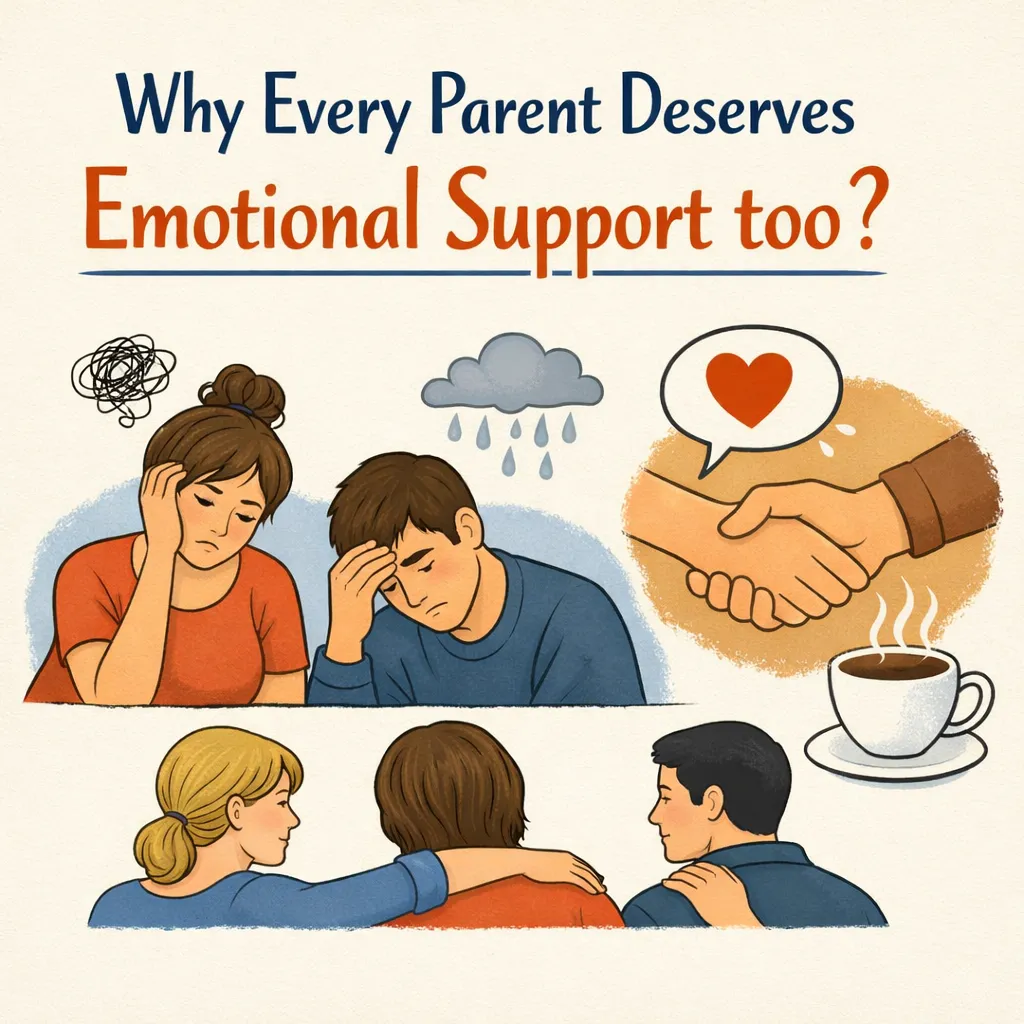

From the moment a child arrives, a quiet assumption settles over the household: the parent is the strong one. The parent is who comforts the nightmares, absorbs the tantrums, holds things together when everyone else falls apart. It's a beautiful role and a lonely one. Because while everyone asks how the children are doing, remarkably few people ever stop to ask how the parent is holding up.
If you've felt like the person everyone leans on but nobody leans toward, you're not imagining it. Parents are surrounded by people yet can feel profoundly alone in the emotional work of raising them. And the truth worth saying plainly is this: you need support and emotional strength just as much as the people who depend on you arguably more, because so much rests on you staying steady.
The Emotional Weight Parents Carry Silently
Parenting isn't just physically demanding; it's emotionally relentless. You're managing not only your own feelings but constantly monitoring and regulating your child's. You worry about their friendships, their health, their future, their happiness often long after they've fallen asleep. This invisible labour rarely gets acknowledged, yet it runs in the background of every single day.
Over time, that unrelenting emotional load takes a toll. Many parents describe feeling depleted, irritable, or strangely numb, then feeling guilty for feeling that way at all. They tell themselves that good parents don't struggle, so they push the difficulty down and carry on. But suppressed strain doesn't disappear it leaks out as short tempers, exhaustion, and a slow disconnection from the joy that drew them to parenting in the first place.
Why Emotional Support for Parents Isn't a Luxury
Emotional support for parents is often treated as optional something to consider only once a crisis hits. But waiting until you're overwhelmed is like waiting until you're drowning to learn to swim. Support is what keeps the overwhelm from arriving in the first place, and it comes in many forms: an honest conversation with someone who understands, a community of other parents, or professional guidance when the weight becomes too much to carry alone.
There's a stubborn myth that seeking support means you're failing as a parent. The opposite is true. A parent who tends to their own emotional health is modelling one of the most important lessons a child can learn that it's healthy to have needs, to ask for help, and to take care of yourself. Children absorb far more from what we do than what we say, and a depleted parent running on empty teaches a very different lesson than a supported one.
What It Really Means to Master Emotional Resilience
Support helps you cope with what's in front of you; resilience helps you meet whatever comes next. To master emotional resilience as a parent isn't to become unshakeable or endlessly patient no one is. It's to recover more quickly when you're knocked off balance, to stay grounded during the storms rather than being swept away by them.
Resilience isn't a trait some lucky parents were born with. It's a set of learnable skills: recognising your emotions before they overwhelm you, calming your own stress response, interpreting hard moments without spiralling into self-blame, and reaching for support instead of white-knuckling through alone. Each of these can be strengthened with practice, and together they change how you experience the daily demands of parenting.
Small Practices That Build Lasting Strength
Building resilience doesn't require hours you don't have. It lives in small, repeated moments: pausing to breathe before responding to a meltdown, naming your own frustration instead of acting on it, letting go of the impossible standard of the perfect parent. It means noticing when you're running low and treating that as information rather than failure.
It also means protecting small pockets of time that are yours alone not as an indulgence, but as maintenance. A parent who never refills their own reserves eventually has nothing left to give. Rest, connection, and moments of genuine calm aren't rewards for finishing the work of parenting; they're what make that work sustainable.
You Deserve Care as Much as You Give It
The love you pour into your children is extraordinary. But you cannot pour endlessly from a cup no one ever refills. Seeking emotional support and building resilience aren't distractions from good parenting they are the foundation of it.
So let this be the permission you may have been waiting for: your wellbeing matters, not only for your children's sake, but for your own. You are more than the strong one who holds everyone together. You are a person who deserves to be held, supported, and cared for, too. Tending to that isn't selfish it's one of the wisest, most loving things you can do for your whole family.






























Sign in to leave a comment.