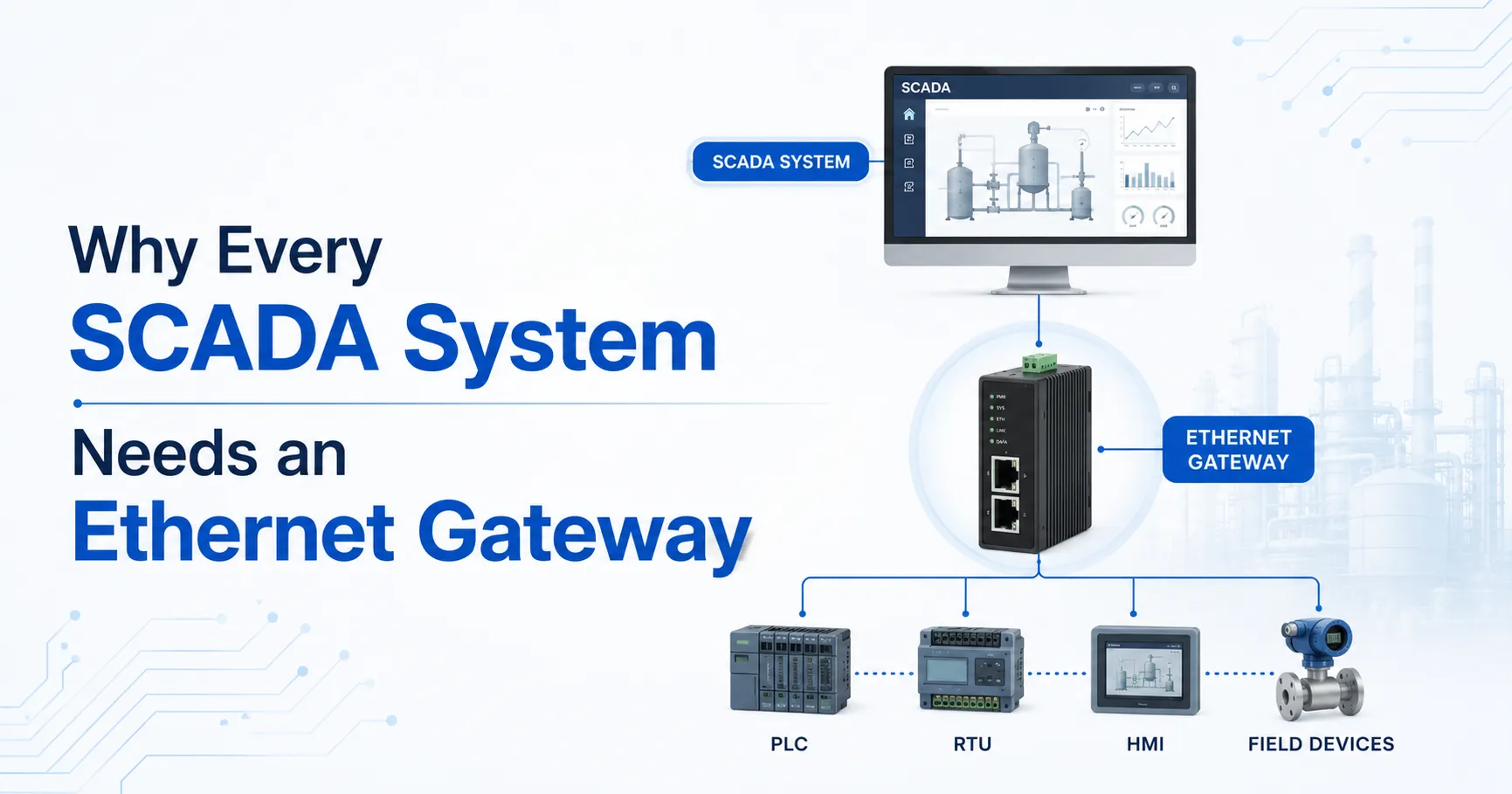

Industrial automation has evolved significantly over the past few decades. As industries move toward digital transformation, real-time monitoring, remote access, and seamless communication between devices have become essential. At the heart of many industrial operations lies the Supervisory Control and Data Acquisition (SCADA) system, which helps organizations monitor, control, and analyze industrial processes.
However, many industrial environments still rely on legacy devices and communication protocols that were not designed for modern Ethernet networks. This creates connectivity challenges that can limit the efficiency and scalability of SCADA systems.
This is where an Ethernet Gateway becomes indispensable. An Ethernet gateway acts as a bridge between traditional industrial devices and modern Ethernet-based networks, enabling seamless communication, improved data accessibility, and enhanced system performance.
Understanding SCADA Systems
SCADA (Supervisory Control and Data Acquisition) is a centralized system used to monitor and control industrial operations across various sectors, including:
- Manufacturing
- Power generation
- Water and wastewater treatment
- Oil and gas
- Building automation
- Transportation
- Renewable energy
A typical SCADA system consists of:
- Sensors and Field Devices:These collect real-time data from industrial processes.
- PLCs and RTUs : Programmable Logic Controllers (PLCs) and Remote Terminal Units (RTUs) process field data and execute control commands.
- Communication Networks: These transmit information between field devices and central control stations.
- Human Machine Interface (HMI): Operators use HMIs to monitor and manage operations.
- SCADA Software: This software gathers, visualizes, stores, and analyzes operational data.
For SCADA systems to function effectively, reliable communication between all components is critical.
What Is an Ethernet Gateway?
An Ethernet Gateway is a communication device that connects industrial equipment using serial protocols such as:
- RS232
- RS485
- Modbus RTU
- Profibus
- CAN Bus
to Ethernet-based networks using protocols such as:
- Modbus TCP
- EtherNet/IP
- MQTT
- TCP/IP
The gateway converts and transfers data between different communication formats, allowing older industrial devices to communicate with modern SCADA systems.
Why SCADA Systems Need Ethernet Gateways
1. Connecting Legacy Equipment to Modern Networks
Many industrial facilities still operate equipment that was installed years or even decades ago.
Examples include:
- Legacy PLCs
- Energy meters
- Motor drives
- Temperature controllers
- Industrial sensors
Replacing these devices can be expensive and disruptive.
An Ethernet gateway allows organizations to integrate existing equipment into modern SCADA systems without costly replacements.
Benefits
- Reduced capital expenditure
- Extended equipment lifespan
- Faster modernization projects
- Improved return on investment
2. Enabling Real-Time Data Collection
Modern industries rely on instant access to operational data.
Without an Ethernet gateway, data from legacy devices may remain isolated and inaccessible.
Ethernet gateways provide continuous data transmission to SCADA systems, allowing operators to:
- Monitor equipment performance
- Detect abnormalities
- Optimize production processes
- Improve decision-making
Real-time visibility leads to faster responses and increased operational efficiency.
3. Supporting Remote Monitoring and Control
Industrial facilities are increasingly distributed across multiple locations.
Examples include:
- Water treatment plants
- Solar farms
- Wind energy facilities
- Pipeline systems
- Utility substations
Ethernet gateways enable remote connectivity through Ethernet and internet-based networks.
Operators can:
- Access SCADA dashboards remotely
- Monitor equipment status
- Receive alerts instantly
- Perform troubleshooting
- Adjust operating parameters
This reduces travel costs and minimizes downtime.
4. Improving Data Accuracy
Manual data collection introduces risks such as:
- Human errors
- Delayed reporting
- Missing information
Ethernet gateways automate data transfer directly from field devices to SCADA software.
Benefits include:
- Accurate data acquisition
- Consistent reporting
- Better analytics
- Improved compliance documentation
Reliable data is essential for process optimization and regulatory compliance.
5. Enhancing Scalability
As businesses grow, their automation infrastructure must expand accordingly.
Traditional serial communication networks often struggle with scalability limitations.
Ethernet gateways allow organizations to:
- Add new devices easily
- Expand network coverage
- Integrate additional production lines
- Support future upgrades
This flexibility ensures that SCADA systems can evolve alongside business requirements.
6. Facilitating Industrial IoT Integration
Industry 4.0 initiatives depend heavily on connected devices and intelligent data exchange.
Ethernet gateways serve as a bridge between operational technology (OT) and information technology (IT).
This enables:
- Cloud connectivity
- Predictive maintenance
- Data analytics
- Artificial intelligence applications
- Digital twin implementations
Without Ethernet gateways, many legacy devices cannot participate in Industrial IoT ecosystems.
7. Reducing System Downtime
Downtime is one of the most costly challenges in industrial operations.
Ethernet gateways help reduce downtime by enabling:
- Predictive Maintenance: Real-time equipment monitoring helps identify issues before failures occur.
- Instant Fault Detection: SCADA systems receive immediate alerts when abnormalities are detected.
- Faster Troubleshooting: Engineers can remotely diagnose communication and equipment issues.
As a result, maintenance teams can act proactively rather than reactively.
8. Simplifying Network Management
Managing multiple communication protocols can be complicated.
Ethernet gateways centralize communication by converting various protocols into a unified Ethernet network.
Advantages include:
- Simplified infrastructure
- Easier maintenance
- Reduced network complexity
- Improved interoperability
This creates a more manageable and efficient industrial communication environment.
9. Increasing Cybersecurity Capabilities
Cybersecurity has become a major concern in industrial automation.
Modern Ethernet gateways often include advanced security features such as:
- User authentication
- Access control
- VPN support
- Firewall protection
- Data encryption
These capabilities help secure communication between SCADA systems and field devices.
A secure network protects critical industrial assets from cyber threats.
10. Lowering Operational Costs
Ethernet gateways contribute to significant cost savings through:
- Reduced equipment replacement costs
- Lower maintenance expenses
- Improved energy efficiency
- Faster issue resolution
- Decreased downtime
Organizations can modernize their infrastructure without undertaking large-scale hardware upgrades.
Key Applications of Ethernet Gateways in SCADA Systems
Manufacturing Plants
Ethernet gateways connect:
- CNC machines
- PLCs
- Industrial robots
- Sensors
to centralized SCADA platforms.
Energy Management Systems
They facilitate communication between:
- Smart meters
- Power analyzers
- Energy monitoring systems
and SCADA software.
Water and Wastewater Facilities
Operators use Ethernet gateways to monitor:
- Pumps
- Flow meters
- Valves
- Chemical dosing systems
in real time.
Oil and Gas Operations
Ethernet gateways enable remote access to:
- Pipelines
- Storage tanks
- Compressors
- Pumping stations
from centralized control centers.
Renewable Energy Projects
Solar and wind farms use Ethernet gateways to connect:
- Inverters
- Weather stations
- Power meters
- Monitoring equipment
to SCADA systems.
Features to Look for in a SCADA Ethernet Gateway
When selecting an Ethernet gateway, consider the following features:
Protocol Support
Ensure compatibility with industrial protocols such as Modbus RTU, Modbus TCP, and Ethernet/IP.
High Reliability
Choose industrial-grade hardware designed for harsh environments.
Remote Configuration
Look for web-based management tools.
Security Features
Select gateways with encryption and authentication capabilities.
Scalability
Choose devices capable of supporting future expansion.
Wide Operating Temperature Range
Industrial environments often require rugged equipment.
Diagnostic Tools
Built-in monitoring and troubleshooting features simplify maintenance.
The Future of Ethernet Gateways in SCADA Systems
As Industry 4.0 adoption accelerates, Ethernet gateways will play an increasingly important role in industrial communication.
Future advancements are expected to include:
- Edge computing integration
- AI-powered diagnostics
- Enhanced cybersecurity features
- Cloud-native connectivity
- Support for advanced industrial protocols
- Improved data processing capabilities
Organizations that invest in Ethernet gateway technology today will be better positioned for future digital transformation initiatives.
Conclusion
SCADA systems depend on reliable communication to deliver real-time monitoring, control, and operational intelligence. As industrial facilities continue to modernize, the challenge of connecting legacy equipment with modern Ethernet networks becomes increasingly important.
An Ethernet gateway provides the perfect solution by bridging communication gaps, enabling remote access, improving data visibility, enhancing scalability, and supporting Industrial IoT initiatives.
Whether in manufacturing, energy, utilities, water treatment, or oil and gas operations, Ethernet gateways help organizations maximize the value of their SCADA systems while reducing costs and improving operational efficiency.
In today's connected industrial environment, an Ethernet gateway is no longer an optional component—it is a critical foundation for building a smarter, more efficient, and future-ready SCADA infrastructure.




















Sign in to leave a comment.