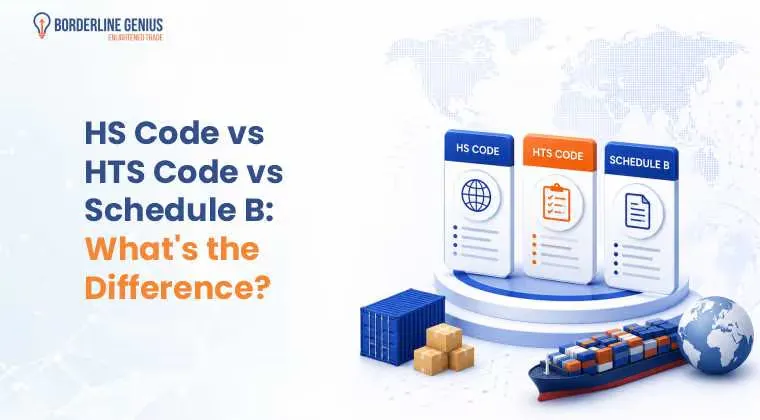

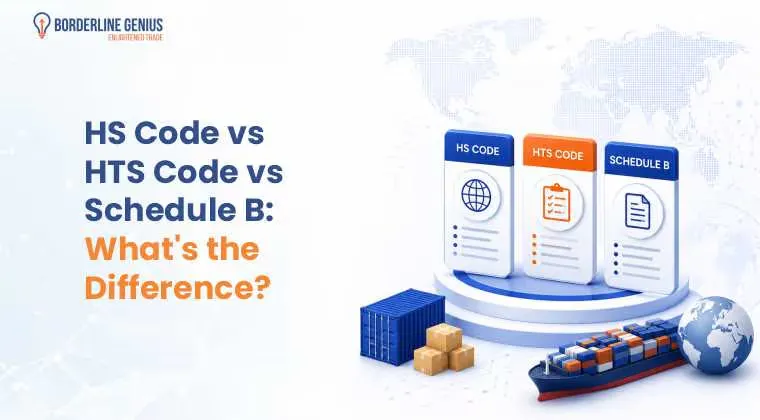
If you work with imports or exports, you've probably come across HS codes, HTS codes, and Schedule B codes.
At first glance, they can look like different names for the same thing.
They're not.
The three systems are connected through the international Harmonized System, but they serve different purposes. Understanding that distinction becomes particularly important when you're dealing with U.S. imports and exports.
The Basic Difference
The easiest way to remember the three is:
HS = international classification
HTS = U.S. import classification
Schedule B = U.S. export classification
The HS system provides the internationally harmonized six-digit foundation. Countries can then add additional digits for their own tariff and statistical requirements.
The United States does this through separate systems for imports and exports.
HS Code: The International Foundation
HS stands for Harmonized System.
The system organizes traded goods using a hierarchical structure of chapters, headings, and subheadings.
The first six digits represent the internationally harmonized portion:
- 2 digits identify the chapter
- 4 digits identify the heading
- 6 digits identify the HS subheading
That six-digit level is important because it creates a common classification reference for international trade.
But it isn't necessarily the complete classification required for a particular country's customs process.
HTS Code: U.S. Imports
HTS stands for Harmonized Tariff Schedule of the United States.
When merchandise is imported into the United States, the HTS provides the U.S. import classification structure.
It is based on the international HS system but adds U.S.-specific detail beyond the six-digit level.
This additional classification information is important for U.S. tariff treatment and statistical reporting.
That's why an HS code supplied by an overseas supplier should not automatically be treated as the complete U.S. HTS classification.
The six-digit foundation may correspond, but the classification beyond that point can differ.
Schedule B: U.S. Exports
Schedule B is the U.S. export classification system.
It is used for classifying goods exported from the United States for export reporting.
Like the HTS, Schedule B is built on the six-digit HS structure.
However, the two systems can diverge beyond that level because they serve different purposes.
So an easy way to remember the relationship is:
HS → international foundation
HTS → U.S. imports
Schedule B → U.S. exports
Why This Matters
The distinction might seem technical until you're responsible for actual trade transactions.
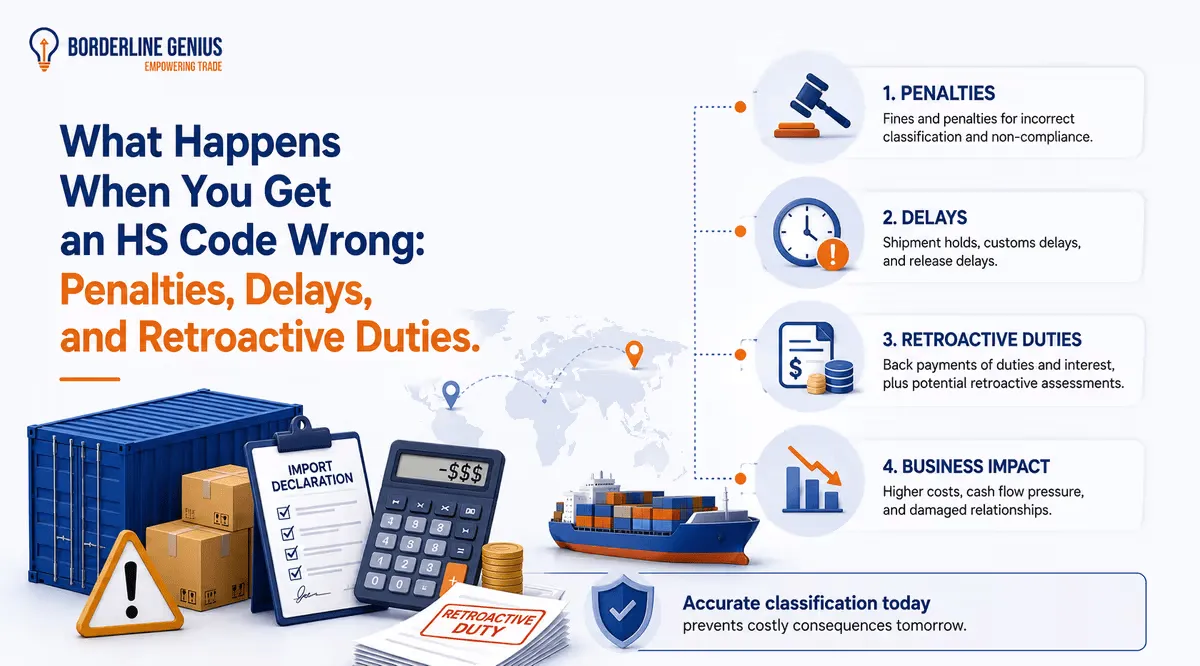
Using an incorrect classification can create problems such as incorrect duty calculations, customs questions, shipment delays, reclassification work, and additional compliance effort.
The problem becomes more complicated when a business manages a large product catalog.
A company may need to maintain product descriptions, specifications, material information, intended use, classification decisions, supporting documentation, and classification history.
That makes classification a process rather than simply a one-time code lookup.
One Common Mistake
A particularly common assumption is:
"The supplier gave us an HS code, so that's our U.S. HTS code."
That's not necessarily correct.
A foreign supplier may be working from its own country's tariff schedule. The first six digits can correspond to the same HS subheading, but the national classification beyond those six digits may be different.
If you're dealing with U.S. imports, the appropriate U.S. HTS classification still needs to be determined.
For a more detailed explanation of HS, HTS, and Schedule B, including their digit structures and practical differences, read the full guide: HS Code vs HTS Code vs Schedule B.
Managing Classification Across a Growing Catalog
For a company handling a small number of products, maintaining classifications may be relatively manageable.
For hundreds or thousands of products, it becomes much harder to keep information consistent.
"Borderline Genius INC." provides Classification Genius to help businesses manage product classification through intelligent product analysis, expert review, bulk classification, centralized product information, classification history, collaboration, and approval workflows.
The objective is not simply finding a code.
It's creating a classification process that can be managed and reviewed as the business grows.
The Simple Rule to Remember
If you're talking about the international classification framework, think HS.
If you're importing goods into the United States, think HTS.
If you're exporting goods from the United States, think Schedule B.
The systems share a common six-digit HS foundation, but that doesn't make their complete classifications interchangeable.
Explore the complete HS vs HTS vs Schedule B guide to see how the three systems compare and why the distinction matters for U.S. trade.

























Sign in to leave a comment.