
International trade involves a lot of numbers, documents, and regulatory requirements. Among them, the HS code can look like one of the simplest details to handle.
Choose a code. Put it on the customs declaration. Pay the applicable duty. Move on.
That approach is exactly where problems can begin.
An HS code is not merely a label for a product. The classification can influence customs duty, import controls, preferential trade treatment, quotas, trade remedies, and other regulatory requirements. When the classification is wrong, the consequences can continue long after the original shipment has cleared customs.
The Most Dangerous Classification Error May Be the One Nobody Notices
An invalid tariff code can be relatively easy to identify.
If the code does not exist or is inconsistent with the declaration, a customs system may flag the shipment for review. The importer may have an opportunity to correct the declaration before the goods move further through the supply chain.
A plausible but incorrect classification is more difficult.
The shipment clears.
The importer assumes everything is fine.
The same HS code gets copied into the next shipment.
Then the next one.
After several months or years, a classification error can become embedded in the company's import process.
That is when a small classification decision can turn into a significant compliance exposure.
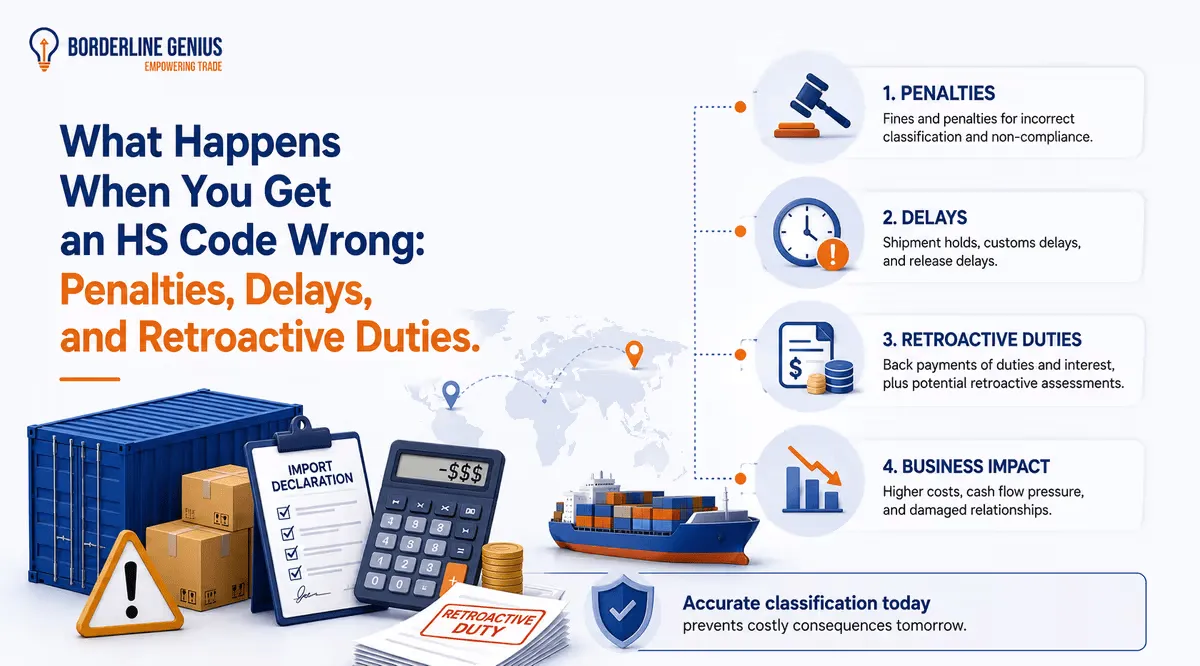
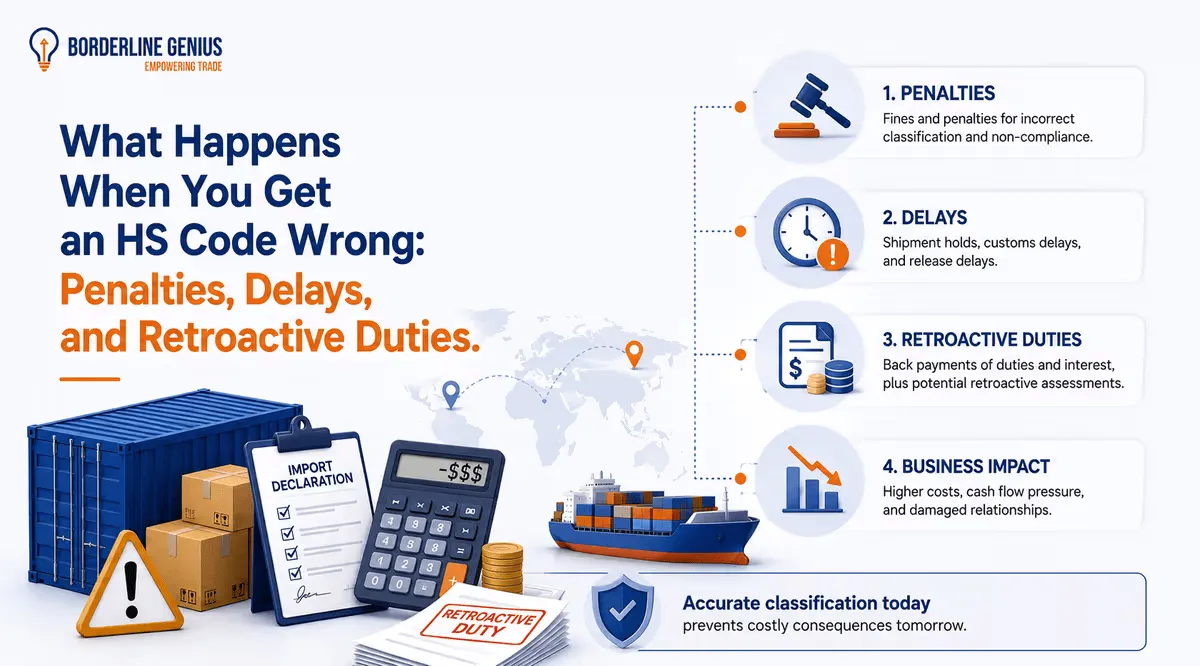
For a detailed look at how incorrect classifications can result in additional duties, customs penalties, shipment delays, preferential origin problems, and retroactive exposure, see What Happens When You Get an HS Code Wrong: Penalties, Delays, and Retroactive Duties.
Why the Financial Impact Can Be Larger Than Expected
The first thing most importers think about is the duty rate.
That's logical, but incomplete.
Suppose a business imports a product under a classification carrying a 5% duty rate when customs later determines that a 10% rate should have applied.
On one shipment, the difference may not look alarming.
Now multiply that difference across hundreds of entries.
The potential liability changes dramatically.
Depending on the customs rules in the relevant country, historical entries may be reassessed. Additional duties and interest may become payable, and penalties can arise where the circumstances meet the applicable enforcement standard.
There is another side to the problem too.
An importer using a classification with a higher duty rate may be overpaying customs duties. Whether those excess duties can be recovered depends on local refund and amendment procedures and applicable deadlines.
So classification accuracy affects both underpayment risk and unnecessary cost.
HS Classification Can Trigger Regulatory Consequences
Duty is only one part of the equation.
Tariff classification can also interact with regulatory requirements.
Depending on the product and jurisdiction, an HS code may help determine whether goods are subject to:
- Import licensing
- Permits
- Quotas
- Tariff-rate quotas
- Product inspections
- Agricultural or health controls
- Trade restrictions
- Anti-dumping duties
- Countervailing duties
- Safeguard measures
This is why correcting an HS code after customs has already identified the problem may not always be enough.
If the incorrect classification caused another regulatory requirement to be missed, the business may have a separate compliance issue to address.
Preferential Trade Claims Add Another Layer
Businesses using free trade agreements and other preferential programs have another reason to take classification seriously.
Rules of origin can depend on tariff classification.
A particular product may need to undergo a specified change in tariff heading, satisfy a regional value content requirement, or meet another product-specific origin rule.
If the underlying HS classification is incorrect, the origin analysis may also be wrong.
That means a company that thought it had legitimately claimed preferential duty treatment could later face questions about those claims.
The problem can become particularly complicated when the same classification has been used repeatedly across historical imports.
Customs Clearance Does Not Prove the Code Was Correct
This distinction is worth remembering.
Customs clearance is not the same thing as classification validation.
A shipment can clear customs and still be subject to a later review under the applicable customs procedures.
That is why importers should avoid treating a previously accepted HS code as automatically correct.
A better question is:
Can we explain why this classification was selected?
If the answer is no, the company may have a documentation problem even if no customs authority has raised an objection yet.
What Should a Good Classification Record Contain?
A defensible classification decision should be supported by meaningful product information.
Depending on the product, that could include:
- Product composition
- Material content
- Technical specifications
- Function
- Intended use
- Manufacturing process
- Product catalogues or technical sheets
- Relevant tariff provisions
- Classification reasoning
- Supporting customs rulings or guidance
The final HS code should be the result of the analysis, not the entire analysis itself.
This becomes especially important when someone needs to review a classification months or years after the original decision.
When Should an Importer Revisit an HS Code?
A classification review doesn't necessarily mean rechecking every product every month.
It makes more sense to focus attention where the financial or regulatory exposure is highest.
A review may be worthwhile when:
- Import volumes are significant
- Duty exposure is substantial
- The product has several potentially relevant tariff headings
- The product has changed
- Materials or components have changed
- The manufacturing process has changed
- A trade agreement has changed
- Tariff schedules have been updated
- New regulatory controls apply
- Customs has questioned similar products
High-risk classifications deserve more scrutiny than low-value, straightforward products.
A More Reliable Classification Process
Businesses can reduce their exposure by making classification repeatable.
Start with accurate product information.
Then apply the applicable tariff classification rules systematically.
Document the reasoning.
Review competing classifications where the product is difficult to classify.
For significant or uncertain products, consider whether a binding tariff ruling or specialist review is appropriate in the relevant jurisdiction.
Finally, revisit classifications when the product or regulatory environment changes.
This approach is much stronger than simply copying an HS code from an old commercial invoice.
The Real Cost of Getting It Wrong
The biggest misconception about HS classification is that an error ends when the shipment clears.
It doesn't necessarily work that way.
A classification mistake can continue through future shipments, historical declarations, preferential trade claims, regulatory requirements, and customs reviews.
That is why classification should be treated as an ongoing part of trade compliance rather than a routine data-entry exercise.
A defensible HS classification gives an importer something valuable when questions arise later: a documented reason for the decision.
And when the financial exposure is large, that distinction can matter.
For the complete analysis of what happens when an HS code is wrong, including penalties, delays, additional duties, origin claim failures, trade remedies, regulatory controls, and enforcement risks, read the full Borderline Genius INC. article on HS code misclassification consequences.























Sign in to leave a comment.