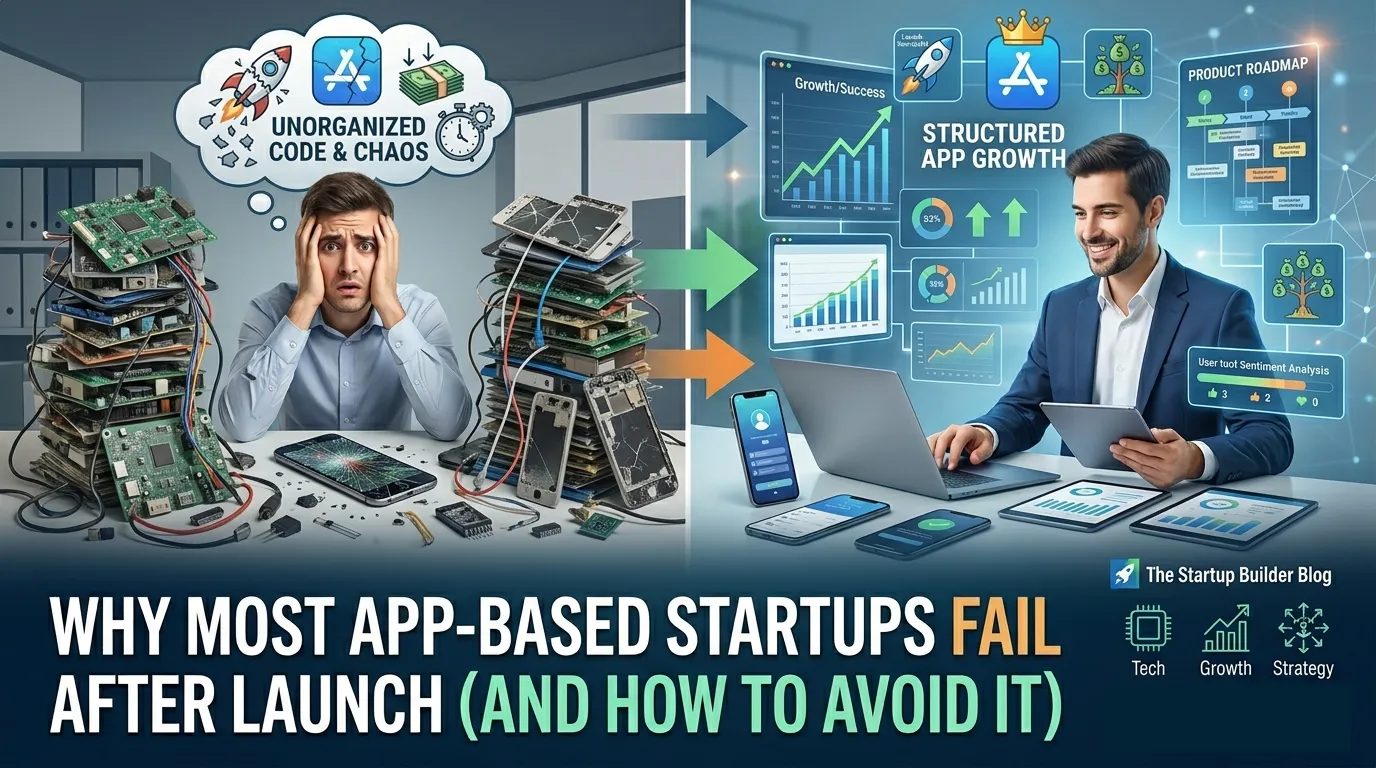

Launching an app is a big moment for any startup. After months of planning, designing, and building, finally seeing it go live feels incredibly satisfying. There’s excitement in the air, a sense of relief, and those first few users signing up make it feel like things are finally moving in the right direction.
But that momentum doesn’t always last.
After a few months, the pace often starts to slow. User engagement drops, day-to-day operations become harder to manage, and small issues in the system begin to surface—things that didn’t seem like a problem at the start suddenly start to matter.
What seemed like a promising product suddenly feels difficult to scale.
The uncomfortable truth is this: most app-based startups don’t fail because of bad ideas—they fail because they are not prepared for what comes after launch. custom application development solutions is real approach to solve this problem
The Illusion of a Successful Launch
A successful launch can be misleading. Early traction often creates the impression that the hardest part is over. Founders tend to believe that once the app is live, growth will follow automatically.
Launch is just the beginning.
An app is not a one-time product—it is part of a living, evolving system. It needs to handle increasing users, growing data, changing requirements, and continuous improvements. Without the right foundation, even the best ideas struggle to survive.
Many startups underestimate this transition from building a product to running a system. And that’s where problems begin.
Where Things Start to Break Down
In the early days, most startups operate in a controlled environment. There are fewer users, limited data, and manageable workflows. Everything seems to function smoothly.
However, as the user base grows, complexity increases.
Simple processes that once worked manually begin to slow things down. Teams start spending more time managing operations than improving the product. Delays become common. Small inefficiencies turn into major bottlenecks.
For example, a startup that initially manages customer onboarding manually might find it easy with 20 users. But with 500 users, the same process becomes overwhelming. Without automation or structured workflows, the team struggles to keep up.
This is the stage where many startups lose momentum—not because they lack demand, but because their systems cannot handle growth.
The Hidden Risk of Quick Solutions
To launch quickly, many startups rely on ready-made scripts or pre-built solutions. While these tools can help validate an idea, they often come with limitations that become evident later.
At the beginning, everything works fine. The app functions, users can interact, and basic features are available. But as requirements evolve, these solutions start to restrict flexibility.
Customization becomes difficult. Performance issues appear under higher loads. Integrating with other tools or systems becomes complicated. What once seemed like a fast and cost-effective choice turns into a barrier to growth.
This doesn’t mean such solutions are useless—they serve a purpose in early validation. But relying on them for long-term scalability often leads to challenges that are difficult to overcome.
Why Systems Matter More Than Features
Many startups focus heavily on adding features. New functionalities are seen as the key to growth and user retention. While features are important, they are only one part of the equation.
Behind every successful app is a well-designed system.
A system defines how data flows, how processes are managed, and how different parts of the business connect. It ensures that operations run smoothly, even as complexity increases.
Without strong systems:
- Processes become inconsistent
- Errors increase
- Decision-making slows down
With the right systems:
- Workflows are streamlined
- Data is centralized
- Teams operate efficiently
In simple terms, features attract users, but systems keep the business running.
The Role of Automation in Scaling
As a startup grows, manual work becomes a major limitation. Tasks like sending notifications, managing approvals, updating records, or tracking progress start consuming valuable time.
This is where automation becomes essential.
Automation doesn’t just save time—it creates consistency. It ensures that processes run the same way every time, without delays or errors. It allows teams to focus on meaningful work instead of repetitive tasks.
Startups that adopt automation early are able to scale more smoothly. They don’t need to constantly increase manpower to manage growth. Instead, their systems handle the workload efficiently.
Thinking Beyond the Product
One of the biggest mindset shifts for startups is understanding that an app is not just a product—it is part of a larger business ecosystem.
This ecosystem includes:
- User management
- Data handling
- Internal workflows
- Communication processes
- Integration with other tools
When these elements are disconnected, operations become fragmented. Teams struggle to stay aligned, and growth becomes difficult to manage.
On the other hand, when everything is connected through a well-designed system, the business operates more smoothly. Decisions are faster, processes are clearer, and scaling becomes more predictable.
How the Right Approach Changes Everything
Startups that succeed in the long run take a different approach. They don’t just focus on launching quickly—they focus on building a foundation that supports growth.
They invest in:
- Scalable architecture
- Efficient workflows
- Strong backend systems
- Continuous improvement
They understand that growth is not just about acquiring users, but about being able to handle that growth effectively.
Where Codevision Technologies Fits In
This is exactly where Codevision Technologies brings value to startups and growing businesses.
Instead of focusing only on development, the approach is centered around building complete systems that support long-term growth. It starts with understanding how a business operates—its workflows, challenges, and goals.
From there, solutions are designed to:
- Improve system architecture
- Streamline processes
- Introduce automation
- Ensure scalability
The goal is not just to deliver an app, but to create a system that works efficiently as the business grows.
Startups working with the right technology partner often avoid the common pitfalls that lead to failure. They are better prepared for growth, more adaptable to change, and more efficient in their operations.
A Realistic Perspective
Imagine two startups launching similar apps.
The first focuses only on building features and launching quickly. The second invests time in building systems and planning for scale.
In the beginning, both may look similar. But as users grow, the difference becomes clear.
The first startup struggles with performance, manual processes, and operational chaos. The second startup handles growth smoothly, adapts quickly, and continues to improve.
The difference is not the idea.
It’s the system behind the idea.
Conclusion
Most app-based startups don’t fail because they lack potential. They fail because they are not prepared for growth.
They underestimate the importance of systems, rely too much on short-term solutions, and delay investing in the foundation that supports long-term success.
Key Takeaway
If you want your app to succeed, don’t just focus on launching it. Focus on how it will operate, scale, and evolve over time.
Because in the end, building an app is just the beginning.
Final Thought
Success in today’s digital world is not about how fast you launch. It’s about how well you grow.
With the right systems, the right approach, and the right technology partner like Codevision Technologies, startups can move beyond survival and build solutions that truly scale.
Because growth doesn’t come from doing more.
It comes from building better.



























Sign in to leave a comment.