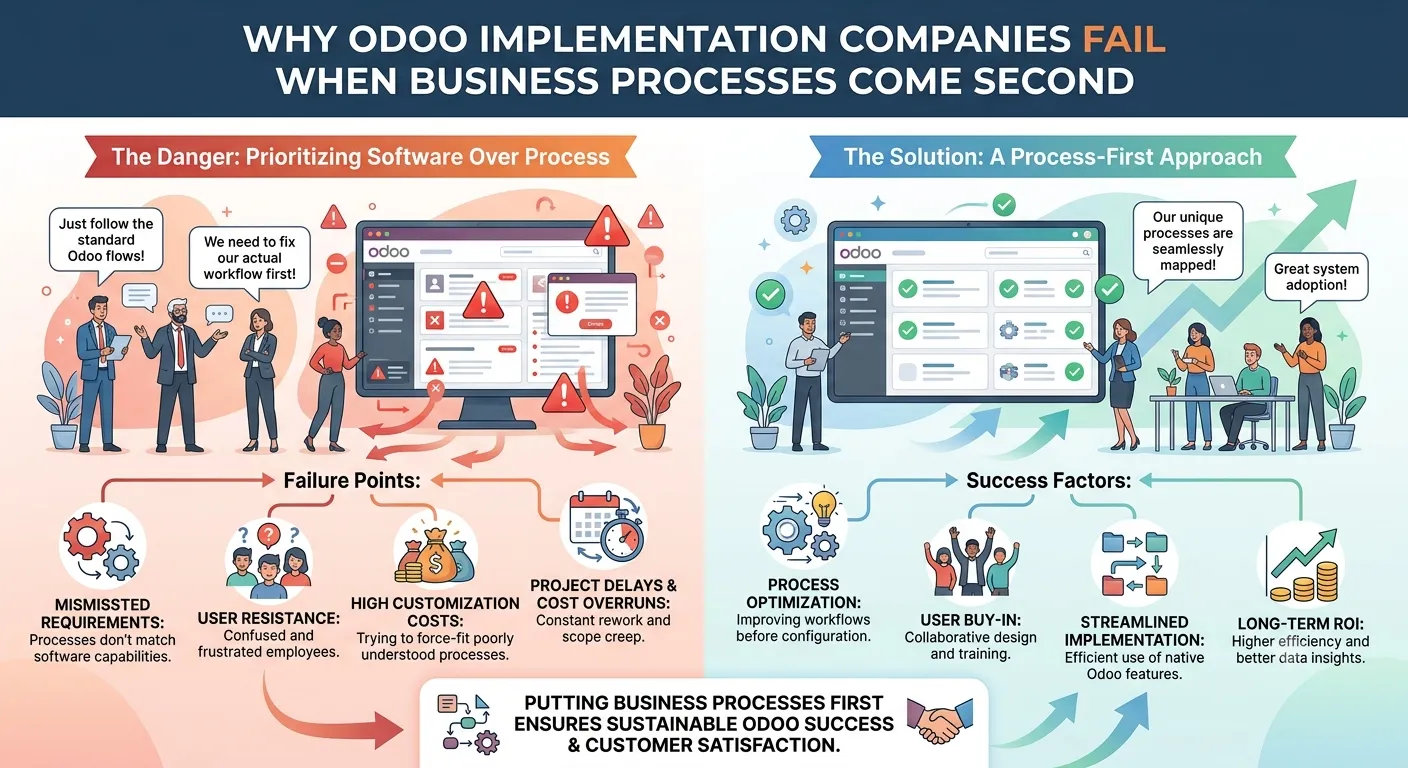

A finance team can have Odoo running and still spend hours correcting invoices, reconciling payments, and moving information between spreadsheets.
That happens when ERP implementation starts with screens and modules instead of the way the business actually operates.
For CTOs, founders, and operations leaders, this distinction matters. An Odoo Implementation Company should not only configure applications. It should understand how orders become invoices, how approvals happen, where inventory data originates, and which exceptions require human decisions.
The real objective is to make the ERP reflect the operating model.
That is why an implementation should begin by mapping workflows, ownership, data dependencies, and decision points before technical configuration begins. For a practical view of how Odoo implementation works in enterprise environments, the starting point is not the software menu. It is the business process behind it.
Why ERP Problems Keep Happening After Go-Live
ERP problems often continue after implementation because companies configure software around departments rather than end-to-end processes.
A typical workflow might cross sales, finance, procurement, inventory, and management. If each department defines its own requirements independently, the resulting system can reproduce the same silos it was supposed to remove.
Gartner predicts that by 2027, more than 70% of recently implemented ERP initiatives will fail to fully meet their original business case goals. Gartner also identifies strategic alignment as a major predictor of ERP success.
The pattern is important: ERP failure is not necessarily caused by missing functionality. It can come from a mismatch between the system configuration and the decisions people need to make every day.
For example, automating invoice creation does little if payment status is still updated manually. Likewise, connecting inventory to sales does not solve the problem if product masters, units of measure, or approval rules are inconsistent.
An effective implementation therefore asks a different question:
What should happen from the first business event to the final outcome?
A Business-Process Framework for an Odoo Implementation Company
An effective Odoo implementation should translate operational requirements into controlled workflows, measurable outcomes, and maintainable configurations.
1. Map the process before configuring the module
Process mapping defines what actually happens, not what the organizational chart says should happen.
Start with five elements:
- Trigger: What starts the workflow?
- Data: What information is required?
- Decision: Where does approval or exception handling occur?
- Action: What should Odoo automate?
- Outcome: What business result should be produced?
This exposes duplicate entry, unnecessary approvals, spreadsheet dependencies, and unclear ownership before they become development requirements.
2. Configure before customising
Configuration should be the default, while custom development should solve a clearly justified business gap.
Gartner's 2026 ERP research found that organizations with 20% or more of their ERP functionality customised had higher risks of schedule and budget overruns than organizations keeping customisation below 20%. Gartner reported a 9.9-point increase in schedule-overrun risk and a 14.5-point increase in budget-overrun risk for the higher-customisation group.
That creates an important decision rule.
Unlike a system built around every existing exception, a well-configured Odoo environment distinguishes between a genuine competitive requirement and a process that should be standardised.
Customisation still has a place. The question is whether the business value justifies the additional testing, maintenance, upgrade, and support requirements.
3. Design controls around business ownership
ERP workflows work best when every critical action has a defined owner.
For example, a purchase workflow may require:
- Request creation by the department
- Budget validation by finance
- Approval based on purchase value
- Purchase order generation
- Goods receipt confirmation
- Invoice matching
- Payment authorisation
This turns Odoo from a collection of applications into an operating control system.
The implementation team should also define who owns master data, who can override rules, and what happens when the standard workflow cannot handle an exception.
What We Learned from a Real Oodles Implementation
In one Oodles Odoo project, a client needed better control over financial transactions inside its existing Odoo environment. The challenge involved managing card and wire-transfer payments while accurately tracking invoice payment status.
Oodles analysed the existing payment workflow, designed the integration approach, and implemented Stripe Payment Gateway functionality using Stripe APIs within Odoo. The resulting setup improved payment tracking and financial visibility.
The documented outcome was a 30% reduction in manual entry errors.
The lesson is broader than payment integration.
The value came from connecting the business event, payment data, invoice status, and ERP workflow rather than treating the integration as an isolated technical task.
This is the type of implementation discipline businesses should expect from an Odoo partner. The goal is not to add another feature. The goal is to remove a point of operational friction.
Organizations evaluating implementation approaches can also review how Oodles approaches enterprise ERP engineering across different operational requirements.
Key Takeaways
- ERP implementation should begin with business-process mapping, not module configuration.
- Every workflow should have a defined trigger, data requirement, decision point, action, owner, and measurable outcome.
- Odoo customisation should be justified by business value rather than used to reproduce every legacy process.
- Gartner's research shows that strategic misalignment and excessive customisation can materially increase ERP implementation risk.
- A successful implementation connects operational workflows instead of simply placing multiple departments inside one application.
- Oodles' documented Stripe-Odoo implementation achieved a 30% reduction in manual entry errors, demonstrating the value of process-focused integration.
Start With the Process, Then Build the System
If your Odoo project needs to connect fragmented workflows, reduce manual work, or bring stronger operational controls into one ERP environment, Odoo Implementation Company services can be explored with the Oodles team.
FAQ
Q: What does an Odoo Implementation Company actually do?
A: An Odoo Implementation Company analyses business requirements, maps workflows, configures Odoo modules, develops justified customisations, integrates external systems, migrates data, tests processes, and supports users after go-live. The strongest implementations connect technical configuration directly to measurable operational outcomes.
Q: How long does an Odoo implementation take?
A: Odoo implementation timelines depend on scope, integrations, data migration, customisation, number of users, and workflow complexity. A focused implementation can be substantially shorter than a multi-company ERP rollout. The timeline should be established after requirements, dependencies, and acceptance criteria are documented.
Q: Should businesses customise Odoo?
A: Businesses should customise Odoo when a requirement creates meaningful operational or commercial value that standard functionality cannot reasonably provide. Excessive customisation increases testing, maintenance, upgrade, and budget risks. Gartner's 2026 research found higher schedule and budget risks among organizations with heavier ERP customisation.
Q: What should companies prepare before Odoo implementation?
A: Companies should document current workflows, approval rules, master data, integrations, reporting requirements, user roles, compliance needs, and critical exceptions before implementation begins. This preparation allows the implementation team to distinguish essential requirements from inefficient legacy practices that should not simply be reproduced.
Q: How do I choose an Odoo Implementation Company?
A: Choose an Odoo Implementation Company that can demonstrate experience with comparable workflows, integrations, data migration, testing, and post-go-live support. Ask how the team handles process discovery, customisation decisions, acceptance testing, and measurable outcomes rather than evaluating the partner only on technical credentials.



























Sign in to leave a comment.