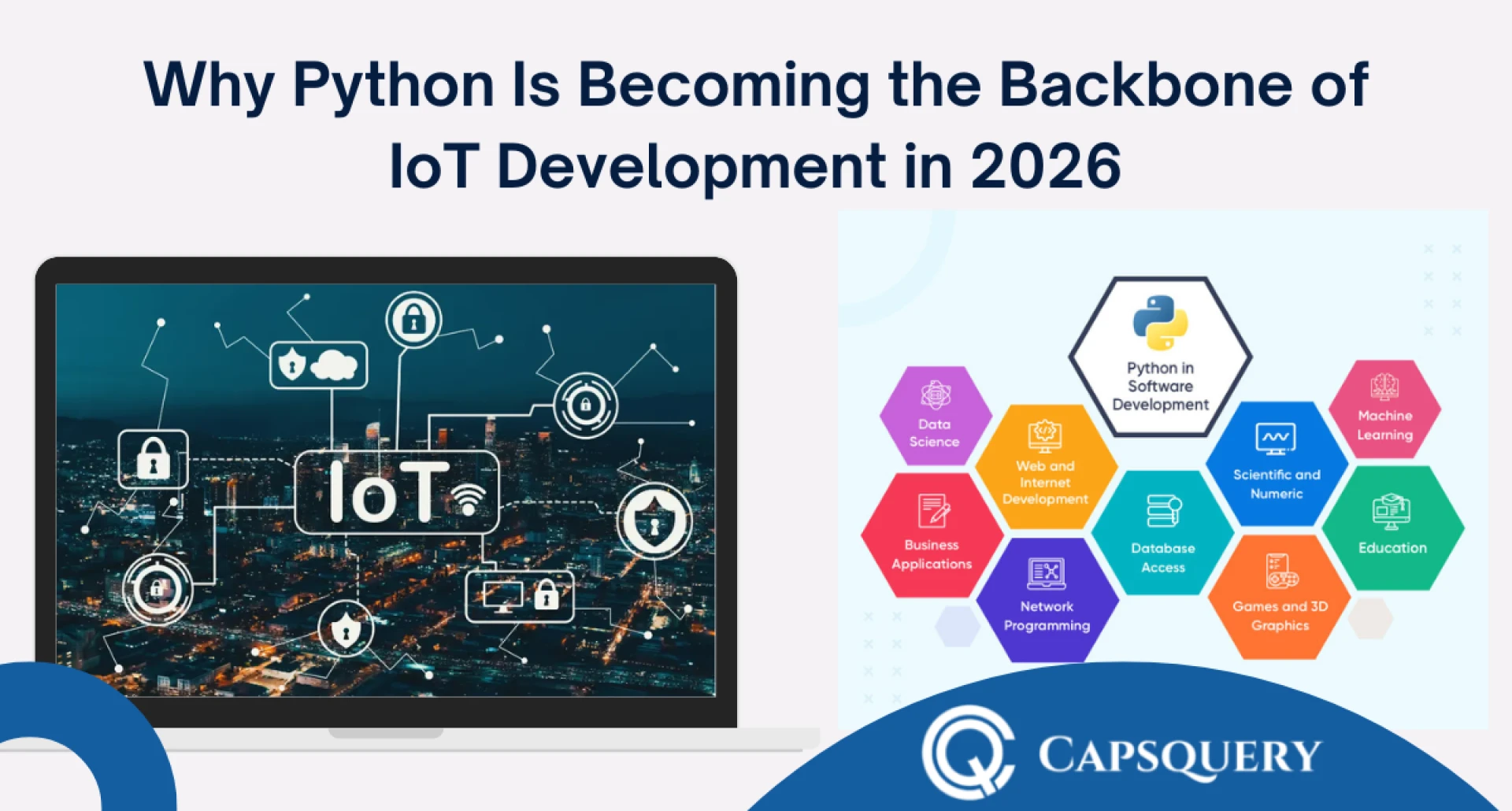

I have been noticing something odd lately. Everywhere I look whether it is a a small IoT startup in Dallas tinkering with smart home sensors or a big healthcare tech company in Houston—people seem to be reaching for Python first. And honestly, it makes sense though I didn’t fully get why until I saw how quickly teams were pushing prototypes out the door. It almost felt like cheating.
Python has slowly, quietly become the backbone of IoT development in 2026. And not just in a buzzword way. In a very real, “we-need-this-to-work-by-Friday” kind of way that engineers in Texas, Cupertino, and pretty much every tech-heavy city know too well.
Python Just Works (Most of the Time)
If you’ve ever tried connecting tiny sensors, dealing with messy real-world data, or syncing a Raspberry Pi with a cloud dashboard, you know the frustration. Python just cuts through a lot of that stress.
The syntax feels like someone finally said, “Hey, writing code doesn’t need to feel like filing taxes.”
There’s this really comforting sense that even if you’re not 100% sure what you’re doing—maybe you’re setting up MQTT on an ESP32 or messing with a temperature sensor in a Dallas warehouse—you’ll figure it out without pulling your hair out.
Massive Libraries = Less Time Googling Fixes
IoT stuff gets weird. Sensors behave differently on Mondays. Wi-Fi also drops. Data shows random spikes for no particular reason.
Python’s ecosystem basically catches a lot of the chaos before it hits you.
- MicroPython
- CircuitPython
- RPi.GPIO
- pySerial
- Machine learning libraries like TensorFlow Lite
They all come bundled like a survival kit for all IoT developers. Teams in Cupertino literally build production prototypes using Python before lunch. I’m not exaggerating. A friend working with a logistics firm in Houston told me they switched from C++ to Python just to speed up sensor data mapping.
He said their codebase instantly felt “less angry.” I get it.
The Edge Computing Thing — Python Just Fits
Edge computing is no longer that cool session at tech conferences. It’s become a necessity.
Businesses—especially ones in Texas, where power consumption and heat become real enemies—don’t want devices constantly talking to the cloud. It’s expensive, slow, and honestly unnecessary.
Python handles local processing like a champ:
- analyzing sensor data locally
- filtering noise
- running lightweight ML models
- making quick decisions on-device
Imagine a bunch of smart farming sensors somewhere outside Dallas. You don’t want every soil moisture reading going to the cloud. You want the device to decide something on its own. Python does this without complaining.
Beginner-Friendly = Bigger IoT Talent Pool
There’s this quiet shift happening. Companies in Houston and Dallas are no longer looking for “IoT engineers only.” They’re hiring Python developers—plain Python folks—and letting them grow into IoT roles.
Because Python is simple, the learning curve is not a Himalayan trek.
More people can build.
More ideas see daylight.
More innovation happens.
It’s a nice loop.
Cross-Platform? Absolute Life Saver
Most IoT systems are Frankenstein monsters—a Pi here, a Linux server there, a microcontroller, and maybe some random Windows machine someone forgot to replace. Python runs on almost all of them.
That’s probably why companies in Cupertino love it for rapid IoT app development. No “rewrite for another platform” nightmares.
AI + IoT = Python’s Sweet Spot
2026 is basically the year where AI quietly sneaks into every device. From tiny cameras doing object detection to HVAC systems predicting failures (I’ve seen this happen in a Dallas corporate building—pretty cool, actually), AI and IoT are merging.
Python is the bridge.
Maybe even the glue.
Or duct tape. Whatever analogy fits—it's holding things together.
And Honestly… Python Has Community Magic
Forums, discord groups, GitHub fixes—someone, somewhere, already solved your weird IoT issue.
That moral support matters when your device keeps rebooting for no sensible reason (every IoT dev has been there). It’s not perfect. Nothing is. But in 2026, Python feel reliable and trustworthy.
Almost like the jeans you know you shouldn’t wear to a meeting, but somehow everyone’s wearing them anyway.
FAQs
1. Why is Python preferred for IoT development in Texas and cities like Dallas or Houston?
Python’s quick development time and strong hardware libraries make it ideal for fast-moving IoT projects commonly built in tech-focused Texas cities.
2. Is Python fast enough for real-time IoT applications?
Yes mainly with MicroPython, CircuitPython, and optimized edge-computing workflows that handle local processing.
3. Can Python run on small IoT devices like ESP32 or Raspberry Pi?
Absolutely. Python works smoothly on Raspberry Pi, and MicroPython supports ESP32, ESP8266, and other microcontrollers used in consumer and industrial IoT.
4. Why do companies in Cupertino use Python for IoT prototypes?
Because Python reduces development time, integrates easily with AI/ML tools, and works across multiple platforms—perfect for innovation-heavy environments like Cupertino.
5. Is Python good for long-term IoT product maintenance?
I have been noticing something odd lately. Everywhere I look whether it is a a small IoT startup in Dallas tinkering with smart home sensors or a big healthcare tech company in Houston—people seem to be reaching for Python first. And honestly, it makes sense though I didn’t fully get why until I saw how quickly teams were pushing prototypes out the door. It almost felt like cheating.
Python has slowly, quietly become the backbone of IoT development in 2026. And not just in a buzzword way. In a very real, “we-need-this-to-work-by-Friday” kind of way that engineers in Texas, Cupertino, and pretty much every tech-heavy city know too well.





























Sign in to leave a comment.