


Picture a hospital pharmacist at 2:00 p.m. on a busy Tuesday. There is a line of urgent medication requests on her screen. A nurse is waiting at the counter. And what is she doing? Counting pills by hand. Re-entering data that was already entered once. Verifying the same kind of routine order she verified forty times this week.
This is not a staffing failure. It is a workflow failure. And it is happening in hospitals, clinics, and community pharmacies across Canada every single day.
The uncomfortable truth is that many pharmacy operations are structured around tasks that offer no clinical value, tasks a machine could handle in seconds. Understanding why this happens, and what it costs your team and your patients, is the first step toward changing it.
Key Takeaways
- Repetitive manual dispensing tasks directly increase medication error rates, staff burnout, and productivity loss.
- A Canadian survey found over 50% of pharmacists experience some degree of burnout, often linked to non-clinical workload.
- Studies show automation can reduce dispensing-related medication error rates by a statistically significant margin.
- Up to 55% of pharmacy staff time may be consumed by supply-chain and distribution "infrastructure" tasks alone.
- Targeted automation solutions free pharmacists to focus on clinical care, patient counseling, and therapeutic oversight.
The Hidden Cost of Doing Things Manually
Here is the thing about manual pharmacy workflows: the problems are rarely dramatic. They do not announce themselves. They accumulate quietly, in the form of slightly longer wait times, a near-miss that almost made it to a patient, a pharmacist who skipped lunch again because the queue never stopped.
Traditional hospital pharmacy workflows rely heavily on manual processes that are increasingly strained by growing patient demands and staffing shortages. Pharmacists spend considerable time on repetitive tasks such as medication dispensing, inventory management, and documentation, leaving less time for clinical activities and patient care.
The volume problem is staggering when you look at it in aggregate. Dispensing error rates translate to an estimated 51.5 million errors during the filling of 3 billion prescriptions each year, according to data reviewed by the National Academies of Medicine. Even a low global dispensing error prevalence of 1.6% across pharmacy settings, as reported in a 2023 PubMed meta-analysis, represents an enormous absolute number when multiplied across millions of annual prescriptions.
What most people miss is that those errors are not random. The most common causes of pharmacy-driven medication errors include workload, similar drug names, interruptions, lack of support staff, insufficient time to counsel patients, and illegible handwriting, according to the NIH's resource on Medication Dispensing Errors and Prevention. Nearly every item on that list is directly worsened by repetitive manual workflows. Load more tasks onto a skilled clinician, and you get more mistakes.
The Burnout Connection
The human cost matters as much as the clinical cost. A survey by the Canadian Pharmacists Association found over 50% of participants experience some degree of burnout and staff shortage. That is not a minor morale issue. Burnout degrades precision, erodes clinical judgment, and increases turnover.
Pharmacists with burnout worked on average 48.6 hours per week and spent more time on administrative tasks per week (7.5 hours vs. 4.3 hours) compared to those without high burnout. The same Canadian research showed that pharmacists reporting high burnout were more likely to report concern they had made a major medication error within the past 3 months (27.6% vs. 8.1%) and had greater intent to leave their current job within 2 years (60.3% vs. 19.0%).
Read those numbers again. Nearly one in three burned-out pharmacists believed they had made a serious error. More than half were ready to leave. For a hospital or clinic system already managing staffing shortages, that trajectory is unsustainable.
Manual Workflow Issues: Where the Inefficiency Lives
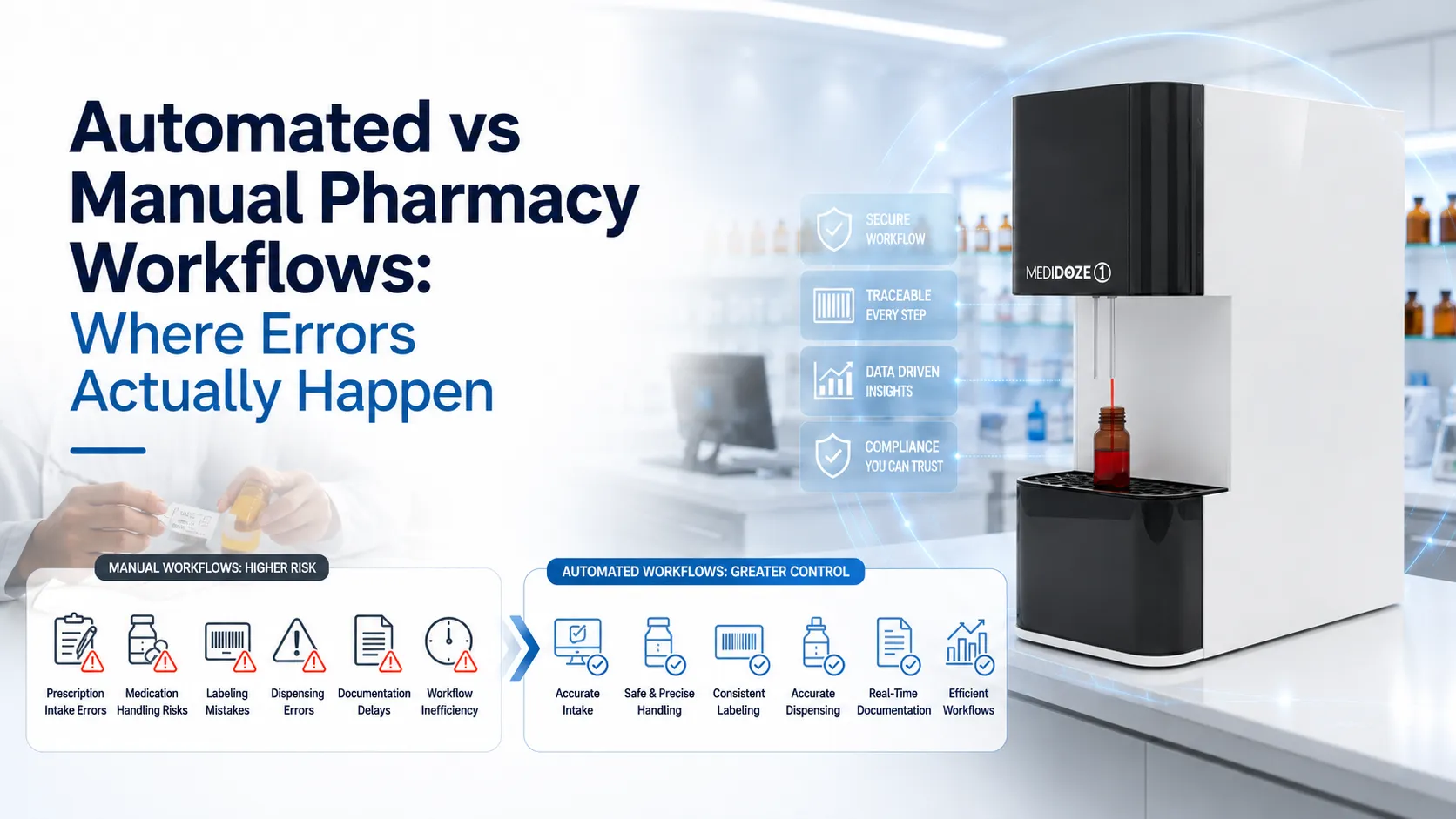
From transcription to transport, many pharmacy workflows still rely on manual handoffs or duplicate steps. When teams are busy, this leads to skipped checks, inconsistent documentation, and inefficiencies that get worse over time. Workarounds then become the norm, making it difficult to pinpoint what's actually broken.
Think about it this way: every time a pharmacy technician physically retrieves, counts, labels, and stages a medication manually, that is several minutes of time that cannot be spent on a patient interaction, a clinical review, or a drug interaction check. Multiply that across hundreds of daily fill orders, and you begin to see why productivity loss is so severe.
Up to 55% of pharmacy staff time is reported to be spent on "infrastructure services," the largest component of which is supply chain activities which includes the buying, making, and supplying of medicines. That figure, drawn from a systematic review on automated in-hospital pharmacy dispensing published in PMC, paints a stark picture of where clinical expertise is actually being spent.
The most common pharmacy workflow problems include managing multiple disconnected systems, which leads to extra logins, constant toggling between platforms, and inefficient handoffs. Teams also frequently struggle with duplicate data entry and manual tracking, relying on spreadsheets and email threads that create extra work and increase the risk of errors.
For hospital and clinic owners, this represents a compounding operational cost: labor hours consumed by low-value tasks, staff retention difficulties, and a ceiling on the clinical services you can actually offer.
The Impact on Nurses and the Broader Care Team
Dispensing inefficiency does not stay contained within pharmacy walls. The consensus of studies indicates that automation reduces the time pharmacists spend on manual tasks, while nurses, on the other hand, spend less time on medication-related tasks when automation is in place, allowing them to devote more time to direct patient care.
In a hospital setting, that downstream effect is significant. Every minute a nurse spends tracking down a delayed medication or resolving a documentation discrepancy is a minute they are not at a patient's bedside.
What the Evidence Says About Automation Solutions
The good news is that the evidence for addressing these problems through automation is both consistent and compelling.
A systematic review and meta-analysis of 23 studies across 10 G20 countries, including Canada, found that automation significantly reduced medication administration time and dispensing-related medication error rates. The statistical significance of those findings (p < 0.00001 for error rates) is not something you often see in healthcare operations research.
Studies show that automation reduces dispensing mistakes by upwards of 85%. Pharmacy automation is no longer a luxury, but a necessity. By implementing automated dispensing, inventory management, compliance tracking, and record synchronization, pharmacies can improve accuracy, efficiency, security, and patient satisfaction. That perspective comes directly from PharmaChoice Canada, advisors to independent Canadian pharmacies.
Automating high-volume, repetitive tasks frees up the remaining staff to focus on care, reduces error rates, and stabilizes daily operations.
For facilities managing opioid-related medications or structured dispensing programs, purpose-built technology becomes especially important. Facilities can learn more about automated dispensing solutions designed specifically for clinical-grade medication management to see how these systems address both safety and workflow requirements in demanding environments.
Barriers to Adoption
Important limitations and barriers to implementation include high upfront costs for equipment, software, and subscription fees; logistical challenges when transitioning to a new system and training personnel; and data security and privacy concerns.
These are real concerns, not excuses. But they need to be weighed against the compounding cost of the status quo: persistent medication errors, staff turnover, and clinical time consumed by tasks that machines can perform more accurately than tired humans.
Automated dispensing systems have been observed to reduce workload and work-related stress by around 21.8% in outpatient pharmacies and decrease drug errors while increasing patient safety by 37% in pharmacies. For hospital administrators calculating return on investment, those figures carry real weight against implementation costs.
The strongest approach is not to automate everything at once, but to identify the specific points in your workflow where repetitive tasks are causing the most harm. By targeting high-volume, low-risk tasks such as batch processing and inventory alerts, automation frees up staff for more critical work. When implemented with training and oversight, automation enhances care rather than replacing staff.
Frequently Asked Questions
Q: How significant is the problem of dispensing errors in Canadian hospitals?
The reported incidence of medication errors in acute hospitals is approximately 6.5 per 100 admissions. While not all of these originate at the dispensing stage, manual workflow inefficiencies at the pharmacy level are consistently cited among the contributing factors, particularly workload and inadequate support staffing.
Q: Does automation actually reduce errors, or does it just shift them?
The evidence strongly supports genuine error reduction. Evidence from systematic reviews indicates that automation substantially mitigates errors in drug administration, encompassing dosage mistakes, and curtails errors in drug dispensing and distribution. Furthermore, it economizes the time healthcare professionals devote to medication management. Errors do not simply migrate; they are structurally removed from the process.
Q: Is pharmacist burnout actually linked to repetitive dispensing tasks?
Yes, the data is clear on this. The ability to work to full scope of practice may be a mitigating factor for burnout in pharmacists. When pharmacists cannot fully focus on their clinical duties, burnout involving high levels of emotional exhaustion and depersonalization, as well as a low sense of personal accomplishment, becomes more likely. Repetitive dispensing tasks are a direct barrier to clinical scope of practice.
Q: What types of automation are most relevant for hospital and clinic pharmacy settings?
The most impactful and widely used technological innovations in pharmacy today are automated dispensing cabinets (ADCs), unit-dose packaging machines, carousel systems, and barcode medication administration (BCMA) scanners. According to the 2023 ASHP National Survey of Pharmacy Practice, most hospitals (86.1%) now use automated dispensing cabinets as the primary method of maintenance dose distribution.
Q: How does improving pharmacy workflow affect nurses?
The benefit flows directly to nursing staff. Automated dispensing cabinets saved 36.1 seconds in controlled medication retrieval time in one study. Another study conducted in North America confirmed a decrease in the average retrieval time from 107 to 48 seconds. These time savings are particularly critical in emergency situations. When nurses spend less time waiting for or tracking down medications, they spend more time on direct patient care.
Conclusion
Repetitive dispensing tasks are not simply a nuisance. They are a structural problem with measurable consequences for patient safety, staff wellbeing, and the financial health of your pharmacy operations. The clinical workforce you employ was trained to make complex therapeutic decisions, not to count tablets.
The solution is not to work harder within a broken workflow. It is to redesign the workflow so that human expertise is applied where it cannot be replaced, and automation handles what it can do better, faster, and with fewer errors.
If you are a physician, hospital administrator, or clinic owner evaluating how to modernize your dispensing operations, start by mapping where your team's time actually goes. The answer will likely confirm what the data already shows. For facilities dispensing controlled substances or specialized medications, reviewing purpose-built tools like those discussed in our related article on automated methadone dispensing machines is a practical next step.
The pharmacists and nurses on your team are too valuable to keep doing what a machine could handle. Give them their time back.





























Sign in to leave a comment.