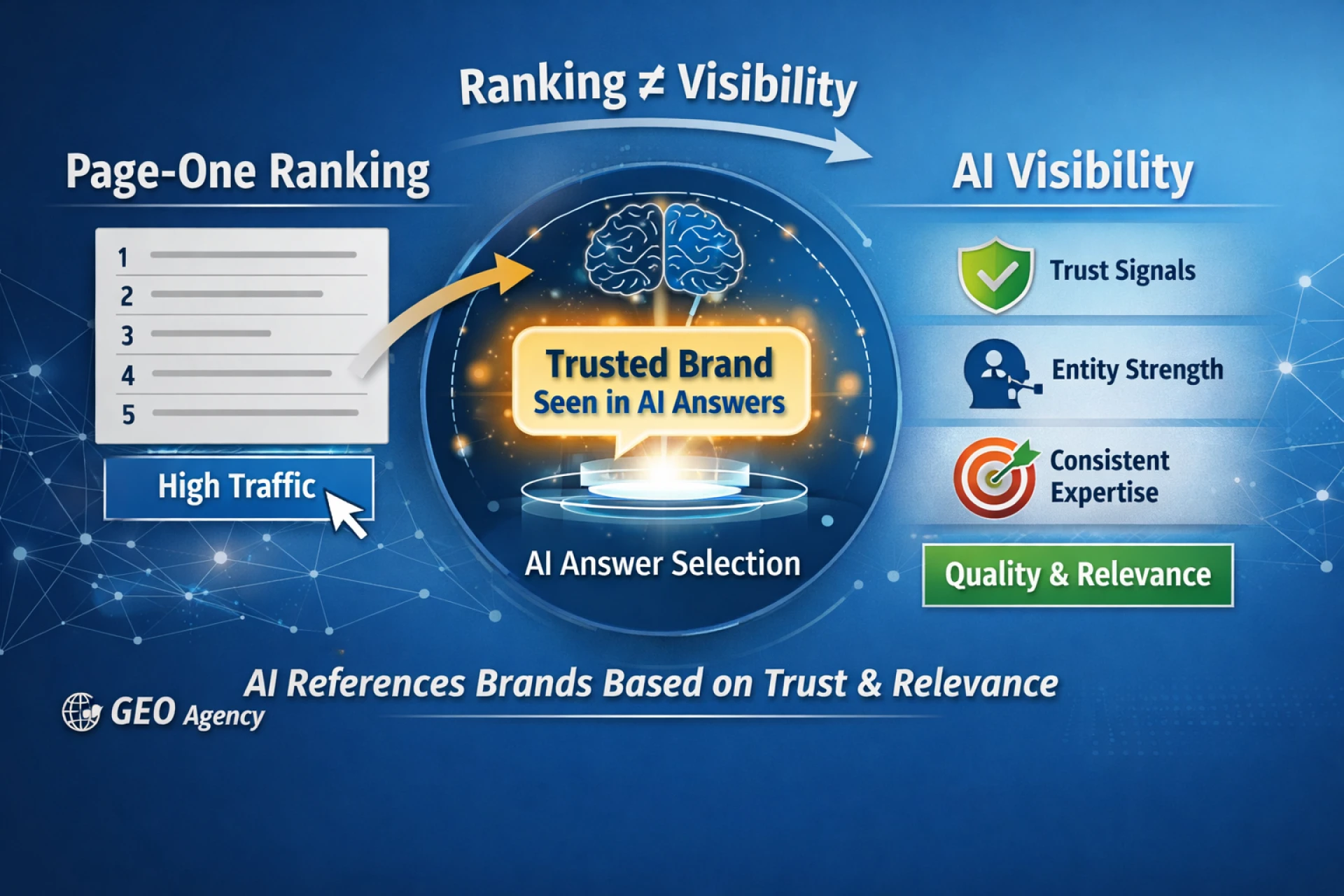

For years, search visibility followed a predictable pattern. If a brand did not rank on page one, it was largely invisible. AI-generated answers have fundamentally changed that dynamic.
Today, brands can appear directly inside AI answers even when they fail to rank for competitive keywords. This is not accidental. It reflects a deeper shift in how visibility is evaluated in the AI answer era.
AI systems do not prioritise rankings alone. They prioritise understanding, confidence, and risk reduction.
This shift explains why traditional SEO metrics alone no longer reflect true visibility. Brands are now judged on how reliably they can be used as a source, not just how well they perform in search results.
For brands working with a geo agency, this shift highlights why Generative Engine Optimisation is no longer optional but foundational for AI-era visibility.
Ranking Pages vs Referencing Brands
Traditional SEO focuses on ranking individual pages. AI systems operate at a different layer. They reference brands, entities, and expertise, not just URLs.
When generating an answer, AI engines pull from previously understood sources rather than real-time search rankings. This means a brand can be referenced even if none of its pages sit on page one.
Example: A cybersecurity consultancy may not rank for broad keywords like “enterprise security solutions.” However, if it has consistently published in-depth breakdowns of threat models, zero-trust frameworks, and compliance standards, AI engines may still reference it when explaining cybersecurity concepts.
In AI systems, recognition often precedes ranking.
This distinction is critical for marketers who still measure success purely through SERP positions. AI visibility operates on accumulated understanding rather than short-term performance.
Entity Strength Matters More Than Keyword Positions
AI visibility depends heavily on entity recognition.
An entity is how AI understands a brand as a distinct and credible concept. This understanding is built through repeated associations across content, mentions, and contextual relevance.
Brands that appear in AI answers usually demonstrate:
- Strong topical focus rather than scattered content
- Repeated association with specific problems or industries
- Clear alignment between brand messaging and subject expertise
Example: A SaaS company specialising in customer retention may not rank for high-volume terms like “customer success software.” However, if its content consistently explains churn metrics, lifecycle frameworks, and retention benchmarks, AI systems begin to associate the brand with the retention strategy itself.
Over time, the brand becomes part of the topic.
Entity strength compounds over time, meaning early consistency can create long-term visibility advantages even without aggressive optimisation.
Consistency Across the Web Signals Authority
AI systems evaluate authority at the brand level, not page by page.
Brands that appear in AI answers tend to show long-term consistency, including:
- Similar messaging across blog content, interviews, and thought leadership
- Alignment between owned content and third-party references
- Depth within a narrow domain rather than surface coverage across many topics
Example: A sustainability consultancy may not dominate search rankings for “green energy solutions.” However, if it is consistently cited in industry reports, quoted in environmental publications, and referenced in policy discussions, AI engines treat it as a reliable sustainability authority.
Consistency reduces uncertainty, and AI systems favour certainty.
From an AI perspective, repetition across credible environments strengthens confidence rather than causing dilution.
AI Filters for Risk Before Relevance
Before AI engines decide whether content is relevant, they evaluate whether it is safe to reference.
Content is often filtered out if it appears:
- Shallow or incomplete
- Overly repetitive or templated
- Promotional without educational depth
- Vague or unsupported by clear reasoning
Even high-ranking pages can be excluded if they do not meet these trust thresholds.
Example: A marketing blog optimised heavily for keywords may rank well but provide generic advice. Meanwhile, a lesser-known consultancy publishing detailed breakdowns of real campaign outcomes may be referenced by AI despite weaker rankings.
From an AI perspective, clarity beats optimisation.
This filtering explains why some high-traffic sites see declining influence despite stable rankings.
Why AI Visibility Can Bypass Page-One Rankings?
AI systems behave more like cautious editors than neutral crawlers. Each reference is treated as a reputational decision.
This explains why AI answers often include brands that:
- Explain concepts clearly rather than chase keywords
- Publish original insights instead of rewritten summaries
- Maintain consistent topical depth over time
AI engines prefer fewer high-confidence sources over many average ones.
This editorial mindset rewards brands that invest in substance rather than scale.
Trust Has Replaced Traffic as the Primary Metric
AI answers are designed to resolve intent, not generate clicks.
Being referenced inside an AI-generated response is a trust signal. It suggests that the brand is considered reliable enough to represent the topic accurately.
Brands that focus on:
- Educating rather than selling
- Explaining rather than ranking
- Demonstrating expertise rather than amplifying volume
are better positioned for AI visibility.
In many cases, trust earned through AI visibility can outweigh traditional traffic-based gains.
What does this mean for Brands?
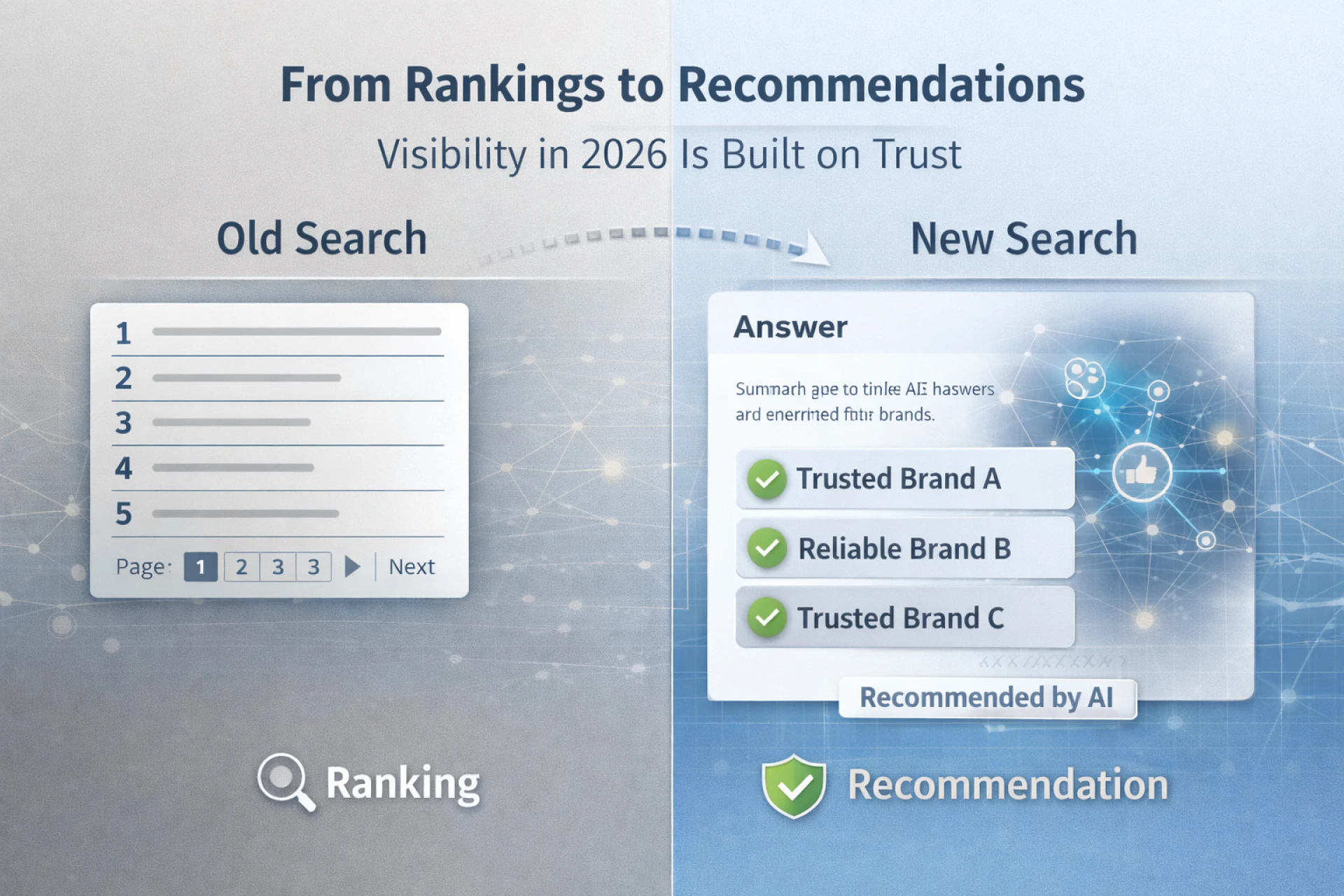
Appearing in AI answers without ranking on page one is no longer an anomaly. It is becoming the norm.
Visibility in the AI era depends less on winning ranking battles and more on becoming a recognised authority within a defined space. Brands that invest in entity strength, topical clarity, and long-term consistency are increasingly rewarded where attention now lives.
In the age of AI answers, credibility earns visibility before rankings ever do.
Conclusion
The rise of AI-generated answers has redefined what it means to be visible online. Rankings still matter, but they are no longer the sole gateway to discovery.
Brands that want sustainable visibility must shift their focus from chasing positions to building trust, authority, and clarity at an entity level. In an ecosystem where AI acts as the gatekeeper, the brands that are understood, consistent, and reliable will continue to surface, regardless of where they rank.
In the AI answer era, being trusted is no longer a by-product of visibility. It is the requirement.

























Sign in to leave a comment.