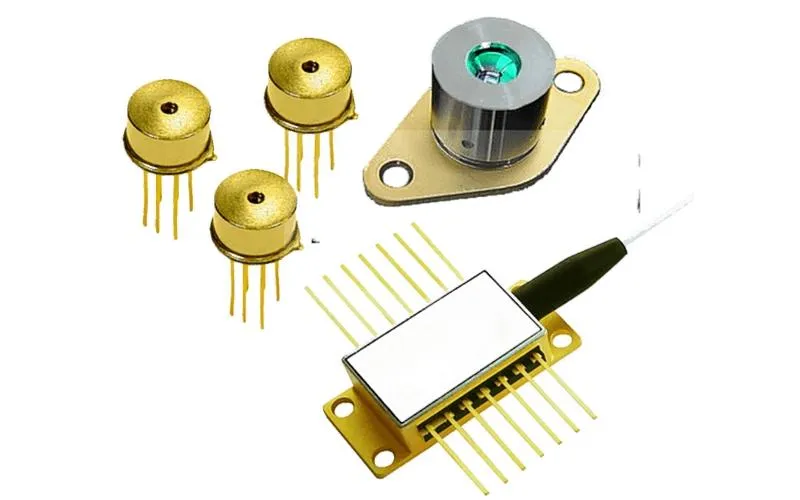

Radio over Fiber is no longer a laboratory curiosity; by 2026 it is the only economical way to move millimeterwave and uppermidband cellular traffic from a remote antenna head to a baseband hotel or satellite modem without drowning in coaxial loss. In 5GAdvanced (5.5G) fronthaul, integrated sensing and communication (ISAC) and VLEO/satellite gateways push RF carriers well past the comfortable sub3 GHz zone where copper is tolerable. Above 3 GHz, coaxial cable becomes lossy, bulky, and EMIprone. NEON’s answer is a DML laser module built on a distributedfeedback directly modulated architecture: the DFB grating pins the cavity to a single longitudinal mode, while current modulation encodes the analog envelope without an external Mach–Zehnder or EML biasing chain.
The HighSpeed DFB DML Laser Series from NEON—NY13D, NY15D, NYCMD and the CW/DWDM variants—shares the same RoF DNA: 7pin hermetic butterfly, SMA RF port, TEC + isolator + monitor PD, −40 to +70 °C case range, 10 mW class output, 30 dB SMSR, and either 12 GHz (Xband) or 18 GHz (Kuband) smallsignal bandwidth. In an antennaremoting link the laser sits at the towertop radio, takes the 0.1–18 GHz RF straight from the frontend, and converts amplitude to optical power by injecting modulation current into the DFB chip. Because the optical carrier is singlemode and the RIN stays under −130 dB/Hz (NY13D/NY15D) or −150 dB/Hz (NYSD), the received photocurrent reconstructs the original envelope with high spuriousfree dynamic range; NEON’s NYC04D blog notes SFDR, not mere OMA, is the analog RoF king metric.
A microwave DFB laser used this way removes the dominant fronthaul bottleneck: cost per remote radio head. EML/MZM transceivers double the BOM and need highvoltage drivers; DML saves SWaPC exactly where 5.5G densification multiplies RRHs by ~5×. For satellite ground station remoting, the same module distributes timing, reference and telemetry carriers over singlemode fiber with nearzero chromatic penalty because the DFB linewidth is narrow and NEON’s enhanced cavity/grating design keeps chirp low enough for long haul analog links.
Deployment is simple: mount the butterfly module on the radio PCB, solder the thermistor/TEC loop to the host APC, drive LD− with bias plus RF, and launch FC/APC pigtail into the fiber. No DSP, no linearizer, no ovencontrolled externals—just a DML laser module translating microwave into light at the antenna and back at the BBU. NEON positions these parts for Cellular/PCS, military T&T, delay lines and reference distribution, which means one qualified optical engine scales from a 1310 nm urban small cell to a 1550 nm SATCOM timing link. For planners weighing capex, power and truckroll risk, directly modulated DFB is the ROI king of RF transport.






















Sign in to leave a comment.