

Nobody warned me about the feeding math.
Before my daughter arrived, I thought breastfeeding was simple — baby cries, you feed, done. What I didn't expect was the questions. Which side did I feed on last? How long did she nurse? Was that 8 feeds in 24 hours or only 6? Is she getting enough milk? Why is she crying again — she just ate 45 minutes ago, didn't she?
I was genuinely losing track. And I wasn't sleeping. And my mother-in-law had opinions. And the pediatrician was asking questions I couldn't answer.
According to the World Health Organization, exclusive breastfeeding for the first 6 months is one of the most effective ways to protect infant health — yet studies show that nearly 60% of mothers in India stop exclusive breastfeeding before 6 months, often due to stress, confusion, and feeling like they can't tell if the baby is feeding enough. That second part is where a Baby feeding tracker App with a nursing timer comes in. Not to add more pressure — but to take some of it away.
Here are 11 actual reasons why using one made a difference for me, and why it might for you too.
First, What Is a Baby Feeding Tracker App with a nursing timer?
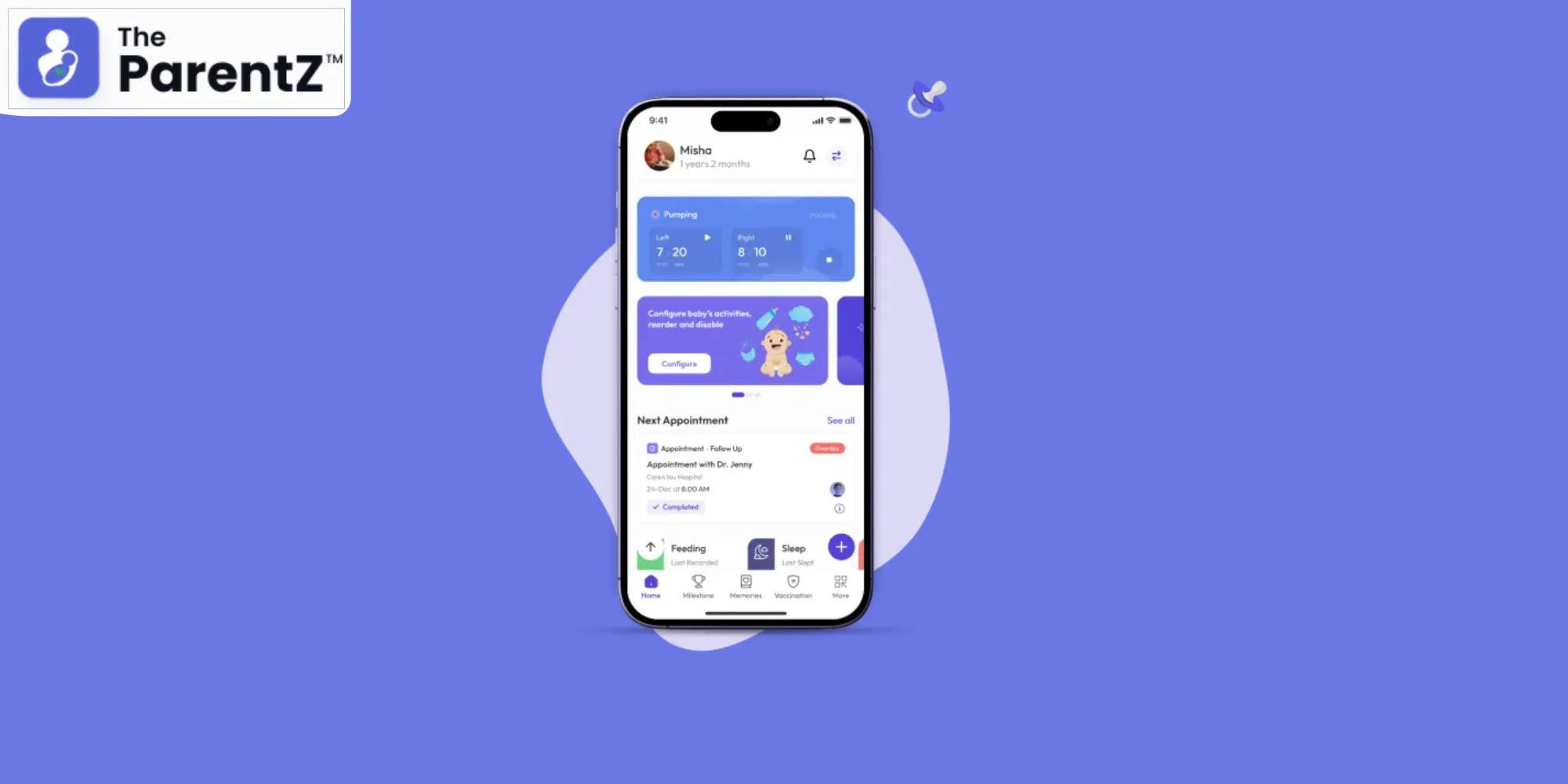
It's an app that does two things together: it tracks when and how long your baby feeds, and it times each nursing session in real time.
You tap "start" when your baby latches. You tap "stop" when the feed is done. The app records the time, duration, and which breast you used. Over days and weeks, it builds a picture of your baby's feeding pattern — how often they feed, how long each session lasts, and whether the pattern is shifting.
That's the core. Good apps add things like formula feed logging, solid food tracking after 6 months, diaper count correlation, and reminders when feeds are overdue. But the timer and log are what make it genuinely useful from day one.
Reason 1: You Stop Guessing Which Side You Fed On Last
This sounds trivial. It is not trivial at 3 AM.
Every lactation consultant in India and everywhere else will tell you: alternate breasts each feed, and start the next session on the side you ended on. This matters for milk supply. If you consistently favor one side, the other produces less.
The problem is that at 3 AM, after a 25-minute nursing session, you will not remember which side you used. You'll think you remember. You'll be wrong about 40% of the time.
The app remembers for you. You open it, and it says "last fed: right breast." Done. No thinking required.
Reason 2: The Nursing Timer Tells You When to Switch Sides
Most new mothers are told to nurse for 10–15 minutes per side before switching. But watching a clock while holding a baby who is actively feeding is harder than it sounds. You're also trying to stay awake.
A nursing timer runs in the background. It can alert you when 10 minutes are up on the first side. You switch, tap the app, and the timer resets. You don't have to watch the clock at all.
Small thing. Genuinely changes the experience.
Reason 3: You Can Actually Answer Your Pediatrician's Questions
Every pediatric checkup in India involves the same questions: How many times is your baby fed in 24 hours? How long are the sessions? Has the frequency changed this week?
Most parents answer from memory and guess badly. I used to say "6 or 7 times, I think" when the actual answer on my app was "9 times yesterday, 7 the day before."
When you have real data, you answer with confidence. More importantly, your doctor can actually assess your baby's intake — and if something's off, they can catch it earlier.
Reason 4: It Tells You When the Next Feed Is Due
Newborns in India are often fed on demand, which is right. But "on demand" doesn't mean feeding every 45 minutes isn't a sign of something worth noticing. And it doesn't mean 4-hour gaps at 2 weeks old are normal either.
The app shows you how long it's been since the last feed. If you're trying to watch the clock between feeds — maybe because your baby is jaundiced and the pediatrician said "not more than 3 hours between feeds" — this is invaluable. You're not staring at your watch. The app handles it.
Reason 5: You Can Tell If Your Baby Is Getting Enough Milk
This is the anxiety that drives most new mothers in India to supplement with formula earlier than needed — the fear that they don't have enough milk and the baby is underfed.
Here's how a feeding tracker helps: the most reliable non-medical indicators of adequate milk intake are feed frequency (8–12 times in 24 hours for newborns) and wet diaper count (6+ wet diapers per day after day 4).
When you log feeds and diapers together, you have actual data. Not a feeling. Not a guess. Your tracker can show your pediatrician a week's worth of feed counts and diaper counts, and they can make an informed call about whether supplementation is actually needed.
Many mothers I know started formula because they felt unsure. Some of them didn't need to. Data doesn't replace your doctor's judgment — but it gives your doctor something to work with.
Reason 6: You Notice Feeding Patterns You'd Otherwise Miss
After two weeks of logging, patterns show up.
My daughter is fed more frequently in the evening — cluster feeding between 5 PM and 9 PM almost every day. Once I could see that pattern on the app, I stopped panicking during those hours. I knew what was happening. I prepared for it. I ate something and drank water before 5 PM, so I was ready.
You can also notice when a pattern changes. If your baby goes from 9 feeds a day to 6 feeds a day over a few days and you don't notice it, that's a potential concern that could go unreported. The app makes the change visible.
Reason 7: It Reduces Arguments With Family Members
I say this without judgment, because this is real life in India.
When your mother or mother-in-law says, "You just fed her, why is she crying again?" — you can show them the log. Last feed was 2.5 hours ago. Baby is due. This is normal. Conversation over.
When your spouse asks, "Did she eat today?" you don't have to think. You show the feed history. It's not about being right. It's about having a shared, objective record that everyone can see.
Reason 8: It Logs Formula and Mixed Feeds Without Judgment
Not everyone exclusively breastfeeds. Not everyone can. And frankly, the pressure on Indian mothers around this is already more than enough.
A good feeding tracker logs formula feeds too — volume, time, which formula, anything you want to note. If you're doing mixed feeding (breast and formula), the app tracks both in the same timeline, so you have a complete picture.
No app should make you feel guilty for how you feed your baby. The point is accurate tracking, whatever your feeding method is.
Reason 9: It Helps You Track Solid Food Introduction After 6 Months
India has some of the richest traditions around introducing solids — dal ka paani, rice water, mashed banana, soft khichdi. When you start introducing foods around 6 months (as recommended), you want to track what was given, when, and whether there was any reaction.
The better apps extend their tracking into solid food logs. You note what food was introduced, in what quantity, and you can add a note if there was any rash, digestive upset, or refusal. This is useful for spotting early food sensitivities and for knowing what's been safely introduced when your pediatrician asks.
Reason 10: Night Feeds Get Logged Without You Fully Waking Up
This one sounds small, but it's actually one of the most useful things about a dedicated app versus writing in a notebook.
At 2 AM, you're not fully awake. You don't want to be. But you can tap two buttons on your phone without turning on a light — start and stop on the timer. The log updates automatically. By morning, every night's feed is recorded without you having any conscious memory of doing it.
Try that with a notebook.
Reason 11: The Data Becomes a Health Record Over Time
After six months of logging, you have something genuinely valuable: a detailed feeding history that shows your baby's growth from purely milk-based to mixed feeds to solids. You can see when the feeds are spaced out. You can see when sleep improved (or didn't). You can see what was introduced when.
This is a medical record, essentially. A pediatrician looking at six months of feeding data has far more context than one who's relying on your memory of the past week.
What Works and What Usually Fails With Feeding Tracker Apps
What works:
Logging immediately. The moment the feed ends, tap done. This takes four seconds and keeps your record accurate. If you wait until later, you'll forget the duration or mix up the side.
The nursing timer itself. Having a running timer on your phone screen during a feed — especially at night — removes the mental load of watching a clock entirely.
What usually fails:
Logging formula volumes. Most mothers log breastfeeds consistently but stop noting formula volumes after a week because it feels like extra work. The fix is to keep it simple — just the volume, nothing else.
Overthinking the data. I've seen mothers stress because their baby fed for 8 minutes instead of the "recommended" 10. Ranges are ranges. The overall pattern matters more than any individual feed. The app is there to show you the pattern, not to grade you on each session.
My honest take: The mothers who get the most out of these apps are the ones who use them consistently for the first 3 months and then scale back. By month 4, you know your baby's patterns well enough that you don't need to log every single feed. But those first 12 weeks of data are worth everything.
App vs. No App: The Honest Comparison
| What You're Tracking | Memory Only | Notebook | Notes App | Baby Feeding Tracker App |
|---|---|---|---|---|
| Which breast last | ❌ Forget by morning | ⚠️ If you write it | ❌ Too slow | ✅ Auto-logged |
| Feed duration | ❌ Usually wrong | ⚠️ Need to time separately | ❌ Manual | ✅ Timer built in |
| Feeds per 24 hours | ❌ Guesswork | ⚠️ Count manually | ⚠️ Count manually | ✅ Auto-calculated |
| Pattern over weeks | ❌ Impossible | ❌ Very hard to see | ❌ No visual | ✅ Graph view |
| Shareable with the doctor | ❌ No | ❌ Can't share easily | ⚠️ Screenshot | ✅ Export/share |
| Works at 3 AM | ❌ Nothing works | ❌ Needs a light | ⚠️ Maybe | ✅ Two taps |
A Quick Setup Guide for New Parents
If you're just getting started, here's what to do:
Week 1: Just use the timer and basic feed log. Don't worry about anything else. Build the habit of tapping start and stop.
Week 2: Add diaper logging. This gives you the second half of the "is my baby getting enough?" picture.
Month 2: Start looking at the weekly patterns. Is feed duration increasing? Are the gaps between feeds getting slightly longer? These are signs of development.
Month 6: Extend to solid food tracking when you start introducing foods. Use the notes field to record any reactions.
Frequently Asked Questions
How many feeds should a newborn have in 24 hours?
The WHO and AAP both recommend 8–12 feeds in 24 hours for newborns in the first few weeks. This gradually decreases as the baby grows and takes more milk per feed. A feeding tracker helps you stay in that range without counting feeds in your head all day.
Can I use the app for formula feeding only?
Absolutely. Formula feed logs work the same way — time, volume, and any notes. The app doesn't assume you're breastfeeding.
Is it normal for feed durations to vary a lot?
Yes. A sleepy newborn might nurse for 5 minutes and seem satisfied. An active 3-month-old might nurse for 20 minutes and still seem unsatisfied. Duration matters less than frequency and wet diaper count. Track all three for the full picture.
My baby feeds constantly during the evening. Is that a problem?
This is cluster feeding, and it's completely normal — especially between 4 PM and 10 PM in the early weeks. Your tracker will show you the pattern clearly. When you can see it's predictable, it's much easier to accept.
Does The Parentz app work for both breastfeeding and formula?
Yes. The Parentz feeding tracker logs both, with separate entry types, so the data stays organized. Visit theparentz.ai for current features.
When can I stop logging feeds?
Whenever you feel confident in your baby's patterns, usually around 3–4 months for most parents. Some continue through 6 months to help with solid food introduction. There's no rule. Use it as long as it helps.
Final Thoughts: It's Not About Being Perfect
A feeding tracker isn't about doing parenting "right." There's no award for having the most detailed feeding log. The point is simpler than that.
New parenthood in India involves a lot of people with a lot of opinions. Your mother says feed more. Your mother-in-law says the baby looks thin. Your neighbor says the formula is better. Your pediatrician says something different from all of them.
In the middle of all that noise, actual data about your baby's actual feeds is the one thing that cuts through it cleanly. You're not guessing. You're not going on feeling. You know what's happening because you recorded it.
The Parentz builds that record for you, one feed at a time. And when you're running on broken sleep and too much advice, having one clear, honest answer — "she fed 9 times yesterday, 40 minutes total, all wet diapers accounted for" — is more calming than anything else.
Key Takeaways
- Newborns need 8–12 feeds per 24 hours — tracking this manually almost always leads to undercounting or overcounting
- A nursing timer removes the need to watch the clock during night feeds — two taps is all it takes
- Feed data plus diaper count is the most reliable non-medical way to assess whether your baby is getting enough milk
- The most common failure: logging breastfeeds accurately but skipping formula volumes. Keep formula entries simple to stay consistent
- The first 3 months of feed data are the most medically valuable — stick with it through that window
- The Parentz tracks breastfeeds, formula feeds, and solid food introduction in one profile — no switching between apps
- Feeding patterns become visible over days and weeks. Seeing the pattern ends most 3 AM anxiety spirals
























Sign in to leave a comment.