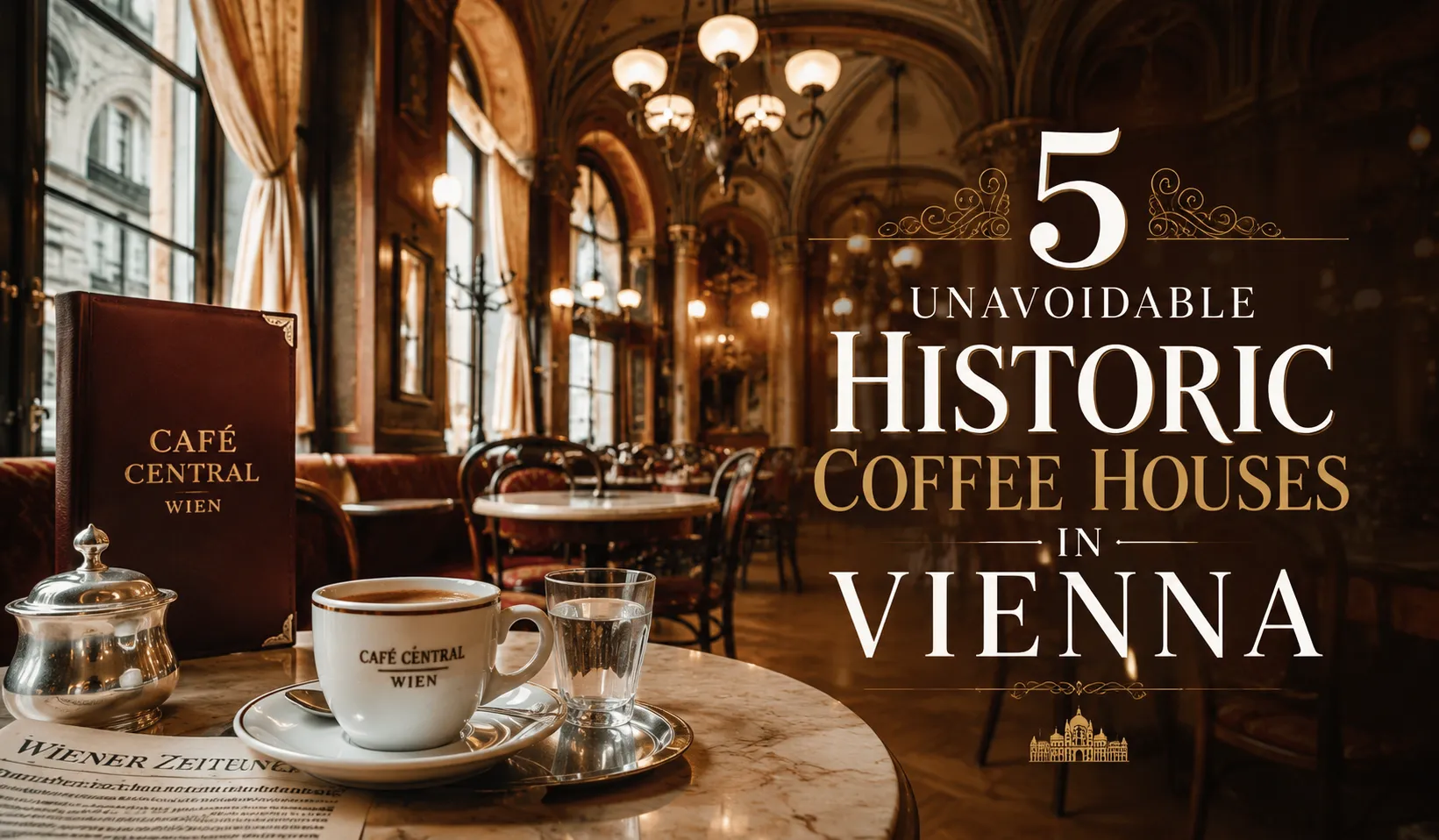

Vienna is home to roughly 1,700 licensed coffeehouses today, but only a handful earn the word unavoidable: the addresses where the city’s coffeehouse culture was actually written, not just served.
Freud thought through his earliest ideas at one. Trotsky played chess at another while plotting a revolution back home. A third still bakes its founder’s original pastry recipe every evening, unchanged since the 1930s.
Visit any of these five, and you’re sitting inside a century and a half of Viennese daily life.
Why Do Vienna's Coffee Houses Carry UNESCO Recognition?
In 2011, Vienna's long-standing culture of café (coffeehouse) was inscribed on the UNESCO List of Intangible Cultural Heritages of Humanity under the Austrian national register protecting the rituals of Viennese coffeehouses.
That’s why a visit here feels different from a coffee shop anywhere else. You’re not just having a coffee; you’re taking part in a practice Austria has formally chosen to protect.
What Actually Makes a Viennese Coffeehouse Different?
The real Vienna coffeehouse is beyond coffee culture; it’s about the marble-topped table, a glass of water on each table, a rack of international newspapers, and a waiter who'll never send you off too fast.
Order one Melange and the table is effectively yours for the afternoon. That unhurried pace makes Viennese coffee culture different from the world.
The 5 Must-Visit Historic Coffee Houses
#1: Cafe Central (Est. 1876)
Housed inside the Palais Ferstel, a former stock exchange designed by Ringstrasse architect Heinrich von Ferstel, Central earned its “Chess School” nickname from regulars who played for hours beneath its vaulted arcades.
Leon Trotsky was among them, years before leading a revolution back home. A special highlight, too, was the presence of Freud and of writer Peter Altenberg; a life-size Altenberg figure still greets guests at the door.
After the Second World War, Central was closed again but re-opened in 1975. Make a reservation for the Apfelstrudel, and get in line for the longest coffee house line in Vienna.
(After 150 years, Cafe Central is currently undergoing a renovation & is temporarily out of service.)
#2: Cafe Landtmann (Est. 1873)
In 1873, Franz Landtmann opened his café where all the neighboring buildings were still being constructed, such as the Burgtheater, the Rathaus (City Hall), and the University of Vienna.
It turned out to be a good move; this Ringstrasse was one of the most elegant, and before the days of Marlene Dietrich, Freud, and composer Gustav Mahler were regulars there.
Landtmann's interior has been converted to keep its original form in a 1929 renovation. Seated beside the Burgtheater and the Rathaus, it still functions almost as a politician's canteen.
#3: Cafe Hawelka (The Bohemian Living Room) (Est. 1939)
In 1939, when the city was facing a post-war avant-garde, Leopold and Josefine Hawelka purchased a small café in the Dorotheergasse. During the hardships of wartime, they transformed it into the unofficial meeting place of Vienna's postwar movement, including Joseph Friederici, a young painter, and poet Friedensreich Hundertwasser.
The cafe is open, as the old-fashioned Buchteln (plum-jam buns, yeast buns baked from fresh and only available in the evening) are still being made on Josefine's own recipe. Little else has changed: the same worn benches, the same layered exhibition posters, the same first-come seating the Hawelkas always kept.
The family's third generation runs it today.
#4: Cafe Sperl (Est. 1880)
Sperl opened in 1880 as Cafe Ronacher before the Sperl family took it over within the year.
Its Art Nouveau interior, Thonet chairs, crystal chandeliers, and parquet floors are reportedly
Vienna's only never-modernized coffeehouse interior. Its billiard tables are from that time as well, and today, it is still a house where one can play billiards; its address is still close to the Naschmarkt, the hem of the theatre district that formed the Vienna Secession generation and not made touristy by that.
Mid afternoon, complete your day with Sunday piano accompanied by the Sperl Torte chocolate-almond cake.
#5: Cafe Schwarzenberg (The Ringstrasse's Oldest Survivor) Est. 1861
Schwarzenberg, which was opened in 1861 by the Hochleitner family, was the oldest surviving Ringstrasse coffeehouse, and only adopted its current name in 1902.
Never attracting writers and revolutionaries, it was the architect Josef Hoffmann’s regular, who is reputed to have sketched designs for Wiener Werkstätte at its tables.
It was rebuilt following the damage during the war and was renovated in 1979, and is still the largest of the 5 and the least noisy, designed to be used for lazy conversations & discussion, not show.
Suggested Walking Route & Nearby Landmarks
A single morning can connect all five without rushing.
Start at Landtmann beside the Burgtheater, walk the Ringstrasse to Schwarzenberg, then cut into the Innere Stadt for Central and Hawelka, minutes apart near Herrengasse and Dorotheergasse. Finish across town at Sperl in the sixth district for a slower, local close.
If a guide is familiar with these routes (as most Libra Tours vintage-carriage guides are), these hikes can be naturally integrated into a broader morning tour of the historic centre – as Libra Tours’ vans hike these stops.
Frequently Asked Questions (FAQs)
Q: What are the most historic coffee houses in Vienna?
A: Below is the list of the most authentic & historic coffeehouses in Vienna:
- Cafe Central
- Cafe Landtmann
- Cafe Hawelka
- Cafe Sperl
- Cafe Schwarzenberg
Each of these coffee houses dates back to the 19th or early 20th century and is protected under Austria's UNESCO-recognized coffeehouse culture.
Q: Do I need a reservation for Vienna's historic coffee houses?
A: Rarely. Reservations are only important at Cafe Central at midday when the crowds are at their thickest, and all the other four stores operate first-come, first-served. The rule to avoid a wait is to arrive at the cafés within half an hour of them opening, particularly at Central, where the coffeehouse queue is always Vienna's longest.
Q: What should I order at a Viennese coffee house?
A: Enjoy a melange, Vienna's classic milk and foam, or a Viennese einspänner if you prefer a strong black coffee and whipped cream. Complimentary with Apfelstrudel served virtually everywhere, Buchteln served at Café Hawelka, or the house Sperl Torte served at Café Sperl – all are signature pastry items at the cafés.
Q: Which Vienna coffee house feels the least touristy?
A: Most local customers in the residential sixth district near the Naschmarkt, "Cafe Sperl". It's just as much a neighborhood institution thanks to its interior, which remains largely unchanged from an old-time Art Nouveau mansion, rather than Central's profound history. History is as deep as Central's, but its interior retains a good deal of its heritage, remaining mostly unchanged from an old-time Art Nouveau mansion.
Q: How much do coffee and cake cost at Vienna's historic cafes?
A: There are five coffee shops, and customers should expect to pay about €5-9 for coffee and €5-8 for cake in each, plus a tip of 5-10 per cent personally to the waiter. No hanging around fee: you only pay for what you order.




















Sign in to leave a comment.