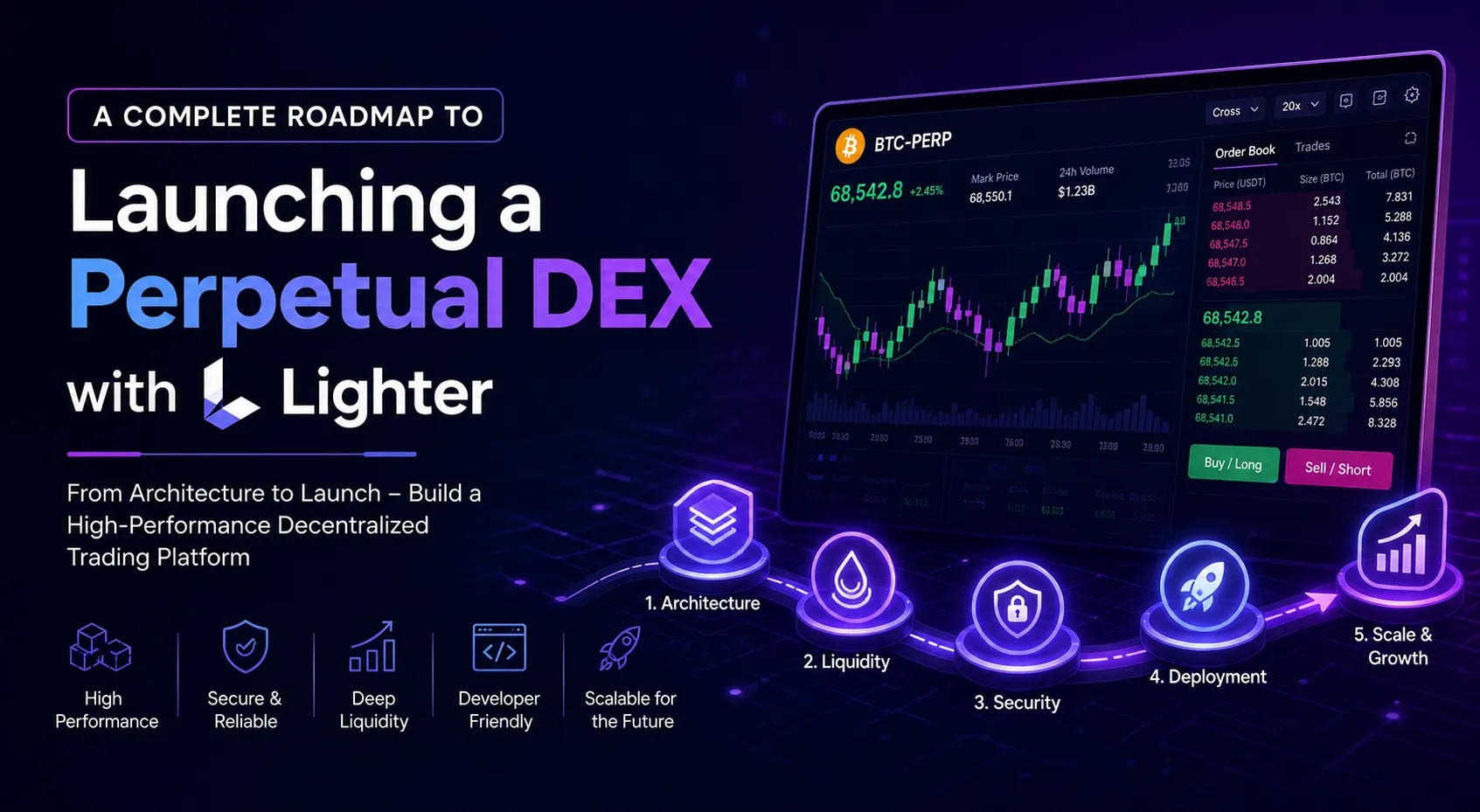

Launching a decentralized derivatives platform requires far more than deploying smart contracts and adding liquidity pools. It involves careful architectural decisions, robust risk management, deep liquidity design, and a clear understanding of trader expectations. A perpetual decentralized exchange (DEX) offers traders the ability to speculate on asset prices without expiry dates, making it a powerful financial primitive within decentralized finance. This blog presents a structured roadmap for building a high-performance perpetual DEX using Lighter, focusing on practical execution, scalability, and trust. Each stage explores the technical, operational, and strategic considerations required for sustainable Perpetual DEX Exchange Development, helping teams move from concept to a fully functional trading ecosystem.
Understanding the Core of Perpetual DEX Architecture
A strong architectural foundation determines how efficiently a perpetual DEX operates under real market conditions. This stage defines how trades are executed, how pricing remains accurate, and how risks are controlled. Without a well-structured core, performance bottlenecks and vulnerabilities can emerge quickly. In Perpetual DEX Exchange Development, this phase requires aligning smart contract logic, data feeds, and execution systems to create a seamless trading environment that balances decentralization with speed, ensuring reliability across varying market conditions.
- Perpetual Contracts and Pricing Mechanics
Perpetual contracts rely on funding rates to maintain price parity with the underlying asset. These periodic payments between long and short traders keep the market balanced without expiry dates. Implementing accurate pricing requires integrating reliable oracles and designing safeguards against manipulation. - On-Chain vs Off-Chain Components
A performant perpetual DEX often combines on-chain settlement with off-chain order matching. This hybrid approach reduces latency while preserving transparency. Deciding what remains on-chain versus off-chain directly impacts speed, cost, and user experience. - Liquidity Models and Market Depth
Liquidity can be sourced through automated market makers, order books, or hybrid systems. Each model has trade-offs in capital efficiency and slippage. For effective Perpetual DEX Exchange Development, aligning liquidity design with target users is essential. - Risk Engine and Liquidation Logic
A robust risk engine monitors positions and enforces margin requirements. Liquidation systems must act quickly to prevent bad debt while ensuring fairness. Designing this system requires careful calibration of collateral ratios and penalty structures.
Why Choose Lighter for Perpetual DEX Development
Selecting the right infrastructure provider significantly influences development speed and platform performance. Lighter offers a purpose-built environment tailored for high-frequency trading and derivatives markets. Its architecture simplifies complex backend requirements while maintaining flexibility for customization. For teams focused on Perpetual DEX Exchange Development, leveraging Lighter reduces the burden of building critical components from scratch, allowing more focus on innovation, optimization, and user-centric features that differentiate the platform in a competitive ecosystem.
- High-Performance Matching Engine
Lighter offers an efficient matching engine capable of handling high-frequency trading activity. This ensures minimal latency and competitive execution speeds, which are critical for derivatives trading environments. - Modular Infrastructure Design
Developers can customize components such as order routing, margin systems, and liquidity integrations. This modularity allows teams to tailor the platform to specific trading strategies and market segments. - Scalability and Cost Efficiency
Lighter’s architecture is optimized to reduce transaction costs while maintaining throughput. This makes it suitable for scaling user bases without compromising performance, a key factor in long-term Perpetual DEX Exchange Development. - Developer-Friendly Tooling
Comprehensive APIs and SDKs streamline integration and testing. This reduces development time and enables faster iteration cycles, allowing teams to focus on innovation rather than infrastructure challenges.
Designing the Trading Experience
User experience determines whether traders adopt and remain active on a platform. A perpetual DEX must deliver clarity, speed, and reliability while handling complex trading functions. Poor interface design or delayed execution can discourage even experienced users. In the context of Perpetual DEX Exchange Development, designing the trading experience involves balancing advanced functionality with intuitive navigation, ensuring that both new and professional traders can interact with the platform confidently and efficiently.
- Advanced Charting and Analytics
Providing detailed charts, indicators, and historical data enhances decision-making. Integrating analytics tools allows traders to evaluate market trends and refine strategies directly within the platform. - Order Types and Execution Flexibility
Supporting multiple order types such as limit, market, stop-loss, and take-profit increases usability. Flexibility in execution ensures traders can manage risk effectively under varying market conditions. - Responsive and Accessible Interface
A clean, responsive design ensures accessibility across devices. Reducing friction in navigation and execution encourages user retention and improves overall engagement. - Real-Time Data Synchronization
Accurate and instant updates on prices, funding rates, and positions are essential. Delays or inconsistencies can lead to poor trading decisions and loss of trust.
Building Liquidity and Market Participation
Liquidity is the backbone of any trading platform, directly influencing execution quality and user satisfaction. Without sufficient liquidity, traders face high slippage and limited opportunities. Establishing strong market participation requires both technical integration and strategic incentives. In Perpetual DEX Exchange Development, this stage focuses on attracting liquidity providers, maintaining order book depth, and creating an ecosystem where trading activity remains consistent and sustainable over time.
- Incentivizing Market Makers
Offering rewards such as reduced fees or token incentives encourages liquidity providers to participate. Structured incentive programs help maintain consistent order book depth. - Integrating External Liquidity Sources
Connecting with other platforms or aggregators enhances liquidity availability. This reduces slippage and improves execution quality for traders. - Dynamic Fee Structures
Adjusting fees based on trading volume or liquidity contribution creates a balanced ecosystem. Traders and market makers both benefit from fair and transparent pricing models. - Community Engagement and Growth
Building a strong community fosters organic liquidity growth. Educational content and active communication channels encourage participation and trust.
Risk Management and Security Considerations
Risk management ensures the long-term stability of a perpetual DEX, especially in volatile market conditions. Security failures or poorly designed liquidation systems can lead to significant losses and reputational damage. This phase of Perpetual DEX Exchange Development focuses on building resilient systems that protect both the platform and its users. It involves implementing strict safeguards, continuous monitoring, and proactive measures to address potential vulnerabilities before they escalate into critical issues.
- Smart Contract Audits and Testing
Comprehensive audits identify vulnerabilities before deployment. Continuous testing ensures contracts remain secure as updates are introduced. - Insurance Funds and Backstop Mechanisms
Establishing an insurance fund protects against unexpected losses during extreme market conditions. This adds a layer of confidence for traders. - Monitoring and Alert Systems
Real-time monitoring detects unusual activity or system anomalies. Automated alerts enable quick responses to potential threats. - User Asset Protection
Implementing secure wallet integrations and multi-signature mechanisms safeguards user funds. Transparency in asset management builds long-term trust.
Regulatory Awareness and Compliance Strategy
Even decentralized platforms must consider regulatory frameworks to operate sustainably. While blockchain technology offers flexibility, ignoring compliance can create long-term risks. This stage of Perpetual DEX Exchange Development involves understanding legal environments, adapting governance structures, and ensuring transparency. A well-defined compliance strategy not only reduces risk but also enhances credibility, making the platform more attractive to institutional and retail participants alike.
- Understanding Jurisdictional Requirements
Different regions have varying regulations for derivatives trading. Identifying applicable laws helps avoid legal complications. - KYC and Privacy Balance
Some platforms integrate optional identity verification to meet compliance needs. Balancing privacy with regulatory expectations is a strategic decision. - Transparent Governance Models
Decentralized governance structures provide clarity in decision-making. Token-based voting systems allow community participation while maintaining accountability. - Documentation and Reporting Standards
Maintaining clear records of operations and updates ensures transparency. This supports both regulatory compliance and user confidence.
Deployment, Testing, and Launch Strategy
Transitioning from development to a live environment requires careful planning and execution. A poorly managed launch can expose vulnerabilities and impact user trust. In Perpetual DEX Exchange Development, this phase focuses on validating system performance, identifying issues, and ensuring readiness for real-world usage. A structured rollout strategy minimizes risks while allowing teams to refine the platform based on user feedback and operational insights.
- Testnet Deployment and Feedback Collection
Launching on a testnet allows users to interact with the platform in a controlled environment. Feedback gathered during this phase informs improvements. - Bug Bounty Programs
Encouraging external developers to identify vulnerabilities strengthens security. Incentivized programs expand testing coverage beyond internal teams. - Gradual Rollout and Feature Release
Introducing features incrementally reduces the impact of potential issues. This approach allows for continuous optimization based on user behavior. - Marketing and Awareness Campaigns
Strategic marketing efforts attract early adopters and build momentum. Clear messaging about features and benefits drives engagement.
Scaling and Continuous Improvement
After launch, maintaining growth and performance becomes the primary focus. A perpetual DEX must evolve with market demands and technological advancements to remain competitive. This stage of Perpetual DEX Exchange Development emphasizes optimization, expansion, and innovation. Continuous improvement ensures that the platform adapts to user needs, enhances functionality, and sustains long-term engagement in an increasingly dynamic trading environment.
- Performance Optimization and Upgrades
Regular updates improve speed, reduce costs, and enhance reliability. Monitoring system performance helps identify areas for refinement. - Expanding Asset Offerings
Adding new trading pairs increases user interest and trading volume. Careful selection ensures relevance and demand. - Cross-Chain Integration
Supporting multiple blockchains broadens accessibility. Interoperability enhances liquidity and user reach. - Data-Driven Decision Making
Analyzing user behavior and trading patterns informs strategic improvements. Data insights guide feature development and optimization.
Conclusion
Launching a perpetual DEX requires a comprehensive approach that blends advanced technology, strong liquidity frameworks, user-focused design, and rigorous security practices. Each stage of development plays a critical role in ensuring the platform operates efficiently while maintaining trust and scalability in a competitive market. By following a structured roadmap, businesses can confidently navigate the complexities of building a high-performance trading ecosystem. For organizations seeking expert guidance, Blockchain App Factory provides Perpetual DEX Exchange Development, delivering tailored solutions that support innovation, reliability, and long-term growth in the decentralized finance space.



















Sign in to leave a comment.