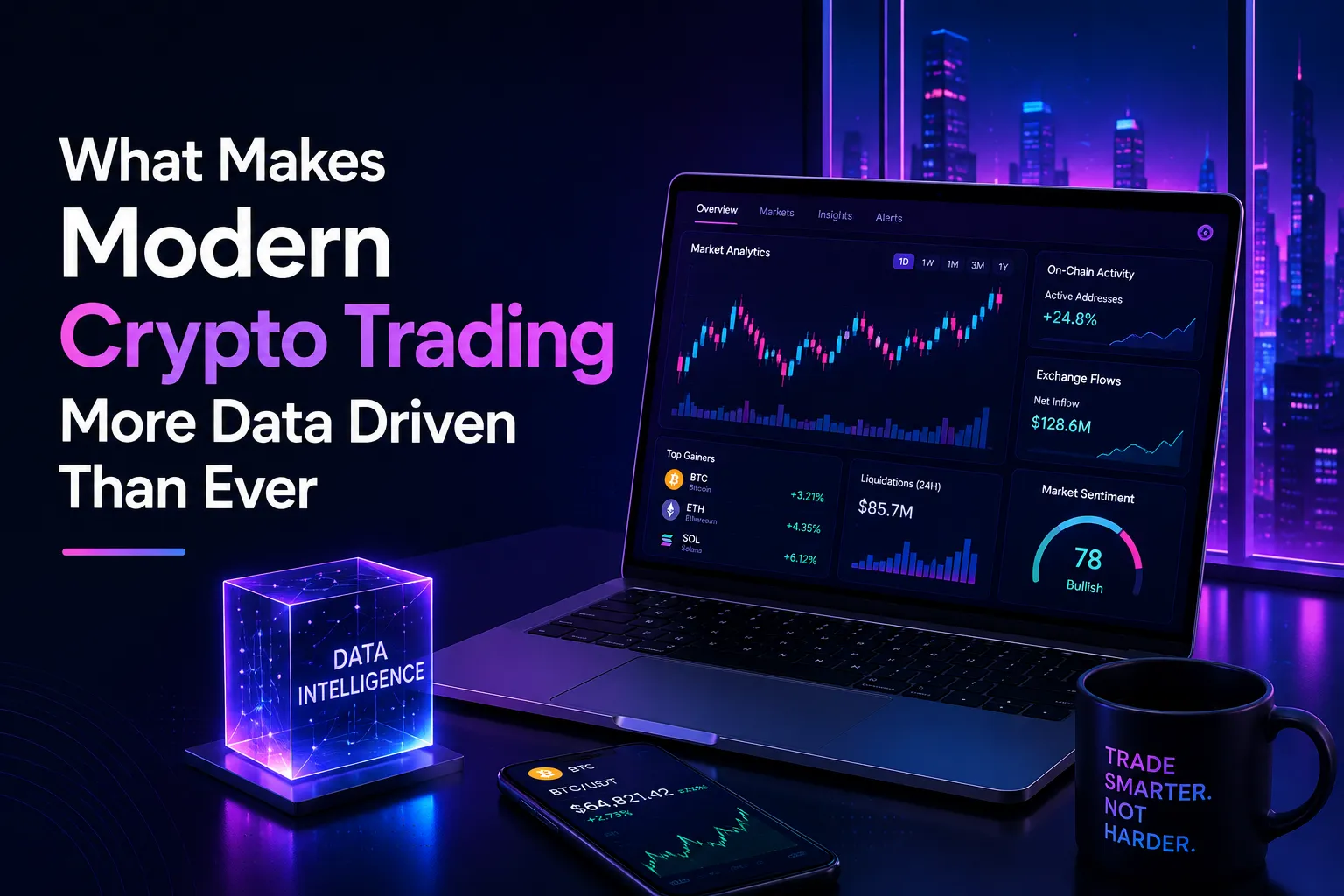

Not long ago, crypto traders could spend a few hours studying charts, reading the latest news, and making trading decisions based on technical indicators alone. While that approach worked in the early days of cryptocurrency, today's market operates on a completely different scale.
Every second, millions of dollars move across exchanges, thousands of blockchain transactions are recorded, and new information spreads across social media, news platforms, and trading communities. The sheer volume of market data has transformed the way traders analyze opportunities.
Modern crypto trading is no longer driven by instinct alone. It's driven by data.
From AI-powered crypto trading to crypto exchange analytics and real-time market intelligence, traders now have access to tools that help them understand market behavior in ways that weren't possible just a few years ago.
The Crypto Market Produces More Data Than Ever
Every trade, wallet transaction, and market event creates valuable information.
On any given day, the crypto market generates data from:
- Spot and futures exchanges
- Blockchain transactions
- Order books
- Trading volume
- Whale wallet movements
- Exchange inflows and outflows
- Funding rates
- Open interest
- News events
- Social media discussions
Each source tells part of the market's story.
The challenge isn't finding information it's understanding which information matters and how different data points connect.
Why Technical Analysis Alone Is No Longer Enough
Technical indicators remain an important part of cryptocurrency trading, but they focus primarily on historical price action.
Indicators such as RSI, MACD, Bollinger Bands, and moving averages help identify trends, but they don't explain what is causing those trends.
For example, a sudden breakout might be driven by:
- Institutional buying
- A surge in whale accumulation
- ETF-related developments
- Increased exchange liquidity
- Positive macroeconomic news
A chart confirms the movement, but additional market data explains why it happened.
This is why modern traders combine technical analysis with broader market intelligence.
AI Powered Crypto Trading Is Changing How Traders Analyze Markets
One of the biggest developments in recent years has been the rise of AI-powered crypto trading.
Artificial intelligence can process enormous volumes of information far faster than any individual trader.
Instead of monitoring dozens of charts manually, AI can analyze:
- Historical price patterns
- Real-time exchange activity
- On-chain analytics
- Liquidity changes
- Market sentiment
- News events
- Derivatives data
- Trading behavior across multiple markets
Rather than replacing traders, AI helps identify meaningful insights while filtering out unnecessary market noise.
This allows traders to focus on strategy instead of data collection.
Crypto Exchange Analytics Reveal What Charts Can't
Every cryptocurrency trade takes place on an exchange, making exchange data one of the most valuable sources of market intelligence.
Crypto exchange analytics provide deeper insight into market activity by monitoring:
- Buy and sell pressure
- Order book depth
- Liquidity distribution
- Exchange inflows and withdrawals
- Large transactions
- Volume spikes
- Market participation
These metrics often reveal changes in market conditions before they become obvious on traditional price charts.
For traders looking to improve decision-making, exchange analytics provide valuable context alongside technical indicators.
On-Chain Analytics Add Another Layer of Insight
Unlike traditional financial markets, blockchain networks are transparent.
This means traders can analyze blockchain activity directly.
Common on-chain metrics include:
- Active wallet addresses
- Token transfers
- Whale accumulation
- Exchange wallet balances
- Network usage
- Staking activity
These insights help traders understand how investors are behaving rather than simply observing price movements.
When combined with technical analysis, on-chain analytics create a much more complete picture of the market.
Market Sentiment Is Now a Key Data Source
Crypto markets are heavily influenced by public perception.
News, social media, regulatory announcements, and community discussions can all affect buying and selling behavior within minutes.
This has made market sentiment analysis an increasingly valuable part of modern trading.
By monitoring sentiment alongside technical and on-chain data, traders gain additional context about whether market momentum is supported by confidence or driven by short-term speculation.
The Rise of Algorithmic and Data-Driven Trading
Professional trading firms increasingly rely on automated systems that evaluate market conditions in real time.
These systems use:
- AI models
- Machine learning
- Statistical analysis
- Market intelligence
- Algorithmic trading strategies
Rather than making emotional decisions, these systems evaluate thousands of variables before identifying potential opportunities.
Retail traders don't need to build sophisticated algorithms themselves, but understanding how data-driven trading works can help them adapt to today's increasingly competitive market.
Smarter Decisions Come From Connecting the Data
Looking at one chart or one indicator rarely tells the full story.
Experienced traders combine information from multiple sources before making a decision.
A typical analysis may include:
- Technical indicators
- Crypto exchange analytics
- Market sentiment
- On-chain analytics
- Liquidity trends
- Whale activity
- Macroeconomic developments
- AI-generated market insights
When these factors align, traders gain greater confidence in both opportunities and risk management.
The goal isn't simply to collect more information it's to understand how different pieces of information influence one another.
The Future of Crypto Trading Will Be Intelligence Driven
As the cryptocurrency industry continues to mature, access to data will become less of a competitive advantage.
What will matter most is the ability to interpret that data effectively.
AI, automation, blockchain analytics, and real-time market intelligence are making it easier to identify patterns that were once difficult to detect. Traders who embrace these technologies while maintaining strong risk management and disciplined decision-making will be better prepared for the next generation of cryptocurrency trading.
Final Thoughts
Modern crypto trading has evolved far beyond watching candlestick charts and waiting for technical indicators to align.
Today's market is shaped by a combination of AI-powered crypto trading, crypto exchange analytics, on-chain analytics, market sentiment, and real-time market intelligence. Together, these data sources provide a deeper understanding of market behavior than price action alone.
The traders who consistently improve aren't necessarily the ones using the most indicators they're the ones making better use of data. By combining multiple forms of analysis and focusing on context instead of isolated signals, traders can make more informed decisions in an increasingly fast-moving and competitive crypto market.



























Sign in to leave a comment.