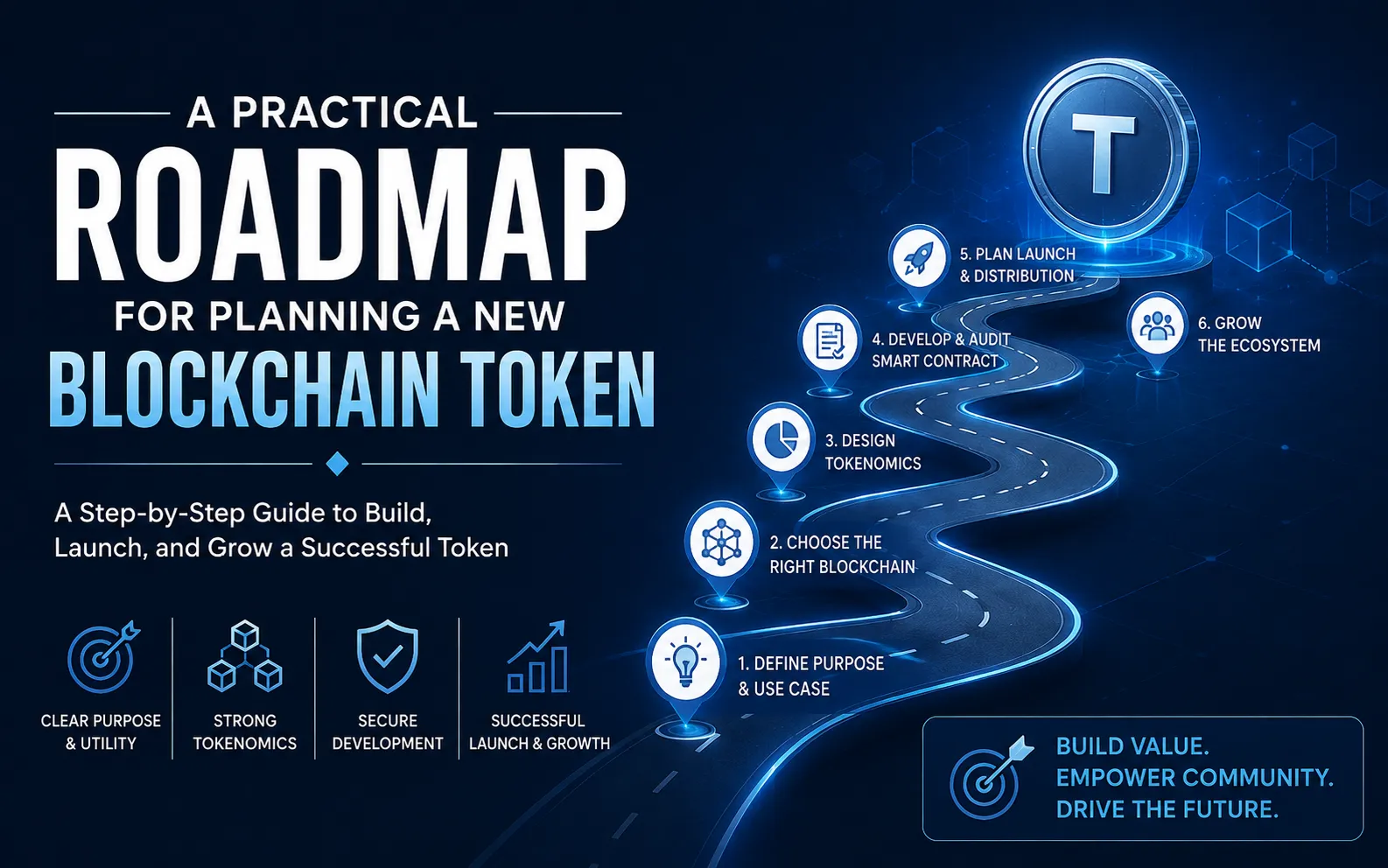

Creating a blockchain token starts long before smart contract deployment. A successful token requires a clear purpose, a suitable blockchain, sustainable tokenomics, secure technical architecture, a realistic launch plan, and a strategy for long-term ecosystem growth. Projects that begin with the technology alone often overlook the economic and operational decisions that determine whether the token can support real users.
The growing maturity of blockchain infrastructure has also made token creation more accessible. Established standards such as Ethereum's ERC-20 provide reusable functionality for fungible assets, while networks such as Solana offer alternative architectures focused on high throughput and low transaction costs. Yet technical accessibility does not remove the need for careful planning.
A practical roadmap should therefore connect the token's purpose with its technical design, economic model, launch strategy, and future development. Each decision should reinforce the next rather than exist as an isolated task.
Start With a Clear Token Purpose
The first step is defining why the token needs to exist.
A token should solve a specific problem or provide a clear function within an ecosystem. It might provide access to a product, support governance, facilitate payments, reward users, represent an asset, or coordinate participation across a decentralized network.
This distinction matters because token design should follow utility. A governance token requires voting mechanisms and an appropriate distribution model. A payment token requires efficient transactions and predictable costs. A gaming token may require high transaction capacity and carefully controlled emissions.
Projects should also determine whether blockchain technology genuinely adds value. Creating a token simply because blockchain assets are popular can produce weak utility and limited long-term demand.
Before technical development begins, the project should be able to explain what users will do with the token, why they need it, and how demand can develop over time.
Choose the Blockchain Based on the Use Case
Once the token's purpose is clear, the next decision is selecting the blockchain.
Blockchain choice influences transaction costs, processing capacity, confirmation speed, security, wallet compatibility, liquidity, and access to existing applications.
Ethereum's ERC-20 standard remains widely used because it provides a common interface for fungible tokens and supports integration across a large ecosystem of wallets and applications. Ethereum's scaling roadmap also increasingly relies on Layer 2 networks to increase transaction capacity while retaining Ethereum as a settlement layer.
Solana provides a different model, emphasizing high throughput and low transaction costs. Its token infrastructure supports functions such as minting, transferring, freezing, burning, and managing token authorities.
Neither approach is universally better. The correct choice depends on the project's requirements.
A project should evaluate expected transaction volume, average transaction value, peak activity, fee sensitivity, developer tooling, wallet support, exchange integration, ecosystem liquidity, and future scalability before committing to a network.
Design the Tokenomics Before Writing the Contract
Tokenomics defines how the token functions as an economic system.
A strong tokenomics model should answer several questions: What is the total supply? How many tokens circulate at launch? Who receives the supply? What creates demand? How are new tokens introduced? Can tokens be burned? How are rewards funded?
The distribution structure is equally important. A project may allocate tokens to founders, investors, employees, advisors, community incentives, ecosystem development, treasury reserves, partnerships, and liquidity.
The percentages should not simply be copied from another token. Each allocation needs a defined purpose.
For example, a large ecosystem allocation can support developer grants and user incentives, while a treasury reserve can finance future operations. Team and investor allocations can support long-term incentives when combined with appropriate vesting schedules.
Projects also need to distinguish between circulating supply and fully diluted supply. A low initial circulating supply can create a substantial gap between launch market capitalization and fully diluted valuation.
This makes unlock planning essential.
Establish Vesting and Unlock Schedules
Token allocation determines who receives tokens. Vesting determines when those tokens become available.
This is one of the most important components of token planning because large unlocks can introduce significant additional supply into the market.
Founders, employees, advisors, and early investors commonly receive allocations subject to vesting. A project may use a cliff followed by linear monthly or quarterly releases. The appropriate schedule depends on the project's development timeline and stakeholder agreements.
The important principle is alignment.
Stakeholders who benefit from the project's long-term success should have incentives that extend beyond the token launch. A vesting schedule can reduce immediate selling pressure while giving investors and team members a reason to remain engaged.
The project should publish a clear unlock calendar so users and investors understand future changes in circulating supply.
Build the Smart Contract Around Security
After the economic model is established, the token contract can be designed.
Smart contracts should implement only the functions required by the project's defined utility. Common token functions include transfers, approvals, minting, burning, pausing, and ownership management. More complex tokens may require staking, vesting, governance, or transfer restrictions.
Every additional feature introduces additional security considerations.
Access control is particularly important. The project needs to determine who can mint tokens, pause transfers, modify parameters, upgrade contracts, or manage treasury functions.
Established security libraries can reduce the risk of implementing common functionality incorrectly. OpenZeppelin, for example, provides widely used reusable smart contract components for token standards, access control, upgradeability, and security mechanisms.
Testing should cover normal transactions and unusual conditions. Developers should examine edge cases involving maximum values, repeated transactions, unauthorized calls, zero values, contract interactions, and unexpected execution sequences.
The goal is to make the contract behave predictably under both normal and adversarial conditions.
Test, Audit, and Verify the Contract
A smart contract should not move directly from development to public deployment.
Testing needs to occur throughout development. Unit tests can validate individual functions, while integration tests examine interactions between contracts and external systems. Fuzz testing can generate unexpected inputs and help identify logic failures that manual tests may miss.
Security audits provide another layer of review.
An independent auditor can examine access control, token supply logic, external calls, upgrade mechanisms, arithmetic operations, and business logic. The audit should focus on the final version intended for deployment. If developers make substantial changes afterward, those changes should receive another security review.
Contract verification on the relevant blockchain explorer also improves transparency. Users and developers can inspect the deployed code and compare it with the intended implementation.
Security should remain an ongoing responsibility after launch rather than a one-time milestone.
Plan the Token Launch Around Circulating Supply
Token launch planning connects technical deployment with market conditions.
A project needs to determine how many tokens enter circulation at launch, how liquidity will be provided, which distribution channels will be used, and how future unlocks will occur.
Initial liquidity deserves careful attention. Too little liquidity can create high slippage and unstable trading, while excessive initial circulation can increase selling pressure.
Projects should also coordinate their token generation event, exchange availability, community distribution, investor unlocks, and marketing activity. Releasing large quantities of tokens while simultaneously generating high short-term demand can produce volatile market conditions when early recipients begin selling.
A launch should therefore be treated as an economic event rather than simply the moment a smart contract goes live.
Build the Ecosystem Around Real Utility
A token cannot rely indefinitely on speculation.
Long-term sustainability requires a growing ecosystem in which users have reasons to acquire and use the asset.
Depending on the project, this can involve payments, governance, access to applications, staking, rewards, developer incentives, digital assets, or ecosystem services.
Community programs should also be designed around meaningful participation. Instead of distributing tokens indiscriminately, projects can reward activities that contribute to ecosystem development.
This approach creates a stronger relationship between token distribution and actual network growth.
Prepare for Multi-Chain Expansion Carefully
Many projects eventually consider expanding beyond their initial blockchain.
Multi-chain deployment can provide access to new users, applications, liquidity pools, and developer communities. It also introduces additional complexity.
The project must maintain consistent token supply accounting across networks and use secure interoperability infrastructure. Bridged or wrapped versions need clear relationships with the original asset.
Liquidity fragmentation is another concern. Deploying a token across multiple networks without sufficient liquidity on each can create poor trading conditions and inconsistent price discovery.
Multi-chain expansion should therefore follow demonstrated user demand rather than being treated as a requirement from day one.
Monitor Performance After Launch
The roadmap does not end at deployment.
After launch, teams should monitor transaction activity, token-holder growth, liquidity, contract interactions, treasury movements, governance participation, and supply changes.
On-chain analytics can reveal whether users are actually interacting with the token or whether activity is driven primarily by short-term speculation.
The team should also track the token's circulating supply against the original unlock schedule. Unexpected changes should be investigated quickly.
Security monitoring is equally important. Administrative actions, ownership transfers, minting events, unusual transaction patterns, and contract interactions can provide early indicators of potential problems.
Continuous monitoring allows teams to respond to changing conditions rather than relying entirely on assumptions made before launch.
Turn the Roadmap Into a Long-Term Strategy
The strongest token projects treat launch as the beginning of an ecosystem rather than the final development milestone.
A practical roadmap should connect each phase:
Purpose → Blockchain → Tokenomics → Allocation → Vesting → Smart Contract → Testing → Audit → Launch → Liquidity → Utility → Monitoring → Expansion
This sequence helps prevent important decisions from being made in isolation.
For example, the blockchain selected at the beginning should support the token's expected transaction model. Tokenomics should reflect the project's utility. Allocation should support long-term incentives. Vesting should protect against unnecessary supply shocks. Smart contracts should implement the economic model securely. Launch liquidity should match expected market activity.
When these components work together, the token becomes part of a coherent product strategy rather than an isolated digital asset.
Conclusion
Planning a new blockchain token requires considerably more than deploying a smart contract. The project needs a clear purpose, suitable blockchain infrastructure, sustainable tokenomics, balanced allocation, carefully structured vesting, secure contract architecture, comprehensive testing, and a realistic launch strategy.
The most effective roadmap begins with utility and works toward technology. This approach helps project teams select infrastructure based on actual requirements rather than trends. It also creates stronger connections between token economics, user incentives, liquidity, security, and long-term growth.
Blockchain App Factory helps businesses plan and develop blockchain token solutions across the full development lifecycle, from blockchain selection and tokenomics to smart contract development, security testing, deployment, and ecosystem planning.
A token launch should therefore be viewed as the beginning of a long-term economic system. When technical architecture, token economics, market strategy, and ecosystem utility are planned together, the project has a stronger foundation for attracting users, supporting sustainable activity, and adapting as the blockchain ecosystem evolves.
















Sign in to leave a comment.