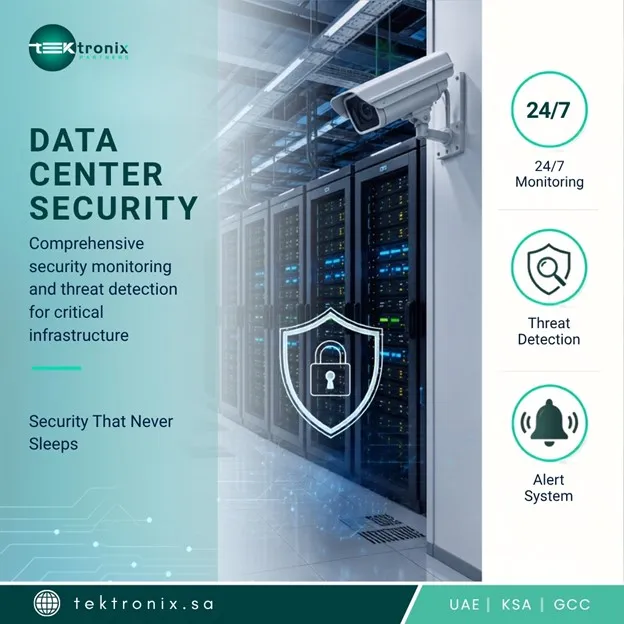

Data Center Security has become one of the most urgent priorities for organizations operating in the Kingdom, as cloud adoption, giga-project investment, and national digitization programs push more critical workloads into local and regional facilities. A single unprotected server hall can expose financial records, government data, healthcare systems, and telecom networks to disruption, making a layered, purpose-built security strategy essential rather than optional.

This guide breaks down the physical and digital defences that modern facilities need — from encrypted storage and hardened firewalls to biometric access points and round-the-clock surveillance — and explains how organizations pursuing Data Center Security KSA initiatives are building resilience into every layer of their infrastructure.
What Is Data Center Security and Why It Matters in Saudi Arabia?
At its core, protecting a facility means defending two things at once: the physical building housing servers, cooling systems, and cabling, and the digital environment running on top of that hardware. A breach in either layer can bring down operations just as effectively — a stolen access badge is as dangerous as a compromised network credential if it leads an intruder to the same rack of servers.
Saudi Arabia's rapid expansion of hyperscale and colocation facilities under Vision 2030 has raised the stakes considerably. Facilities hosting government workloads, banking platforms, and telecom infrastructure are now expected to meet international assurance frameworks while also satisfying local regulatory requirements on data residency and incident reporting, which means security design has to address compliance and operational resilience simultaneously.
Cybersecurity for Data Center: Protecting the Digital Core
Cybersecurity for Data Center environments cover everything from network segmentation and endpoint hardening to continuous vulnerability management across every server, switch, and management interface inside the facility. Because a single compromised management port can give an attacker a path into an entire rack, segmentation between customer environments, management networks, and public-facing services is treated as a foundational design principle rather than an afterthought.
Patch management, credential hygiene, and continuous monitoring of administrative access all fall under this umbrella too. Facilities that skip routine patching or leave default credentials active on management interfaces remain among the most common entry points attackers exploit, regardless of how strong the perimeter defences look on paper.
A mature security program also extends to the supply chain — vetting the firmware and software running on switches, sensors, and management appliances before they ever reach the server hall, since a compromised component installed at the hardware level can bypass network-layer defences entirely.
Data Center Encryption: Safeguarding Data at Rest and in Transit
Data Center Encryption protects information whether it is sitting on a storage array or moving between racks, buildings, or cloud regions. Strong encryption standards applied to data at rest mean that even if a drive were physically removed from a facility, the information on it would remain unreadable without the correct keys — a critical safeguard against both theft and improper disposal of retired hardware.
Encryption in transit is equally important, particularly for facilities that replicate data between a primary site and a disaster-recovery location. Traffic moving across those links needs to be encrypted end-to-end so that interception at any point along the route — including third-party fibre routes — does not expose sensitive content.
Key management is the part organizations most often underestimate. Encryption is only as strong as the process protecting its keys, so facilities typically separate key custody from the storage systems themselves and enforce strict rotation policies to limit the damage of any single compromised credential.
Data Center Firewalls: The First Line of Network Defence
Data Center Firewalls sit at every meaningful boundary inside a modern facility — between the internet and the internal network, between customer environments in a shared colocation space, and between management systems and production workloads. Next-generation firewall appliances go beyond simple port blocking, inspecting traffic patterns for known attack signatures and unusual behaviour that could indicate a breach already in progress.
High-availability pairing is standard practice for firewall deployment in critical facilities, since a single point of failure at the network boundary could take an entire hosting environment offline. Redundant appliances, automatic failover, and regularly tested configuration backups keep protection continuous even during hardware maintenance or an unexpected outage.
- Application-aware inspection to catch threats that bypass simple port filtering
- Redundant, high-availability firewall pairs to eliminate single points of failure
- Segmented zones separating customer, management, and public-facing traffic
Data Center Access Control: Managing Who Enters Critical Zones
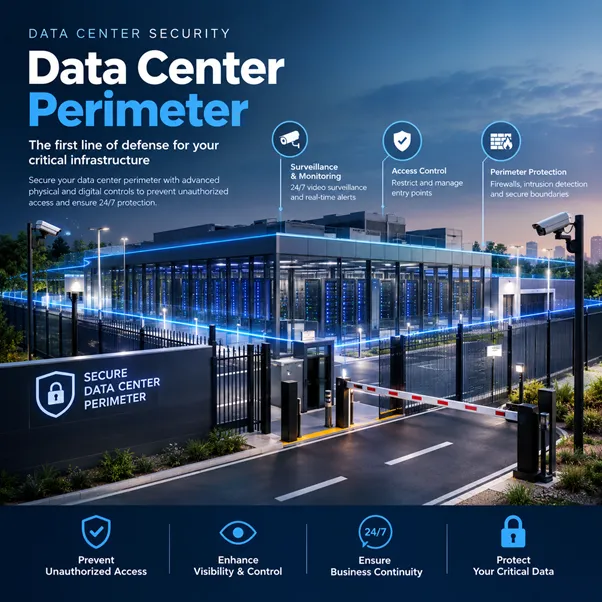
Data Center Access Control determines who can physically reach server rows, cooling plants, and network equipment rooms, and it is frequently layered into concentric rings — perimeter fencing, building entry, floor-level checkpoints, and individual cage or rack locks. Each ring typically requires a different credential or verification method, so a single stolen badge cannot grant an intruder a direct path to the server floor.
Biometric verification, mantrap entry vestibules, and two-person authorization rules for the most sensitive rooms are now common in facilities that host regulated workloads. These controls not only stop unauthorized entry but also produce a precise, timestamped record of exactly who accessed which zone, which auditors and compliance teams rely on heavily during incident reviews.
Data Center Surveillance: Round-the-Clock Visual Monitoring
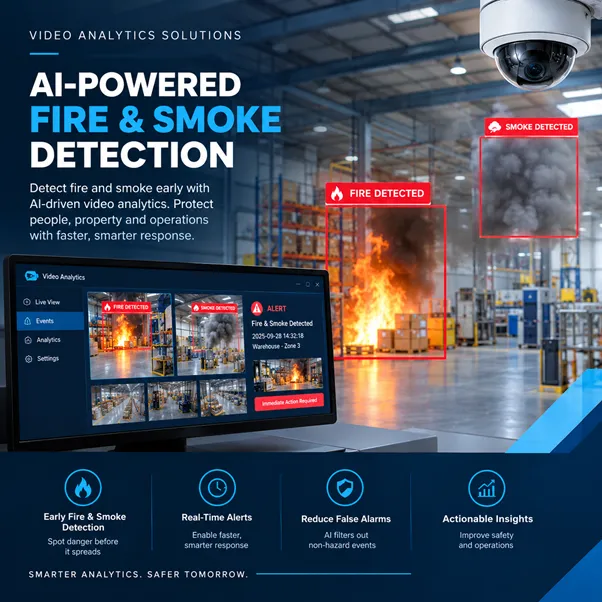
Data Center Surveillance combines high-resolution cameras, video analytics, and centralized monitoring to give security teams full visual coverage of entry points, server rows, loading docks, and perimeter fencing. Modern camera systems use motion and behaviour analytics to flag unusual activity automatically, rather than relying solely on a guard watching dozens of screens for an entire shift.
Footage retention policies matter as much as camera placement. Facilities handling regulated data typically retain recordings for a defined compliance period and store them in a way that preserves chain of custody, so video evidence remains admissible and reliable if it is ever needed for an investigation.
Data Center Intrusion Detection: Spotting Threats Before They Escalate
Data Center Intrusion Detection systems watch for both physical and network-based intrusion attempts, correlating alerts from door sensors, motion detectors, and network monitoring tools into a single operational picture. A door forced open outside scheduled hours, an unexpected device appearing on the management network, or repeated failed access attempts all generate alerts that security teams can act on immediately rather than discovering after the fact.
Integrating physical and network intrusion alerts into one dashboard shortens response times considerably. A security operations team that sees a badge-clone attempt and a suspicious network login within minutes of each other can correlate the two events and respond to what might be a coordinated attack, rather than treating each alert in isolation.
Data Center Threat Detection: Proactive Risk Management
Data Center Threat Detection goes a step further than intrusion detection by actively hunting for early indicators of compromise — unusual data transfer volumes, abnormal login times, or subtle configuration changes that do not match approved change records. Behavioural analytics and machine-learning models increasingly support this work, flagging patterns that would be invisible to manual log review.
Regular penetration testing and red-team exercises complement automated detection tools by actively probing defences the way a real attacker would, revealing gaps before they can be exploited in production. Facilities that combine continuous automated monitoring with periodic manual testing consistently catch issues earlier than those relying on either approach alone.
- Behavioural analytics to catch anomalies automated rules would miss
- Correlated physical and network alerts for faster incident response
- Scheduled penetration testing to validate defences under real attack conditions
Data Center Security KSA: Meeting Local Compliance and Growth Demands
Facilities pursuing Data Center Security KSA compliance must account for national regulatory guidance on data residency, incident reporting, and critical-infrastructure protection alongside international frameworks their global customers may require. Meeting both sets of expectations at once has become a competitive differentiator for facility operators seeking enterprise and government tenants.
The pace of growth adds further pressure. As new hyperscale campuses and edge facilities come online across the country, security teams need designs that scale predictably — access control platforms, surveillance networks, and firewall policies that can extend to a second or third building without being rebuilt from scratch each time.
Environmental resilience is a related consideration unique to the region: heat, dust, and occasional grid instability all place additional demands on physical security hardware, cooling-linked safety systems, and backup power arrangements protecting the security infrastructure itself.
Data Center Security Riyadh: Securing the Capital's Digital Infrastructure
In the capital specifically, Data Center Security Riyadh deployments are concentrated around emerging technology districts, financial services campuses, and telecom colocation hubs, where facility density means physical and cyber risks are closely watched by both regulators and enterprise tenants. Multi-tenant facilities in particular need strict isolation between customer environments so that one tenant's incident never becomes another tenant's exposure.
Riyadh's growing cluster of hyperscale and colocation campuses also means facility operators are increasingly expected to demonstrate security maturity during the sales process itself — enterprise and government customers routinely request audit access, penetration-test summaries, and physical-security walkthroughs before signing a hosting agreement.
Why Tektronix Is Saudi Arabia's Trusted Data Center Security Partner
Designing a facility's security posture requires more than selecting individual products — it requires an integrator who understands how physical access control, surveillance, firewalls, and threat detection need to work together as one coordinated system. Tektronix has spent years delivering that kind of integrated security design for facilities across the Kingdom, working closely with facility owners, IT teams, and compliance officers from initial risk assessment through to ongoing operational support.
Our engineering team conducts full site assessments, maps physical and network risk together rather than separately, and designs layered defences tailored to each facility's tenant mix, regulatory obligations, and growth plans. Full solution details, technical documentation, and case examples are available on Tektronix's data center security solutions page, where our specialists outline supported architectures for facilities of every size.
For organizations comparing security vendors, we recommend requesting a live site assessment rather than relying on a generic proposal. Tektronix arranges detailed walkthroughs covering access control zoning, surveillance coverage, and network segmentation — a process outlined in full on our data center solutions and services page.
- Experienced local engineering team spanning physical and network security design
- Vendor-agnostic architecture recommendations matched to compliance requirements
- Proven deployments across banking, telecom, government, and colocation facilities
- Ongoing monitoring and technical support based in Saudi Arabia
Explore complete solution briefs, architecture diagrams, and enquiry details on the Tektronix data center security page to plan your facility's next security upgrade.
Conclusion
Data Center Security now depends on layering Cybersecurity for Data Center practices with strong Data Center Encryption and resilient Data Center Firewalls to protect every workload running inside a facility. Physical safeguards matter just as much: precise Data Center Access Control, continuous Data Center Surveillance, reliable Data Center Intrusion Detection, and proactive Data Center Threat Detection together close the gaps that any single measure would leave open. Organizations pursuing Data Center Security KSA and Data Center Security Riyadh initiatives can rely on Tektronix to design, deploy, and support that layered defence from first assessment to ongoing operations.
Frequently Asked Questions
1. What does Data Center Security actually cover?
It spans both physical protections — fencing, badges, biometrics, cameras — and digital defences such as firewalls, encryption, and continuous monitoring, since a facility is only as secure as its weakest layer.
2. How is Cybersecurity for Data Center different from general IT security?
It focuses specifically on the network segmentation, management-plane hardening, and vulnerability practices unique to hosting dense, multi-tenant, and mission-critical infrastructure rather than a typical office network.
3. Why is Data Center Encryption important if physical access is already restricted?
Physical controls reduce the chance of theft, but encryption protects the data itself if a drive is ever removed, misplaced during decommissioning, or intercepted while replicating between sites.
4. Can existing Data Center Firewalls and access systems be upgraded without a full rebuild?
In most cases yes — modern firewall appliances and access-control platforms are designed to integrate with existing network segments and door hardware, allowing a phased upgrade rather than a disruptive rebuild.
5. Where can organizations pursuing Data Center Security KSA and Data Center Security Riyadh projects get a site assessment?
Tektronix offers full site assessments, architecture recommendations, and documentation through its data center security solutions page, covering facilities of any size across the Kingdom.
For more information contact us on:
Tektronix Technology Systems
+966 5021 04086
Building No. 8194, Additional No. 4368, Office No. 21, Third Floor
King Abdul Aziz Road, Al Rabie District
Riyadh 13315, Saudi Arabia




























Sign in to leave a comment.