

The Facial Recognition System has rapidly evolved from a futuristic concept into an indispensable pillar of modern security infrastructure across the UAE. As the Emirates continues its ambitious journey toward becoming one of the world’s most technologically advanced nations, intelligent biometric solutions are being deployed at an unprecedented scale — from international airports and smart city corridors to corporate headquarters and government facilities. Whether you are a business owner, a security integrator, or a public authority, understanding how face detection, facial identification, and facial authentication work together can give your organisation a decisive edge in safety, compliance, and operational efficiency.
What Is a Facial Recognition System and How Does It Work?
At its core, a Facial Recognition System is a biometric technology that analyses the geometric and physiological features of a human face to verify or identify an individual. Unlike traditional access control methods such as PIN codes or swipe cards, this technology requires no physical contact and operates in real time, making it both hygienic and highly efficient.
The process typically unfolds in three interconnected stages:
1. Face Detection
Face detection is the foundational step that locates and isolates a human face within a digital image or live video feed. Using convolutional neural networks (CNNs) and deep learning algorithms, modern detection engines can identify multiple faces simultaneously — even in low-light environments, at wide angles, or in crowded scenes. Advanced facial recognition software today achieves detection accuracy rates exceeding 99.5% under controlled conditions.
2. Facial Identification
Facial identification goes a step further by mapping the detected face against a database of known individuals. The system extracts up to 128 unique facial landmarks — such as the distance between the eyes, nose bridge width, and jawline contour — and encodes them into a mathematical faceprint. This faceprint is then compared against enrolled records using similarity scoring, enabling both one-to-one verification and one-to-many searches across large populations.
3. Facial Authentication
Facial authentication is the security-specific application of identification, confirming that a person is who they claim to be before granting access to a restricted area, device, or digital service. It is the engine behind contactless entry systems, mobile banking security, and employee time-attendance management. When paired with liveness detection, it effectively counters spoofing attempts using photographs or 3D masks.
Facial Recognition Software: The Intelligence Behind the Technology
The effectiveness of any biometric deployment depends heavily on the quality of its underlying facial recognition software. Leading platforms today combine several advanced capabilities:
- Deep learning and AI model training on diverse, inclusive datasets for cross-demographic accuracy
- Anti-spoofing and liveness detection to prevent fraud using static images or video replays
- Edge computing support, allowing processing directly on the facial recognition device without depending on cloud connectivity
- Encrypted data pipelines and GDPR/UAE PDPL-aligned privacy architecture
- Integration APIs for seamless connectivity with existing access control, HR, and surveillance platforms
- Real-time alerting and watchlist matching for law enforcement and high-security environments
Organisations working with Tektronix LLC benefit from facial recognition software that is calibrated specifically for Middle Eastern environments — accounting for lighting conditions typical of Gulf architecture, partial face occlusion from traditional attire, and the multi-national demographic diversity of the UAE workforce.
Facial Recognition Device: Hardware That Powers Precision
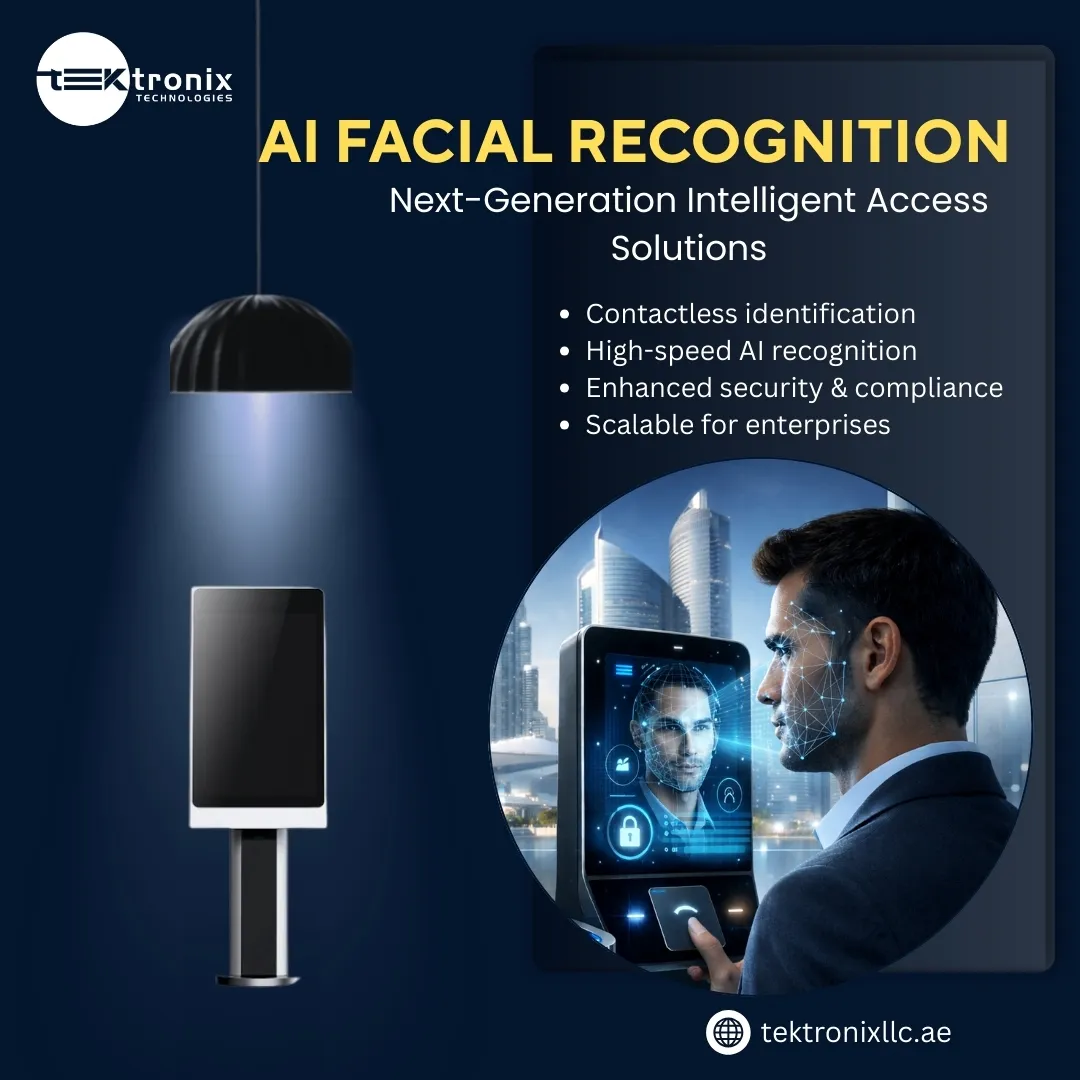
A high-performing facial recognition device is the physical gateway through which biometric intelligence is applied in the real world. Devices range from compact wall-mounted terminals for office entry to ruggedized outdoor units for perimeter security, and high-throughput e-gate readers for border control.
Key hardware features to evaluate include:
- Dual-camera systems — combining RGB and infrared (IR) sensors for reliable performance in both bright sunlight and total darkness
- Wide dynamic range (WDR) imaging — critical for environments with mixed indoor and outdoor lighting
- On-device processing (edge AI) — ensures near-zero latency and continues functioning during network outages
- Tamper-evident enclosures — rated IP65 or above for outdoor installations in the UAE’s harsh climate
- Multi-modal biometric support — some devices combine face, fingerprint, and iris recognition for layered verification
When selecting a facial recognition device for deployment in the UAE, it is essential to choose hardware certified by the Emirates Authority for Standardisation and Metrology (ESMA) and compatible with the General Directorate of Residency and Foreigners Affairs (GDRFA) digital ecosystems where applicable.
Facial Recognition System UAE: A Nation-Wide Biometric Revolution
The Facial Recognition System UAE market has undergone extraordinary growth, driven by the country’s Vision 2031 agenda, smart government initiatives, and an unwavering commitment to public safety. The UAE government has invested heavily in building a biometric identity backbone that spans immigration, law enforcement, healthcare, and smart mobility.
Key nationwide deployments and trends include:
- Abu Dhabi and Dubai international airports utilise automated biometric e-gates that process millions of passengers annually using contactless facial scanning
- The UAE’s Federal Authority for Identity, Citizenship, Customs and Ports Security (ICP) has integrated biometric verification across its national ID and e-government services
- Smart police stations across the Emirates use AI-powered surveillance systems incorporating real-time facial identification for crime prevention
- Expo City Dubai set a benchmark for biometric visitor management, demonstrating how large-scale events can be secured without creating bottlenecks
For enterprises operating within this progressive regulatory environment, partnering with an experienced provider of Facial Recognition System UAE solutions ensures both compliance and competitive advantage. Tektronix LLC brings over a decade of regional expertise to every project, ensuring solutions are tailored to local requirements.
Facial Recognition System Dubai: Smart Security in the City of the Future
Dubai’s ambition to become the world’s smartest city has made it a global showcase for advanced biometric technology. The demand for a reliable Facial Recognition System Dubai implementation spans virtually every sector:
- Retail and hospitality — luxury hotels on Sheikh Zayed Road and retail destinations in Dubai Mall use facial authentication for VIP guest recognition and personalised service delivery
- Financial services — banks and fintech firms in the DIFC deploy facial biometrics for secure customer onboarding (KYC) and fraud prevention
- Construction and industrial sites — workforce management on major infrastructure projects uses facial time-attendance to eliminate buddy punching and ensure HSE compliance
- Healthcare — hospitals and clinics integrate facial recognition software into patient identity management systems to reduce medical errors and streamline admissions
- Education — universities and schools implement automated attendance tracking, replacing manual roll calls with frictionless face detection systems
The Roads and Transport Authority (RTA) and Dubai Police have also pioneered the use of facial recognition in traffic enforcement and public safety monitoring, establishing Dubai as a reference market for the broader region. Enterprises seeking a trusted provider of Facial Recognition System Dubai solutions will find that Tektronix LLC offers end-to-end design, supply, installation, and post-deployment support.
Facial Recognition System Abu Dhabi: Biometrics at the Heart of the Capital
As the federal capital and economic powerhouse of the UAE, Abu Dhabi has established itself as a leader in intelligent security infrastructure. The rollout of Facial Recognition System Abu Dhabi solutions reflects the emirate’s commitment to both citizen safety and seamless public services.
Notable application areas in Abu Dhabi include:
- Abu Dhabi International Airport (AUH) has implemented end-to-end biometric travel corridors, allowing pre-registered passengers to move from check-in to boarding gate using only their face
- Critical national infrastructure such as oil and gas facilities, power plants, and government data centres rely on multi-layer facial authentication combined with security clearance systems
- The Abu Dhabi Department of Education and Knowledge (ADEK) has piloted smart attendance solutions in public schools, demonstrating the scalability of the technology in student-dense environments
- Yas Island’s entertainment and hospitality ecosystem uses visitor facial analytics to optimise crowd flow and personalise guest experiences at theme parks and venues
Facial Recognition System Sharjah: Intelligent Access for the Cultural Capital
Sharjah’s reputation as the UAE’s cultural and educational capital is increasingly backed by sophisticated security technology. The adoption of Facial Recognition System Sharjah solutions is growing across the emirate’s universities, museums, industrial zones, and government departments.
Key deployment contexts in Sharjah include:
- University of Sharjah and American University of Sharjah campuses are exploring contactless access control for libraries, laboratories, and secure research facilities
- Hamriyah Free Zone and Sharjah Airport International Free Zone (SAIF Zone) use facial recognition devices for contractor and visitor management at industrial gates
- Cultural institutions, including several Sharjah museums, have trialled biometric ticketing and visitor analytics to enhance security and visitor experience
- Sharjah Police has aligned its smart surveillance infrastructure with the national biometric grid, enabling city-wide situational awareness
Why Choose Tektronix LLC for Your Facial Recognition Deployment?
Tektronix LLC is a UAE-based technology integrator with extensive experience in physical security, IT infrastructure, and intelligent building solutions. Our team of certified engineers has successfully deployed biometric access control, AI-powered surveillance, and integrated command centre solutions across commercial, industrial, and government sectors throughout the Emirates.
Our differentiators include:
- Regional expertise — over a decade of delivering advanced security solutions in Dubai, Abu Dhabi, Sharjah, and the wider Gulf region
- Vendor-neutral approach — we work with globally recognised facial recognition software and hardware brands, recommending the best fit for your specific environment
- End-to-end service — from site survey and system design to installation, commissioning, training, and ongoing maintenance
- Compliance-first design — all solutions are architected to meet UAE data protection laws, ESMA standards, and international privacy frameworks
- Proven track record — trusted by leading banks, real estate developers, logistics companies, healthcare groups, and government entities across the UAE
The Future of Biometric Security: Trends Shaping the Next Decade
The convergence of artificial intelligence, edge computing, and 5G connectivity is unlocking new frontiers for facial recognition technology across the UAE and the globe. Several transformative trends are already reshaping the landscape:
- Emotion and behaviour analytics — next-generation platforms are incorporating sentiment analysis to detect stress, confusion, or unusual behaviour in public spaces, adding a new dimension to proactive security
- Federated learning — allows AI models to be trained across distributed datasets without centralising sensitive biometric data, addressing privacy concerns at scale
- Masked face recognition — COVID-19 accelerated the development of algorithms capable of accurate facial identification even when the lower half of the face is covered, a critical capability for healthcare and high-compliance settings
- Digital twin integration — biometric data feeds are being embedded into smart building digital twins, enabling predictive access management and real-time occupancy optimisation
- Interoperable national identity ecosystems — the UAE’s push toward a unified biometric identity layer across health, travel, finance, and government services will make facial authentication a universal mechanism for citizen interaction
Conclusion
The deployment of an advanced Facial Recognition System is no longer a luxury reserved for government agencies or large multinationals — it is an accessible, scalable, and operationally transformative technology available to organisations of all sizes across the UAE. From the innovation corridors of Dubai and the institutional hubs of Abu Dhabi to the educational campuses and industrial zones of Sharjah, biometric intelligence is reshaping how people, premises, and processes are secured.
Whether you require frictionless face detection for a high-footfall retail environment, robust facial identification for a critical infrastructure site, or enterprise-grade facial authentication for a multi-site corporate network, the right combination of facial recognition software and purpose-built facial recognition devices can deliver measurable returns in security, compliance, and efficiency.
Tektronix LLC stands ready to be your trusted partner in this journey — bringing technical excellence, regional insight, and an unwavering commitment to quality to every deployment. Contact us today to discover how a bespoke Facial Recognition System UAE solution can future-proof your organisation’s security infrastructure.
FAQs
1. How accurate are modern Facial Recognition Systems in real-world UAE environments?
Modern Facial Recognition Systems deployed in the UAE achieve accuracy rates of 99% or higher under optimal conditions. Leading facial recognition software platforms are specifically trained on diverse datasets that include Middle Eastern demographic characteristics, ensuring reliable performance across nationalities. Accuracy can be further enhanced by using high-resolution facial recognition devices with infrared sensors that compensate for the bright sunlight and high-contrast lighting common in Gulf environments.
2. Is Facial Recognition technology legally compliant in the UAE?
Yes, when implemented responsibly. The UAE’s Personal Data Protection Law (Federal Decree-Law No. 45 of 2021) governs the collection and processing of biometric data, requiring organisations to obtain informed consent, implement data minimisation principles, and maintain robust security controls. A compliant Facial Recognition System UAE deployment should include encrypted data storage, clearly defined retention policies, and transparent user consent mechanisms. Tektronix LLC designs all biometric solutions with regulatory compliance built in from the ground up.
3. What is the difference between Facial Recognition and Facial Authentication?
Facial recognition is the broader technology that encompasses both identification (searching a database to find who someone is) and verification. Facial authentication is specifically the verification use case — confirming that a live person matches a previously enrolled identity record. Authentication is what powers access control, mobile unlock, and financial transaction approval, while broader recognition capabilities support law enforcement and public safety applications. Both rely on the same underlying face detection and biometric matching engine.
4. Can Facial Recognition Devices operate effectively outdoors in the UAE’s climate?
Absolutely. Industrial-grade facial recognition devices designed for outdoor deployment feature IP65 or IP67 weatherproof ratings, wide operating temperature ranges (typically −40°C to +60°C), and anti-glare optics capable of functioning in direct sunlight. For UAE deployments specifically, it is advisable to select devices with active thermal management and UV-resistant enclosures. Tektronix LLC sources and deploys hardware validated for the Gulf’s extreme environmental conditions, ensuring consistent performance year-round.
5. How long does it take to implement a Facial Recognition System for a business in Dubai or Abu Dhabi?
Implementation timelines vary depending on the scale and complexity of the deployment. A single-site office solution with a facial recognition device for access control and time-attendance can typically be installed and commissioned within one to two weeks. Large-scale multi-site deployments, such as a campus-wide Facial Recognition System Dubai or Facial Recognition System Abu Dhabi project integrating with existing IT and security infrastructure, may require four to twelve weeks from survey to go-live. Tektronix LLC provides a detailed project timeline during the initial consultation, ensuring minimal disruption to your operations.





























Sign in to leave a comment.