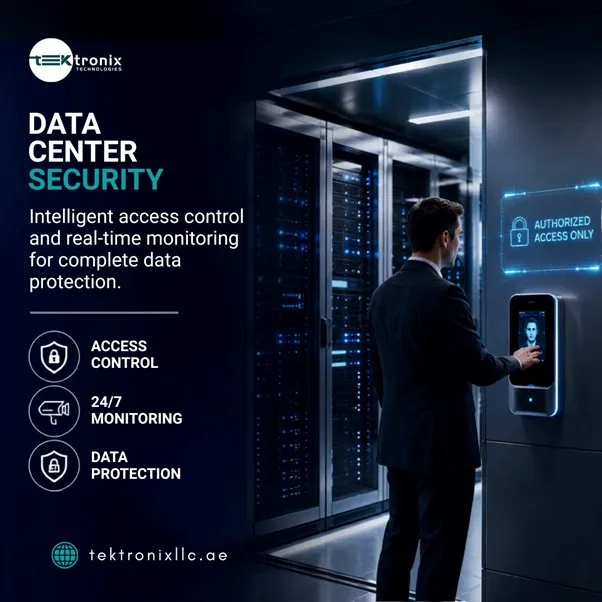

As the UAE cements its position as a global technology, logistics, and financial hub, protecting digital infrastructure has become a boardroom-level priority. Enterprises, government entities, and cloud providers across Dubai, Abu Dhabi, and the wider Emirates are investing heavily in Data Center Security UAE strategies, recognizing that even a brief outage or breach can carry severe financial, operational, and reputational consequences in a region defined by rapid digital transformation.
Why Data Center Security Matters in the UAE's Digital Economy
The UAE's smart-city initiatives, expanding financial services sector, and booming cloud computing market have turned data centers into critical national infrastructure. Government mandates around data sovereignty, coupled with a rising volume of sophisticated cyberattacks targeting the Gulf region, mean that facility operators can no longer treat physical security and cybersecurity as separate disciplines. A modern, converged approach to data center protection is essential for maintaining uptime, regulatory standing, and customer trust.
Financial institutions, healthcare providers, telecom operators, and oil and gas companies operating in the UAE all rely on always-on infrastructure. For these sectors, resilience isn't optional — it's a contractual and regulatory obligation, and it starts with a well-designed security architecture built around layered, defense-in-depth principles.
UAE Data Center Market Growth and Investment Trends
Dubai and Abu Dhabi have both positioned themselves as regional colocation and hyperscale hubs, with free zones such as Dubai Silicon Oasis and Dubai South actively courting infrastructure investment. As more government workloads migrate to sovereign cloud platforms and enterprises adopt hybrid IT models, the number of tier-rated facilities across the Emirates continues to expand. This growth brings welcome economic opportunity, but it also widens the attack surface that operators must defend, making a coherent, forward-looking security roadmap essential from day one rather than an afterthought bolted on after commissioning.
Facility operators are also responding to customer demand for transparency. Enterprise tenants increasingly request evidence of independent audits, uptime guarantees, and documented incident-response procedures before signing colocation agreements — pushing the entire market toward higher, more consistent security baselines across the region.
The Convergence of Physical and Cyber Security
Historically, facility guards and IT security teams operated in separate silos, using different tools and reporting lines. That separation is no longer tenable. A tailgating incident at a server room door is, in effect, a cybersecurity event, and a network intrusion can just as easily originate from a compromised badge reader as from a phishing email. Leading UAE operators now run converged security operations, where physical alarms, access logs, and network alerts feed into the same dashboard and the same incident-response playbook, allowing teams to correlate events across domains instead of investigating them in isolation.
This convergence also simplifies compliance reporting. Auditors reviewing a facility against ISO 27001 or sector-specific frameworks increasingly expect to see physical and logical controls documented together, with clear mapping between who can enter a room and what that same identity can access on the network.
Core Pillars of Modern Data Center Solutions
Comprehensive Data Center Solutions bring together physical security, network defense, and intelligent monitoring into a single, integrated ecosystem. Rather than relying on isolated point products, leading facilities in the UAE are deploying unified platforms that correlate data across cameras, access readers, sensors, and network appliances to give security teams a complete operational picture in real time.
Data Center Access Control Systems
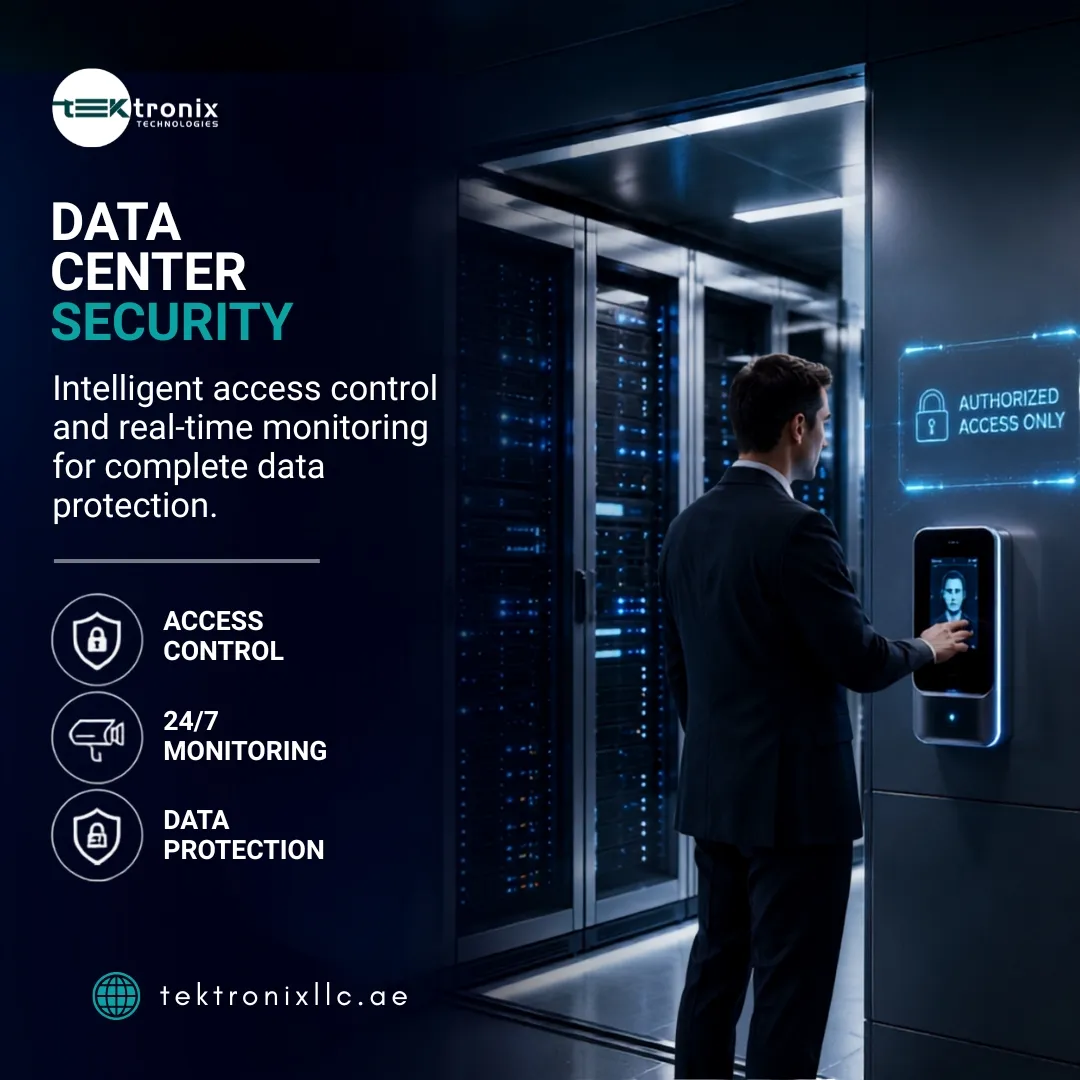
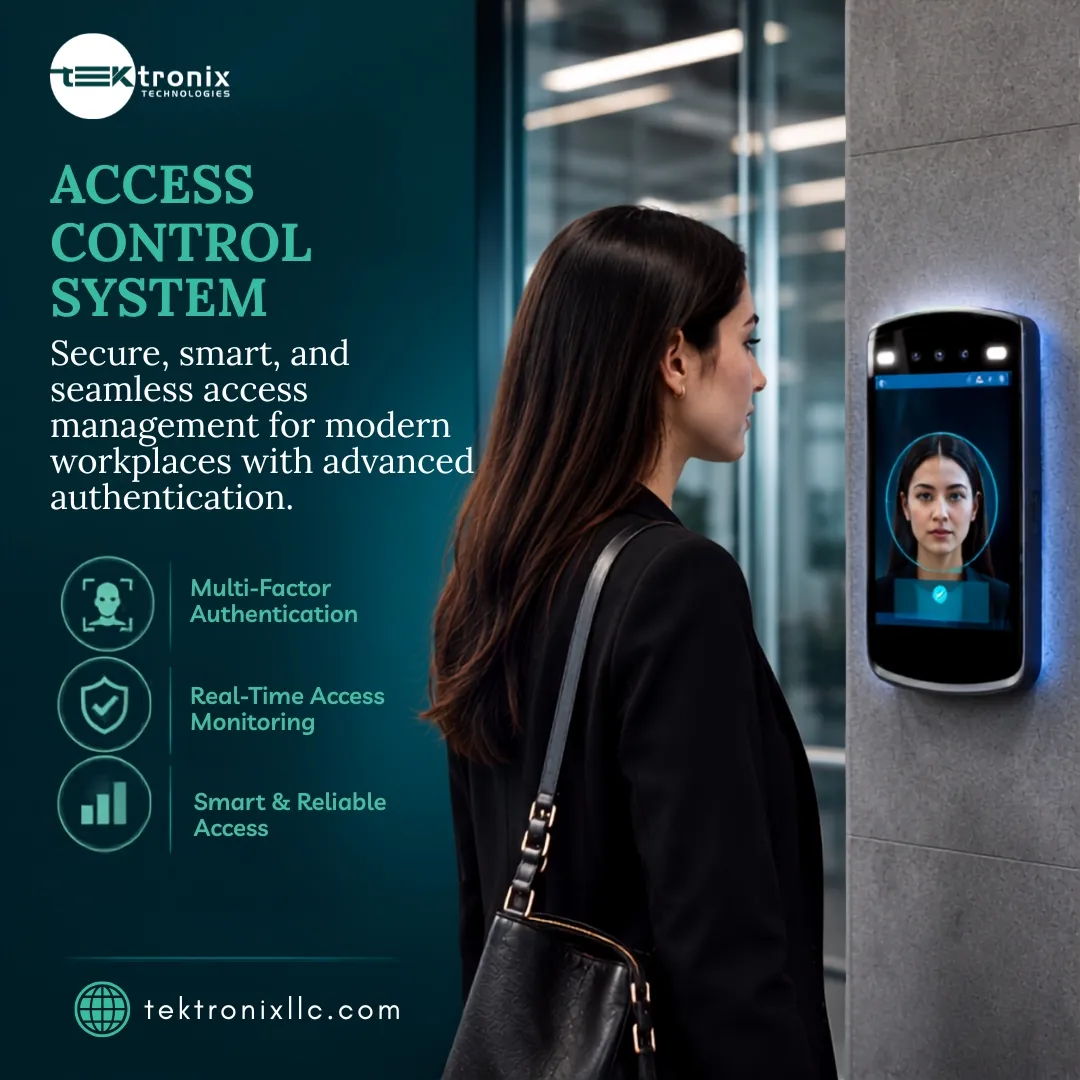
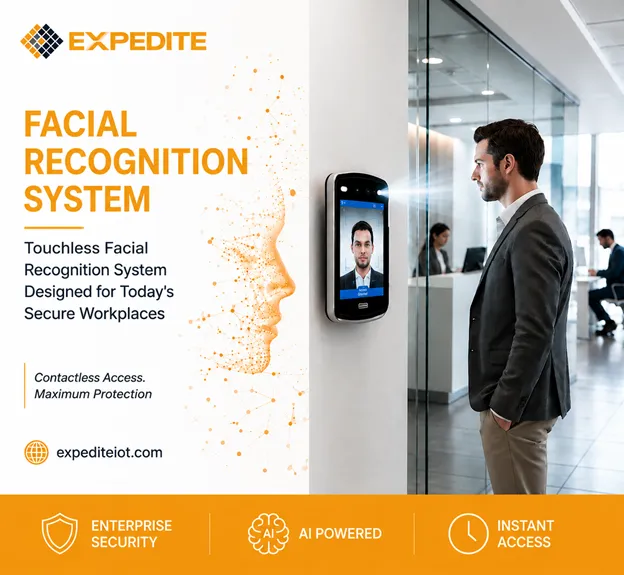
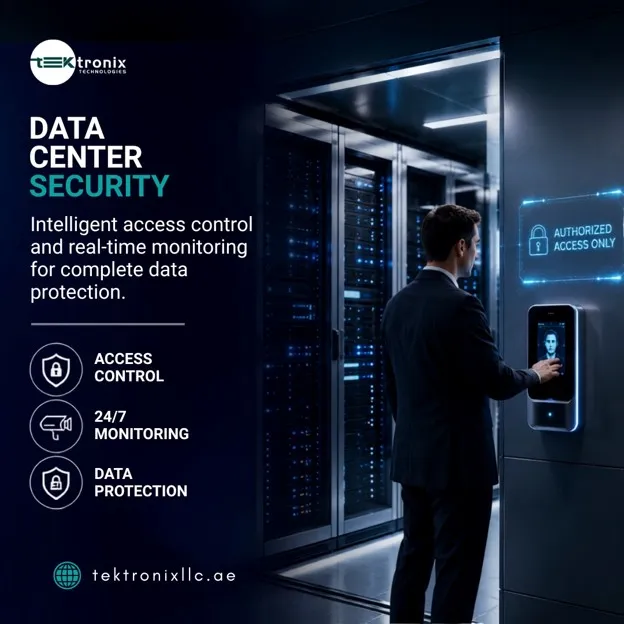
Restricting and verifying who can physically enter a facility is the foundation of any security program. Modern Data Center Access Control deployments combine biometric verification — including facial recognition and fingerprint scanning — with smart-card credentials, PIN codes, and mantrap portals that prevent tailgating. Enterprise-grade readers, such as HID-compatible multi-technology devices, are increasingly paired with multi-factor authentication to ensure that server rooms and network cabinets remain accessible only to authorized personnel, with a full audit trail for every entry and exit.
Data Center Surveillance and Monitoring
Continuous visual monitoring remains indispensable. High-resolution Data Center Surveillance systems now incorporate AI-powered video analytics, pan-tilt-zoom cameras, and thermal imaging to detect unauthorized movement, loitering, or equipment tampering around racks, generator yards, and perimeter fencing. Integration with a centralized visitor management system also ensures that every contractor, vendor, or auditor entering the facility is logged, verified, and tracked throughout their visit.
Data Center Intrusion Detection
Perimeter breaches must be identified before they reach critical assets. Data Center Intrusion Detection solutions typically layer fiber-optic perimeter sensors, seismic and vibration detectors, and tamper-evident alarms on doors, vents, and raised floors. When paired with a 24/7 security operations center, these systems allow rapid, automated escalation the moment an anomaly is flagged, reducing response time from minutes to seconds.
Advanced Data Center Threat Detection Technologies
Beyond the physical layer, facilities need visibility into digital risk. Data Center Threat Detection platforms use machine learning and behavioral analytics to baseline normal network activity and flag deviations — such as unusual data transfers, privilege escalations, or lateral movement — long before they escalate into a full breach. Security information and event management (SIEM) tools aggregate logs from firewalls, servers, and access systems, giving analysts a single pane of glass to investigate and respond to incidents across the entire environment.
Data Center Encryption: Protecting Data at Rest and in Transit
Even with strong perimeter and network defenses, data itself must be rendered unreadable to unauthorized parties. Data Center Encryption using AES-256 and equivalent standards protects information both at rest on storage arrays and in transit across internal and external networks via TLS. Enterprise deployments increasingly rely on dedicated hardware security modules (HSMs) for key generation, storage, and rotation, ensuring that encryption keys are never exposed even if underlying storage is compromised.
Data Center Firewalls and Network Perimeter Defense
Network-layer protection remains a non-negotiable component of any security stack. Next-generation Data Center Firewalls go beyond simple packet filtering, offering deep-packet inspection, intrusion prevention, application-aware segmentation, and DDoS mitigation. Combined with a zero-trust network architecture — where every request is verified regardless of origin — these firewalls dramatically reduce the attack surface available to both external threat actors and compromised internal devices.
The Role of Security Operations Centers in Continuous Monitoring
A 24/7 security operations center (SOC) ties every layer of protection together. Analysts staffing a SOC watch live camera feeds, access logs, network alerts, and environmental sensors simultaneously, applying standard operating procedures to triage anomalies within minutes rather than hours. For UAE facilities, many operators now supplement in-house SOC staff with managed detection and response (MDR) partners who provide round-the-clock coverage, escalation protocols, and post-incident forensic support — particularly valuable for mid-sized enterprises that cannot justify a fully staffed internal team.
Runbooks and tabletop exercises are equally important. A SOC is only as effective as the response plan behind it, so mature operators rehearse scenarios ranging from a forced-entry attempt to a coordinated distributed denial-of-service campaign, ensuring that every stakeholder — from facility guards to network engineers — knows their role when an alert fires.
Zero Trust Architecture and Network Segmentation
As colocation facilities host multiple tenants on shared infrastructure, network segmentation has become a baseline expectation rather than a differentiator. A zero-trust model verifies every device and user attempting to communicate across the network, regardless of whether the request originates inside or outside the facility perimeter. Micro-segmentation further isolates workloads at the application level, so that a compromise in one tenant's environment cannot move laterally into another's. Combined with continuous identity verification, this approach significantly limits the blast radius of any single security incident.
Common Vulnerabilities in Legacy Facility Environments
Many older facilities across the region were designed before today's threat landscape existed, and retrofitting them introduces predictable gaps. Aging card-only access readers without biometric verification, analog CCTV systems with limited retention and poor low-light performance, and flat, unsegmented networks are among the most common weaknesses uncovered during security assessments. Physical vulnerabilities are just as significant — loading docks without mantrap controls, unmonitored roof access points, and generator yards positioned outside the primary surveillance zone are frequent findings in legacy-site audits.
Addressing these gaps doesn't always require a full rebuild. Many operators achieve substantial risk reduction through targeted upgrades — replacing single-factor readers with biometric-enabled devices, adding fiber-optic perimeter sensing to existing fence lines, and layering a modern video management platform over legacy camera hardware where budgets don't yet allow full replacement.
Emerging Trends: AI and Automation in Facility Protection
Artificial intelligence is reshaping how UAE operators approach protection, moving teams from reactive alarm response toward predictive risk management. Video analytics platforms can now distinguish between a stray cat and a human intruder along a perimeter fence, dramatically cutting false-alarm volume and analyst fatigue. Predictive maintenance models flag failing sensors or cameras before they go offline, and automated access-review tools continuously reconcile who should have facility access against who actually does, flagging stale credentials for revocation.
Looking ahead, expect deeper integration between building-management systems and security platforms, tighter coupling between identity governance and physical credentials, and continued investment in digital twin technology that allows security teams to simulate response scenarios before they ever occur in the real world.
Regulatory Compliance and Industry Standards in the UAE
UAE data centers operate under an increasingly structured regulatory environment. Facilities are expected to align with guidance from the Telecommunications and Digital Government Regulatory Authority (TDRA), the Dubai Electronic Security Center (DESC), and sector-specific frameworks such as the National Electronic Security Authority (NESA) standards, alongside international benchmarks like ISO 27001 for information security management. Meeting these requirements isn't just about avoiding penalties — it signals to customers and regulators alike that an operator takes data protection seriously.
With over two decades of deployment experience across the Gulf region, Tektronix LLC has worked directly with facility operators, system integrators, and government stakeholders to design security architectures that satisfy these evolving compliance frameworks while remaining operationally practical for day-to-day management.
Choosing the Right Partner for Data Center Perimeter Security
Selecting a vendor with proven regional experience matters as much as the technology itself. Tektronix LLC and its Expedite IoT division design and deploy data center perimeter security solutions tailored to the operational realities of UAE facilities — from free zone data centers in Dubai to enterprise server rooms in Abu Dhabi — combining access control, surveillance, intrusion detection, and network defense into a single managed program backed by local support teams.
Best Practices for Implementing Robust Facility Protection
Organizations looking to strengthen their security posture should start with a formal risk assessment covering both physical and cyber vectors, then apply a defense-in-depth model that layers redundant controls rather than relying on any single system. Regular penetration testing, third-party audits, and staff training on social engineering tactics all help close gaps that technology alone cannot address. Redundant power, cooling, and network paths should be reviewed alongside security controls, since resilience and protection are ultimately two sides of the same operational goal.
Conclusion
Protecting a data center in today's threat landscape requires far more than a lock on the server room door. It demands a converged strategy spanning biometric access management, intelligent surveillance, layered intrusion detection, encrypted data pathways, and enterprise-grade firewalls — all aligned with UAE regulatory expectations. Organizations that invest in this integrated approach position themselves to operate with confidence, maintain regulatory standing, and earn the trust of the customers and partners who depend on their infrastructure. Working with an experienced regional partner ensures these layers work together as a single, well-managed security program rather than a patchwork of disconnected tools.
Frequently Asked Questions
1. What is data center security and why is it important in the UAE?
It refers to the combined physical and digital measures — access control, surveillance, encryption, and network defense — used to protect a facility's infrastructure and data. In the UAE, it's critical due to the region's rapid digital growth, strict data sovereignty expectations, and the high concentration of financial, government, and telecom workloads hosted locally.
2. Which technologies are used to detect threats inside a data center?
Modern facilities rely on machine-learning-based anomaly detection, SIEM platforms, network traffic analysis, and behavioural analytics to identify unusual activity such as unauthorized data transfers or privilege escalations before they escalate into serious incidents.
3. How does encryption protect data stored in a facility?
Encryption converts stored and transmitted data into unreadable ciphertext using standards like AES-256 and TLS, so that even if storage media or network traffic is intercepted, the underlying information remains inaccessible without the proper decryption keys, which are typically managed through dedicated hardware security modules.
4. What role do firewalls play in preventing cyberattacks on data centers?
Next-generation firewalls inspect traffic at the application layer, enforce network segmentation, and block distributed denial-of-service attempts, forming a critical barrier between internal systems and external threats while supporting a broader zero-trust security model.
5. How should a business choose a provider for facility protection in the UAE?
Look for a partner with proven regional deployment history, familiarity with UAE regulatory frameworks such as TDRA and DESC guidance, and the ability to deliver an integrated program covering access control, surveillance, intrusion detection, and network security under one managed roadmap.
For more information contact us on:
Tektronix Technology Systems Dubai-Head Office
+971 50 814 4086
+971 55 232 2390
Office No.1E1 | Hamarain Center 132 Abu Baker Al Siddique Rd – Deira – Dubai P.O. Box 85955

























Sign in to leave a comment.