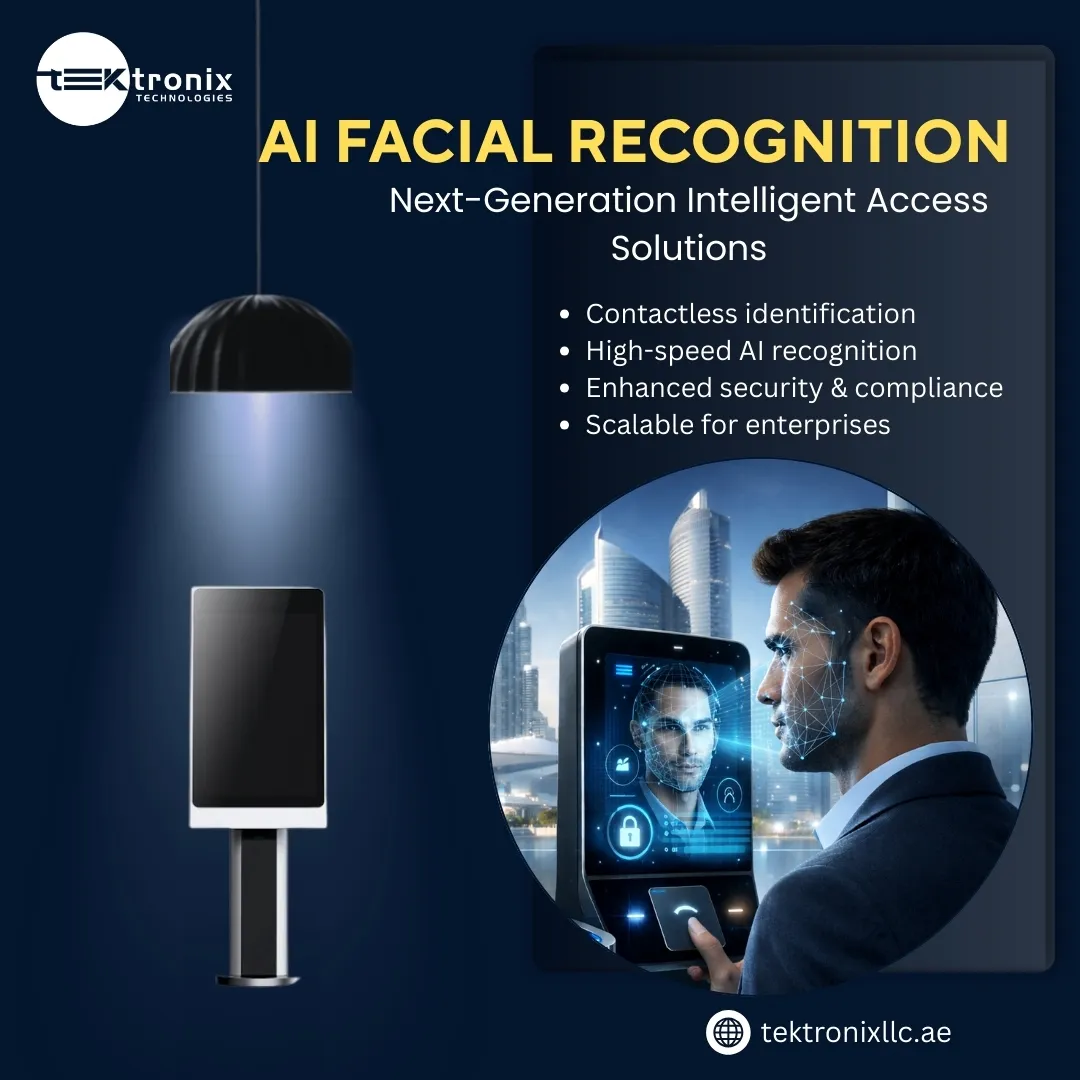

Advanced facial recognition technology is fundamentally transforming how governments, enterprises, and critical infrastructure operators across the UAE approach physical security, access control, and identity verification. Once confined to border agencies and intelligence services, today's facial recognition systems are deployed across airports, smart cities, commercial towers, healthcare campuses, and financial institutions — delivering real-time, contactless identity verification at a scale and accuracy level that no human-led process can match.
From the smart surveillance corridors of Dubai and Abu Dhabi to the growing industrial free zones of Sharjah, the adoption of facial identification and facial authentication platforms is accelerating rapidly — driven by regulatory mandates, smart city initiatives, and an increasing need to protect high-value assets and people in one of the world's most dynamic economies.
The Rise of Biometric Security in the UAE
The United Arab Emirates has positioned itself as a global pioneer in smart governance and digital transformation. The UAE Vision 2031 and Emirates Blockchain Strategy 2021 have both established biometric technologies — including face detection and liveness verification — as cornerstones of the national digital identity infrastructure. The country's low crime tolerance, high tourist inflow, and significant expatriate workforce create a unique security environment where automated identity verification is not a luxury but an operational necessity.
Key drivers of adoption include the UAE's Smart Cities programme (with Dubai and Abu Dhabi both operating sophisticated command-and-control centres), EXPO City legacy infrastructure, massive ongoing construction and infrastructure projects requiring workforce management, and a financial sector under increasing KYC (Know Your Customer) and AML compliance pressure from the UAE Central Bank and the Financial Intelligence Unit (FIU).
How a Facial Recognition System Works: The Technology Behind the Lens
A modern facial recognition system operates through a multi-stage deep learning pipeline that converts a camera image into a secure, searchable identity record. Understanding this pipeline helps organizations evaluate vendor claims and deployment trade-offs.
1. Face Detection and Localization
The first stage uses convolutional neural networks (CNNs) to detect and localize all human faces within a camera frame — regardless of angle, partial occlusion, lighting condition, or distance. High-performance face detection engines such as MTCNN, RetinaFace, or YOLO-based architectures can process multiple faces per frame at 30+ frames per second on modern edge AI hardware.
2. Biometric Feature Extraction and Embedding
Once a face is detected, the system generates a mathematical facial embedding — a compact numerical vector of 128 to 512 dimensions — that encodes the unique geometry of facial landmarks: eye spacing, nasal bridge width, jaw contour, cheekbone prominence, and lip structure. This embedding is the biometric signature used for all subsequent comparison and matching operations. Critically, the raw image is not stored — only the encrypted embedding — ensuring privacy-by-design compliance.
3. Facial Identification vs. Facial Authentication
It is important to distinguish between two distinct use cases. Facial identification (1:N matching) compares an unknown face against a database of enrolled identities to determine who a person is — used in surveillance watchlist screening, border control, and law enforcement. Facial authentication (1:1 matching) verifies that a person is who they claim to be — used in access control, employee attendance, financial transactions, and customer onboarding. Both modes require different performance thresholds, hardware configurations, and regulatory compliance frameworks.
Choosing the Right Facial Recognition Software and Devices
Selecting the right facial recognition software and hardware pairing is critical to deployment success. Enterprise-grade platforms offer features that consumer-facing systems do not:
- Liveness detection (anti-spoofing): Ensures that the system cannot be fooled by photographs, video replays, or 3D-printed masks — a mandatory requirement for financial-grade facial authentication applications.
- Multi-spectral and low-light performance: Near-infrared (NIR) camera modules enable reliable face detection in complete darkness and outdoor glare — essential for 24/7 security operations in the UAE's intense sunlight conditions.
- GDPR and UAE PDPL compliance: Privacy-preserving architectures that store only encrypted embeddings, not biometric images, and support data subject rights under the UAE Personal Data Protection Law (Federal Decree-Law No. 45 of 2021).
- SDK and API integration: Open integration layers that connect with existing access control systems, HR platforms, visitor management systems, and video management software (VMS).
- Edge AI processing: On-device inference capability that eliminates latency and reduces bandwidth consumption — critical for remote sites, offshore facilities, and bandwidth-constrained environments.
A purpose-built facial recognition device — such as a wall-mounted access terminal with an integrated NIR camera, anti-spoofing module, and local AI processing chip — delivers faster throughput and greater reliability than a generic IP camera running cloud-based analysis. Leading manufacturers including Hikvision DeepinMind, Dahua, ZKTeco, and Suprema offer UAE-certified hardware with operating temperature tolerances suited to Gulf climate conditions.
Facial Recognition Across the Emirates: City-by-City Deployment Landscape
Facial Recognition in Dubai
Dubai is the UAE's most advanced deployment market for biometric security. Facial recognition in Dubai is embedded across Dubai Airports (DXB and DWC) through the Smart Gates programme managed by GDRFA (General Directorate of Residency and Foreigners Affairs), which processes millions of travellers annually using iris and face biometrics. The Dubai Police Command and Control Centre deploys city-wide biometric surveillance across smart intersections and public venues. The Dubai Land Department and DIFC financial entities use facial authentication for KYC during property transactions and account onboarding. Major commercial real estate developers including Emaar, Nakheel, and Aldar are integrating biometric access control into their premium residential and commercial tower developments.
Facial Recognition in Abu Dhabi
Abu Dhabi's security architecture reflects the emirate's dual role as the UAE's political capital and energy heartland. Facial recognition in Abu Dhabi is prominently deployed at Zayed International Airport (AUH), in Abu Dhabi Police's smart patrol vehicles and fixed CCTV networks, and across ADNOC's upstream and downstream facilities for workforce identity management and access control. The Abu Dhabi Department of Economic Development (ADDED) and free-zone authorities including KIZAD and KEZAD also mandate biometric workforce registration for contractors and blue-collar workers — reducing buddy-punching, ensuring HSE compliance, and supporting payroll accuracy.
Facial Recognition in Sharjah
Sharjah's manufacturing-heavy economy and cost-conscious industrial operators have embraced biometric attendance and access control as a cost-efficient alternative to card-based systems prone to misuse. Facial recognition in Sharjah is growing across industrial and free-zone facilities managed by SAIF Zone, Hamriyah Free Zone, and SHAMS, where large blue-collar workforces require touchless, tamper-proof identity verification at shift gates. Sharjah International Airport has also begun integration of biometric boarding processes aligned with GCAA's national aviation biometrics roadmap.
Key Industry Applications for Facial Recognition Solutions in the UAE
A comprehensive facial recognition solution delivers value across multiple industry verticals in the UAE:
- Critical infrastructure and government: Border control, airport passenger processing, smart city surveillance, and national ID verification programmes managed by ICA (Federal Authority for Identity, Citizenship, Customs & Port Security).
- Banking and financial services: Video KYC for remote account opening, real-time fraud prevention at ATMs and teller counters, and regulatory compliance with CBUAE and FATF biometric identity guidelines.
- Healthcare: Patient identity verification to eliminate medical record errors, staff authentication for pharmaceutical access control, and visitor management in restricted clinical areas.
- Hospitality and retail: VIP guest recognition, frictionless hotel check-in, contactless payment authentication, and loyalty programme identification in luxury retail environments across Dubai Mall, Mall of the Emirates, and Yas Mall.
- Construction and energy: Workforce attendance management on mega-projects, gate access control for restricted plant areas, and integration with payroll and HSE management systems.
- Education: Student and staff attendance automation in universities and schools, combined with campus access control and safeguarding protocols.
Why Partner with Tektronix LLC for Facial Recognition in the UAE
Tektronix LLC is a UAE-headquartered technology integrator with over a decade of proven experience deploying intelligent security, biometric access control, and video analytics systems across the GCC. Our certified engineers have designed and commissioned facial recognition UAE deployments for clients spanning government ministries, international airports, ADNOC-affiliated energy facilities, tier-one real estate developers, and multinational financial institutions.
Our deep familiarity with the UAE's regulatory environment — including ICA biometric data standards, GDRFA e-gate integration protocols, CBUAE KYC guidelines, and UAE Personal Data Protection Law (PDPL) requirements — ensures that every deployment is not only technically excellent but fully compliant with local legal mandates. We partner exclusively with globally certified vendors whose platforms carry ISO/IEC 19794, NIST FRVT, and GDPR compliance validation.
Conclusion
The UAE's security landscape is undergoing a profound transformation — and facial recognition is at the heart of it. What began as a niche border-control technology has matured into a comprehensive security ecosystem — spanning facial recognition software platforms, purpose-built facial recognition devices, and end-to-end facial recognition solutions tailored to the UAE's unique regulatory, climatic, and operational context.
Whether you are securing a government facility in Abu Dhabi, managing workforce access on a Dubai construction megaproject, streamlining guest experiences in a Sharjah hospitality venue, or onboarding customers for a UAE financial institution, the right biometric identity platform — designed and deployed by a trusted local integrator — delivers measurable improvements in security, compliance, and operational efficiency. The era of card-swipes and PIN codes is ending. The era of intelligent, contactless, real-time identity verification has arrived.
FAQs
FAQ 1: Is facial recognition technology legal in the UAE?
Yes. Biometric identity systems including facial recognition are legally deployed and actively promoted under UAE national digital transformation programmes. The UAE Personal Data Protection Law (Federal Decree-Law No. 45 of 2021) governs the collection, storage, and processing of biometric data, requiring explicit consent for commercial applications and mandating data minimisation principles. Government-led programmes — including ICA Smart Gates and Dubai Police surveillance networks — operate under separate sovereign regulatory frameworks. Reputable integrators such as Tektronix LLC ensure that every commercial deployment is fully aligned with PDPL requirements, including encryption of biometric templates, data subject rights implementation, and Data Protection Impact Assessment (DPIA) documentation.
FAQ 2: How accurate are facial recognition systems in real-world UAE conditions?
Leading enterprise-grade facial recognition systems achieve false acceptance rates (FAR) of below 0.01% and false rejection rates (FRR) of 0.1–0.5% under controlled conditions, validated by NIST FRVT benchmarks. In real-world UAE deployments, accuracy is influenced by camera resolution (minimum 2MP recommended), IR illumination for night-time operations, face angle (systems perform optimally at ±30° from frontal), and enrollment image quality. High-quality facial recognition devices equipped with NIR sensors maintain reliable performance in direct sunlight and night-time conditions. A professional site survey and pilot deployment by a certified integrator is strongly recommended before full-scale rollout.
FAQ 3: Can facial recognition software integrate with our existing access control system?
Yes. Modern facial recognition software platforms offer open API and SDK integration with leading access control ecosystems including Honeywell Pro-Watch, Lenel OnGuard, Genetec Security Center, and HID Global, as well as time-and-attendance platforms, HR information systems (HRIS), and visitor management systems. For UAE-specific deployments, compatibility with existing ONVIF-compliant IP camera infrastructure is standard — allowing organisations to add biometric capabilities without full infrastructure replacement. Tektronix LLC conducts pre-deployment compatibility assessments to map the optimal integration path for your specific environment.
FAQ 4: What is the difference between a facial recognition solution for access control vs. surveillance?
Access control and surveillance represent two distinct deployment paradigms for facial recognition solutions. Access control (facial authentication / 1:1) involves a cooperative subject standing at a designated terminal for identity verification — allowing the use of higher-quality cameras, controlled lighting, and anti-spoofing modules, delivering verification in under one second. Surveillance (facial identification / 1:N) involves non-cooperative subjects captured by wide-area cameras in uncontrolled conditions — requiring higher-performance algorithms, watchlist database management, and human review workflows for match confirmation. UAE organisations typically deploy both modes: access-control terminals at entry points and surveillance analytics on common-area camera networks.
FAQ 5: How long does it take to deploy a facial recognition system across a large UAE facility?
Deployment timelines for a facial recognition system depend on facility scale, infrastructure maturity, and integration complexity. For a medium-sized commercial facility with 10–30 access points and an existing IP camera network, a full biometric access control rollout typically requires three to six weeks: one week for site survey and hardware procurement, one to two weeks for device installation and network configuration, one week for enrollment campaign and database population, and one week for parallel testing and staff training. Large-scale deployments — such as an energy facility with multiple access zones, integration with an ERP platform, and connection to a central HSE management system — may require twelve to twenty weeks. Tektronix LLC provides phased deployment plans to minimise operational disruption and ensure system reliability from day one.
































Sign in to leave a comment.