

Video Analytics is redefining how industrial operators across Bahrain and the GCC enforce worker safety — especially during the high-risk, low-visibility window of night shifts. As mega-projects under Vision 2030, Bahrain’s Economic Vision, and regional infrastructure expansions push construction and manufacturing operations into round-the-clock schedules, the ability to automatically detect Personal Protective Equipment (PPE) compliance in real time has moved from innovation to operational necessity.
This guide explores how AI-powered PPE detection and video analytics solutions are transforming night-shift safety management across oil and gas facilities, petrochemical plants, construction megaprojects, and logistics hubs throughout the Gulf Cooperation Council. From the science of low-light detection to regulatory compliance, ROI modelling, and real-world deployment considerations, this is the practitioner-grade resource your safety and technology teams need.
1. The Night Shift Safety Crisis in GCC Industrial Operations
Across the GCC, a significant share of industrial fatalities and serious injuries occur between the hours of 10 PM and 6 AM. The reasons are well-documented: reduced supervisor presence, worker fatigue, compressed visibility, and a documented tendency for PPE compliance rates to fall during night hours when direct oversight is lowest. Studies from GCC occupational health bodies consistently show PPE adherence drops by 25–40% during overnight rotations compared with daytime shifts.
The consequences are severe. A worker on a petrochemical site in Jubail or a construction tower in NEOM who removes their hard hat, forgets their high-visibility vest, or skips eye protection for “just a moment” during a night operation creates a liability that no safety briefing or manual inspection regime can reliably prevent. Traditional human supervisors cannot maintain constant vigilance across expansive facilities in darkness. Camera systems alone, without intelligence, produce footage that is reviewed only after incidents occur — too late to matter.
1.1 The Limitations of Manual Night-Time Safety Enforcement
- Supervisor fatigue: Human monitors become progressively less effective after hour four of a night shift, with attention deficits well-documented in occupational psychology research.
- Facility scale: A single offshore platform, industrial complex, or Tier 1 construction site may cover hundreds of thousands of square metres — physically impossible to patrol continuously.
- Documentation gaps: Manual observation cannot produce the timestamped, auditable compliance records that regional regulators and international insurers increasingly require.
- Reactive rather than preventive: Without automated alerting, safety breaches are typically discovered only when an incident has already occurred or during post-shift video review.
These limitations create the precise conditions in which AI-Powered Video Analytics delivers its highest return: continuous, objective, fatigue-free monitoring that operates as effectively at 3 AM as it does at noon.
2. How Video Analytics Software Detects PPE in Low-Light Conditions
Understanding the technology stack behind night-time PPE detection is essential for decision-makers evaluating Video Analytics Software vendors and deployment architectures. Modern systems have evolved far beyond simple pixel-comparison motion detection — they represent a convergence of computer vision, deep learning, and edge computing engineered specifically for challenging industrial environments.
2.1 Low-Light and Thermal Imaging Infrastructure
Effective night-shift PPE detection begins with the right imaging hardware integrated with the analytics engine:
- StarLight and ultra-low-lux cameras: Advanced image sensors that produce colour video at illumination levels as low as 0.001 lux — capturing detail in conditions where the human eye sees only darkness.
- Near-infrared (NIR) illumination: Covert or visible IR illuminators that flood a scene with wavelengths the camera sensor captures but workers do not perceive, preserving workplace ambience while enabling full-detail imaging.
- Thermal imaging integration: Radiometric cameras that detect body heat signatures regardless of ambient light, enabling detection of human presence and rough positional data even in complete darkness or through dust and smoke.
- PTZ auto-tracking: Pan-tilt-zoom cameras with AI-driven auto-tracking that follow workers through a scene, maintaining the angular resolution required for accurate PPE classification without static blind spots.
2.2 AI-Powered Object Recognition for PPE Classification
At the core of any effective system is AI-Powered Object Recognition — the ability of a trained deep learning model to identify specific PPE items on a human figure within a video frame, under challenging real-world conditions. Here is how enterprise-grade systems handle this:
- Convolutional Neural Network (CNN) architectures: Trained on millions of annotated industrial images, these models learn to recognise hard hats, safety vests, gloves, safety glasses, steel-toed boots, fall-arrest harnesses, and respiratory protection across a vast range of body positions, lighting conditions, and occlusion scenarios.
- Multi-class simultaneous detection: A single inference pass identifies multiple PPE categories on multiple workers simultaneously, enabling real-time monitoring of entire crews rather than individual workers in sequence.
- Pose estimation integration: Skeleton-based human pose models help the PPE classifier understand body orientation, resolving ambiguities that arise when a worker is viewed from behind or at an angle where a standard bounding-box detector would fail.
- Confidence scoring and threshold management: Each detection is accompanied by a confidence score. Operators can set classification thresholds appropriate to their risk environment: a nuclear facility may require 95%+ confidence before clearing a worker; a lower-risk warehouse may accept 85% as operationally sufficient.
2.3 Edge vs. Cloud Processing Architectures
GCC industrial operators face a practical choice between on-premises edge processing and cloud-based analytics pipelines:
- Edge computing: AI inference runs on ruggedized edge servers co-located with cameras at the facility. Advantages include ultra-low latency (sub-100ms alert generation), full operation during WAN outages, and data sovereignty compliance for facilities subject to Bahrain PDPDL or Saudi PDPL requirements.
- Cloud processing: Video streams are transmitted to a hosted analytics platform. Advantages include rapid model updates, centralised management of multi-site deployments, and elastic scaling during high-occupancy periods.
- Hybrid architecture: Edge devices handle real-time alerting and local recording; cloud platforms receive anonymised analytics data and model telemetry for continuous improvement and enterprise reporting. This is the most common architecture for large GCC operators managing multiple facilities.
3. Real-Time PPE Compliance Monitoring: From Detection to Corrective Action
Detection without response is surveillance without safety. Real-Time PPE Compliance Monitoring closes the loop between an AI-identified PPE violation and a corrective action that prevents an injury. The workflow in a mature deployment follows a defined escalation chain:
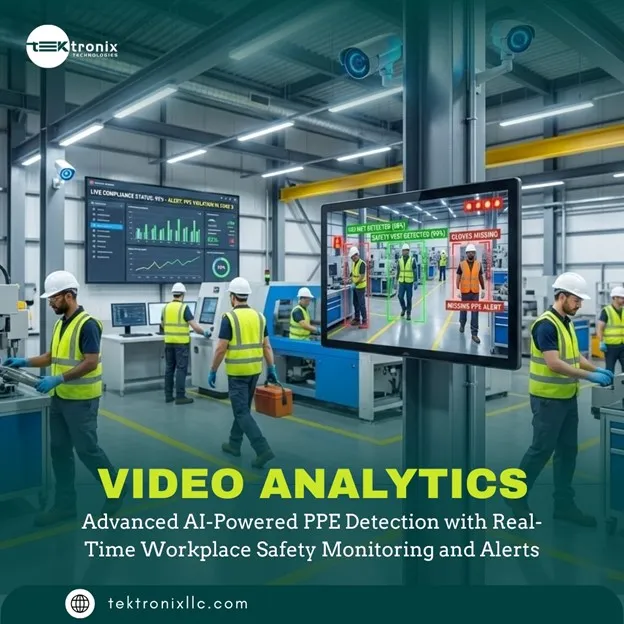
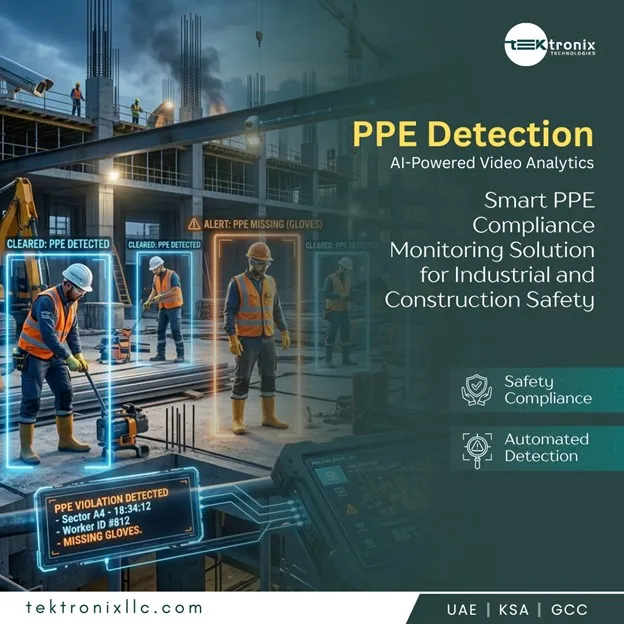
- Detection event: The AI model identifies a worker in a designated safety zone without required PPE. A bounding box is drawn around the non-compliant individual; the specific missing item(s) are classified and logged.
- Immediate on-site alert: A zone-specific alarm is triggered — this may be an audible PA announcement, a visual strobe, a message to a nearby supervisor’s radio or mobile device, or an automated intercom prompt directing the worker to don their equipment.
- SOC/Control Room notification: The event is simultaneously pushed to the Safety Operations Centre dashboard with a live video clip, GPS zone reference, timestamp, worker classification, and specific PPE violation details.
- Escalation on non-compliance: If the worker does not achieve compliance within a configurable time window (typically 30–60 seconds), the system escalates to a senior supervisor or initiates a zone lockout depending on risk classification.
- Automated incident record: A structured incident report — including video evidence, location, time, zone, and violation type — is written to the compliance management system for regulatory reporting and trend analysis.
3.1 Integration with Permit-to-Work and Access Control Systems
Leading deployments in the GCC integrate PPE compliance monitoring directly with Permit-to-Work (PTW) systems and physical access control:
- PTW compliance gating: Workers attempting to enter a high-risk zone are scanned at the entry point. Those not wearing the PPE specified on their active work permit are physically denied access until compliance is achieved.
- Biometric cross-referencing: Where facial recognition is operationally and legally permissible, detected violations are linked to worker identity records, enabling targeted retraining and repeat-offender tracking.
- Shift handover briefing data: Compliance statistics from the outgoing night shift are automatically compiled and presented to the incoming day shift supervisor, creating a continuous safety culture rather than isolated shift accountability.
3.2 Dashboard Analytics and Compliance Reporting
A robust Video Analytics Solutions platform provides operations and safety managers with a comprehensive compliance intelligence dashboard:
- Zone-level compliance heatmaps: Visual overlays showing which areas of a facility record the highest PPE violation frequencies, enabling targeted engineering controls and supervision allocation.
- Time-series compliance trending: Hourly, daily, and weekly compliance rate graphs that reveal systemic patterns — such as the predictable compliance dip between 2–4 AM that characterises most night-shift operations.
- PPE category breakdown: Separate tracking for each equipment category — hard hats, vests, gloves, eye protection — enabling root cause analysis (for example, a spike in glove non-compliance may signal supply issues rather than behavioural problems).
- Regulatory compliance reporting: Automated generation of reports formatted for submission to Bahrain’s Ministry of Labour and Social Development, Saudi Arabia’s Ministry of Human Resources, and international certification bodies (ISO 45001, OSHA equivalents).
4. High Accuracy Detection: Performance Standards for GCC Industrial Environments
Operators evaluating vendors must interrogate High Accuracy Detection claims rigorously. Detection accuracy is not a single number — it is a function of camera resolution, lighting conditions, worker density, PPE colour contrast against background, model training data diversity, and inference hardware capability. Here is how to assess and specify accuracy requirements:
4.1 Key Performance Metrics
- Detection rate (Recall): The percentage of actual PPE violations that the system correctly flags. For critical safety applications, a minimum of 92% recall is the industry standard; enterprise deployments should target 95%+.
- False positive rate (Precision): The percentage of system alerts that are genuine violations vs. false alarms. High false positive rates desensitise safety teams — a system generating 200 false alerts per shift will be ignored within weeks. Target precision of 90%+ in operational conditions.
- Detection latency: The time between a violation occurring and an alert being generated. For real-time safety applications, sub-three-second latency is the standard; edge deployments routinely achieve sub-one-second.
- Night-time performance parity: The ratio of detection accuracy at night vs. daytime. Systems should achieve no more than a 5% degradation in recall under night-shift imaging conditions with appropriate camera hardware. Vendors claiming “night performance equivalent to daytime” should be required to substantiate this with validated field data from comparable GCC environments.
4. Deployment Roadmap: Implementing PPE Detection for Night Shifts
Successful enterprise deployments follow a structured methodology that accounts for the physical, operational, and change-management dimensions of introducing AI safety monitoring into an established industrial culture.
4.1 Phase 1 — Site Assessment and Baseline Establishment (Weeks 1–4)
- Facility walkthrough to map all safety-critical zones, camera coverage gaps, lighting conditions, and worker flow patterns across both day and night shifts.
- Review of existing PPE policy, incident records, and regulatory requirements to define the detection taxonomy (which items must be detected in which zones).
- Night-shift observation sessions to document the specific lighting, movement, and occupancy patterns that the AI model will need to address.
- Baseline compliance rate measurement using manual observation and existing CCTV footage to establish the pre-deployment benchmark against which ROI will be calculated.
4.2 Phase 2 — System Design and Procurement (Weeks 5–10)
- Camera specification: type, resolution, low-light rating, mounting positions, and field-of-view calculations for each monitored zone.
- Edge or hybrid architecture design, including server specifications, network segmentation, cybersecurity controls, and data flow diagrams.
- Integration design for existing systems: access control, PTW platform, HR/workforce management, and safety management systems.
- PDPDL/PDPL compliance review: data protection impact assessment (DPIA), consent framework design, retention policy, and access controls.
4.3 Phase 3 — Installation, Commissioning, and Model Tuning (Weeks 11–18)
- Physical installation of cameras, edge hardware, and network infrastructure with full HSE site safety compliance.
- AI model deployment and initial calibration: zone definition, detection threshold setting, alert routing configuration.
- Night-shift performance validation: system operated in parallel with manual monitoring to validate detection rates and false positive levels against agreed KPIs.
- Model fine-tuning based on site-specific observations: lighting artefacts, PPE variants, worker movement patterns.
4.4 Phase 4 — Go-Live, Training, and Continuous Improvement
- Operational handover to safety operations team with comprehensive training on dashboard, alert management, and reporting functions.
- Supervisor and worker communication programme explaining the system’s purpose, capabilities, and data governance.
- 30/60/90-day performance reviews comparing compliance rates, incident rates, and system KPIs against baseline.
- Quarterly model updates incorporating new site conditions, PPE variants, and revised regulatory requirements.
5. Why Tektronix LLC Is the GCC's Trusted AI Video Analytics Partner
Tektronix LLC has delivered technology solutions to enterprise clients across Bahrain, Saudi Arabia, the UAE, Qatar, Kuwait, and Oman for over a decade. Our AI-powered PPE detection and video analytics platform is purpose-built for the industrial environments, regulatory frameworks, and workforce characteristics of the GCC region.
Our proven differentiators include:
- GCC-trained AI models: Detection models validated on regional industrial datasets — accounting for local PPE variants, environmental conditions, and cultural workforce diversity.
- End-to-end delivery: From site survey and system design through installation, commissioning, model tuning, and 24/7 managed support — a single accountable partner.
- Regulatory expertise: Deep knowledge of PDPDL, PDPL, UAE Information Assurance, and GCC labour law requirements embedded in every deployment design.
- Vendor-neutral architecture: Integration with leading camera hardware (Axis, Hanwha, Hikvision), VMS platforms (Milestone, Genetec), and enterprise safety systems (SAP EHS, Intelex) without proprietary lock-in.
- Scalable multi-site management: Centralised management console supporting simultaneous monitoring and compliance reporting across multiple facilities in multiple GCC jurisdictions.
Conclusion
Night shifts represent the highest-risk, lowest-visibility window in GCC industrial operations — and traditional safety management approaches have consistently failed to close this gap. Video Analytics powered by advanced AI, purpose-built low-light imaging, and real-time alerting infrastructure finally gives safety managers the ability to enforce PPE compliance continuously, objectively, and at scale — regardless of whether the clock reads noon or 3 AM.
For operators in Bahrain and across the GCC, the convergence of regulatory pressure, ESG accountability, mega-project workforce scale, and demonstrable ROI has made AI-powered safety monitoring a strategic imperative rather than a technology experiment. Facilities that deploy now will build the compliance data history, the institutional knowledge, and the safety culture advantage that will define industry leadership in the years ahead.
FAQs
Q1. How accurate is AI-powered PPE detection during GCC night shifts?
Accuracy varies by system quality, camera specification, and operating environment, but enterprise-grade AI-Powered Video Analytics deployments using appropriate low-light cameras — StarLight or NIR-assisted — routinely achieve 92–97% recall and 90–95% precision for primary PPE items (hard hats, vests, gloves, eye protection) under night-shift conditions. The critical qualifier is “enterprise-grade with appropriate hardware”: budget cameras paired with generic models will underperform significantly. Tektronix LLC mandates a night-performance validation phase in every deployment, requiring the system to meet agreed accuracy KPIs before operational handover.
Q2. Does deploying Video Analytics Software comply with Bahrain PDPDL and GCC data protection laws?
Yes, with appropriate design. Video Analytics Software deployments can be architected for full compliance with Bahrain’s PDPDL, Saudi Arabia’s PDPL, and UAE data protection regulations. Key compliance measures include: conducting a Data Protection Impact Assessment (DPIA) before deployment; implementing data minimisation (anonymising worker imagery where individual identification is not required for safety purposes); setting clear retention periods and automated deletion policies; restricting access to video records through role-based controls; and documenting the legitimate interest or consent basis for surveillance. Tektronix LLC’s standard deployment methodology includes a dedicated regulatory compliance workstream addressing all applicable GCC data protection requirements.
Q3. What PPE items can the AI model detect, and can it be customised for site-specific requirements?
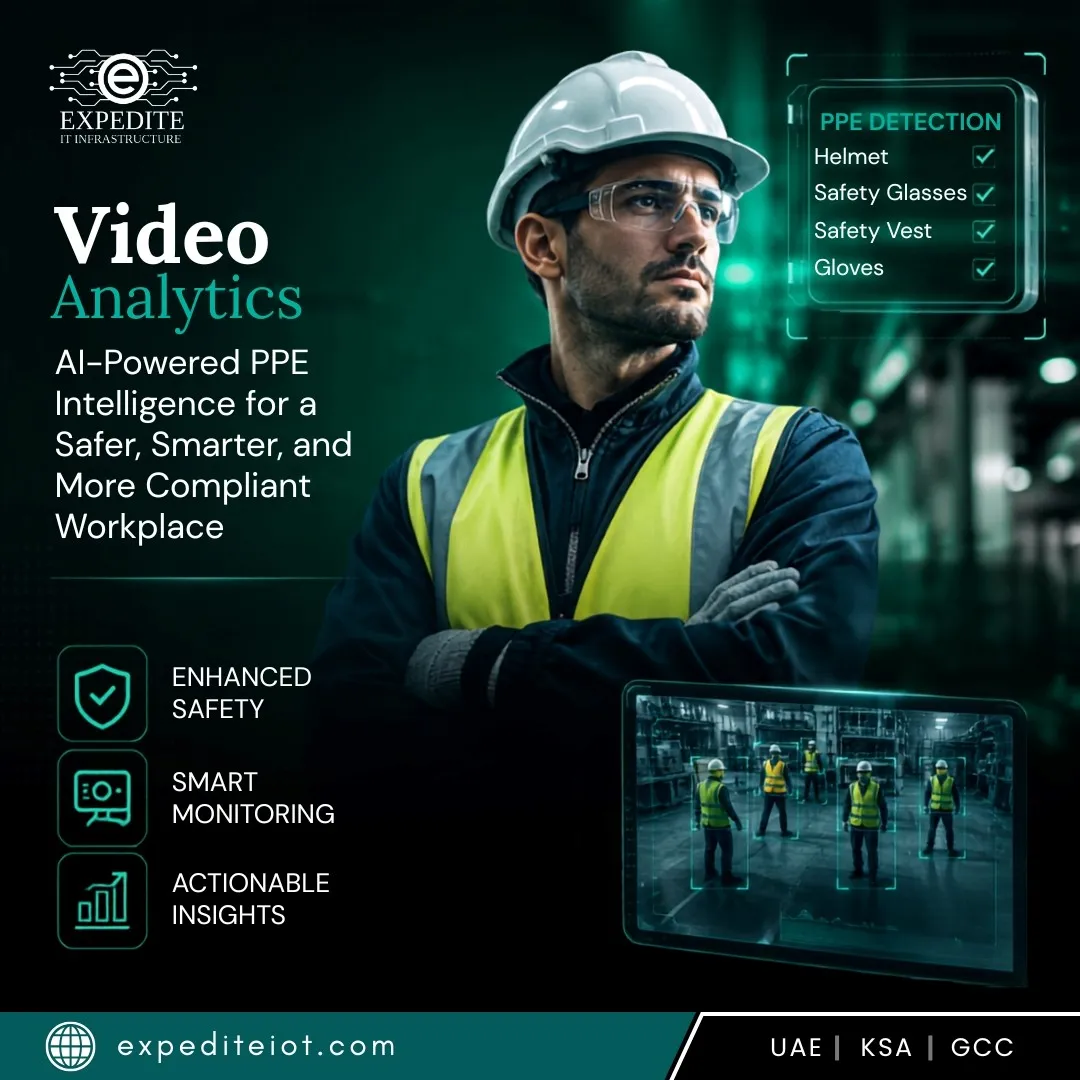
Standard AI-Powered Object Recognition models used in industrial PPE applications detect: hard hats/helmets, high-visibility vests and jackets, safety gloves, safety glasses and face shields, steel-toed footwear, fall-arrest harnesses, and respiratory protection. Most enterprise platforms allow site-specific customisation: adding novel PPE categories (for example, specific chemical-resistant suit types used in petrochemical environments), adjusting detection confidence thresholds per zone and per equipment type, and incorporating zone-specific compliance rules (for example, gloves required only in machining areas, not in administrative zones). Tektronix LLC’s model customisation service supports this through additional training data collection and supervised fine-tuning cycles.
Q4. How long does it take to deploy a PPE detection system across a large GCC facility?
A typical enterprise deployment at a mid-to-large GCC industrial facility follows an 18-to-22-week programme: four weeks for site assessment and baseline; six weeks for design and procurement; eight weeks for installation, commissioning, and model validation; and an ongoing continuous improvement programme post-go-live. Facilities with existing camera infrastructure can compress the installation phase. Tektronix LLC has completed deployments at multi-building industrial complexes in Bahrain and Saudi Arabia within 14 weeks through parallel workstream management. The Real-Time PPE Compliance Monitoring system is fully operational at go-live, not dependent on a post-deployment learning period, because model training is completed during the commissioning phase.
Q5. What is the ROI timeframe for AI PPE detection in GCC industrial operations?
Most GCC operators achieve full return on investment within 18 to 30 months, with safety-focused organisations in high-risk sectors (oil and gas, petrochemicals) reporting payback in as little as 12 months following the prevention of even one serious incident. The ROI calculation should include: incident and near-miss cost avoidance, regulatory penalty avoidance, insurance premium reductions, supervisor redeployment efficiency gains, and the commercial value of ISO 45001 and OSHA-equivalent certifications that documented compliance monitoring supports. High Accuracy Detection directly drives ROI quality — a system with high false positive rates creates administrative burden that erodes the efficiency gains, while a system with low recall leaves safety gaps that expose the operator to the incident costs the investment was designed to prevent. Tektronix LLC provides a site-specific ROI model as part of the pre-sales assessment process.
For more information contact us on:
Tektronix Technology Systems Dubai-Head Office
+971 55 232 2390



























Sign in to leave a comment.