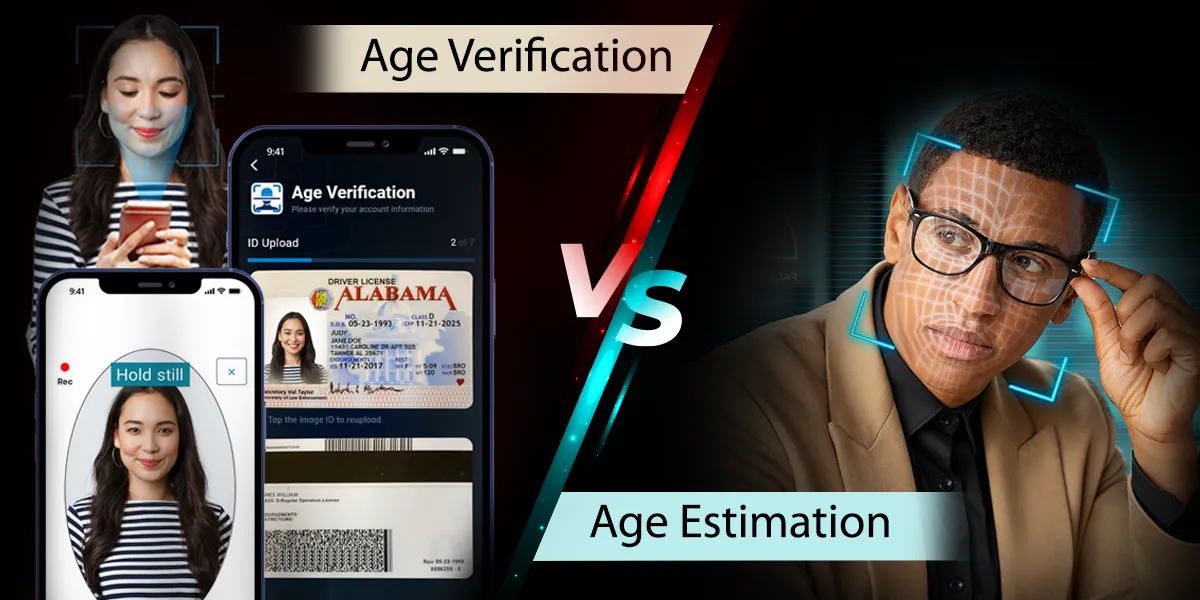

As more products and services—like alcohol delivery, tobacco sales, gaming platforms, and dating apps—shift online, knowing who can access them has never been more important. Businesses can’t rely on guesswork anymore, especially when minors can bypass restrictions with just a few clicks.
Adding to the pressure are strict global regulations like Know Your Customer (KYC) mandates, online safety laws, and youth protection rules that require companies to prove they’re keeping underage users out.
In this digital world, simply estimating someone’s age isn’t enough. The real question is: which method truly protects users and keeps businesses compliant: age estimation or age verification?
In this blog post, we will discuss age gating and age verification methods, their pros, the significance of each method, and the difference between them.
What Is Age Estimation?
This process involves determining a person’s age based on biological indicators. The most common way is through facial recognition. As it is driven by technology, it uses AI and machine learning algorithms to analyze a person’s facial features. It is widely used in age-restricted industries like gaming, retail, alcohol, online platforms, and vending systems to ensure compliance with legal age restrictions.
Types of Age Estimation Technologies
There are different types of age estimation technologies used to determine a person’s age or age range to give them access to age-restricted products, services, or content.
We will discuss the most common types of age estimation technologies.
- AI Facial Analysis-Based Estimation: This technology uses AI and machine learning algorithms to analyze specific facial features from a photo or video feed. It examines biometric markers that change with age, like skin texture, wrinkle patterns, and bone structure, to predict an approximate age.
- Behavioral Analysis: This technology estimates a user’s age by looking at how they interact online—their activity patterns, the way they communicate, and even their voice. Machine learning algorithms can identify behavior differences between age groups to make an educated guess about the user’s age.
- Data-Based Contextual Estimation: This approach involves cross-referencing a user’s submitted data against trusted third-party databases like public records or credit bureaus to verify a person’s age or age limit.
- Self-Declared Age Fields: This is the simplest method, which requires the user to manually enter their birth dates or confirm they are of a certain age. This method is considered low-friction and is also the least reliable, as users (especially minors) can provide false information. For highly regulated products or content, this method is often paired with more robust verification solutions.
Pros of Age Estimation
Age estimation offers several benefits that make it a convenient choice for many platforms.
- Fast and Frictionless: Age estimation method offers a quick and non-intrusive way to check a user’s age without lengthy processes, which is essential for high-traffic websites and apps.
- Privacy-Preserving (No ID Required): Users don’t need to share government IDs or personal data, as it often uses facial analysis or other on-device methods, which reduce data exposure.
- Useful in Low-Risk Contexts: This method is best suitable for platforms like social media, gaming, and content sites where legal verification isn’t always needed, but age appropriateness is the key.
- Supports Parental Control Ecosystems: Helps build ecosystems where content and features can be automatically tailored to age groups, protecting children without over-sharing.
What Is Age Verification?
It is the process of confirming a user’s age to confirm they meet the legal requirements for accessing age-restricted content, products, and services. Its purpose is to ensure legal compliance, protect minors from harm, and prevent fraud. It serves as a digital gatekeeper for sensitive materials.
Types of Age Verification Methods
Age verification methods ensure that only legally eligible customers access age-restricted products or services. Each age verification method allows businesses to stay compliant, reduce human error, and prevent underage access.
- Government ID Verification: In this age verification method, users submit scans or photos of passports, driver’s licenses, or national IDs. AI, using optical character recognition (OCR), reads the data and matches it to the user’s photo.
- Database Checks: Provided ID data or personal details are cross-referenced with large databases from credit bureaus, utility companies, or government records for validation.
- Mobile Driver’s Licenses (mDLs): Digital versions of physical IDs or smartphones that offer secure and real-time age confirmation.
- Third-Party Identity Verification Providers: Services that integrate various methods like ID checks, database lookups, and biometrics for businesses.
Pros of Age Verification
- Highest level of Assurance: Age verification done via government-issued identification and biometric analysis offers a high degree of assurance, which is vital for businesses operating in regulated industries.
- Protects Businesses from Legal Penalties: Implementing a reliable age verification system helps companies comply with strict regulations. It protects businesses from hefty fines, lawsuits, license revocations, and reputational damage.
- Detects Deepfakes, Bots, and Synthetic Identities: Modern age verification solutions use artificial intelligence (AI) and machine learning to deal with sophisticated fraud.
- Supports Access to High-Risk and Regulated Content: It ensures that only age-eligible individuals can access potentially harmful or age-inappropriate content and services.
- Audit Trails for Compliance: Robust age verification platforms can generate detailed and tamper-evident audit logs and data trails that document every verification attempt and decision.
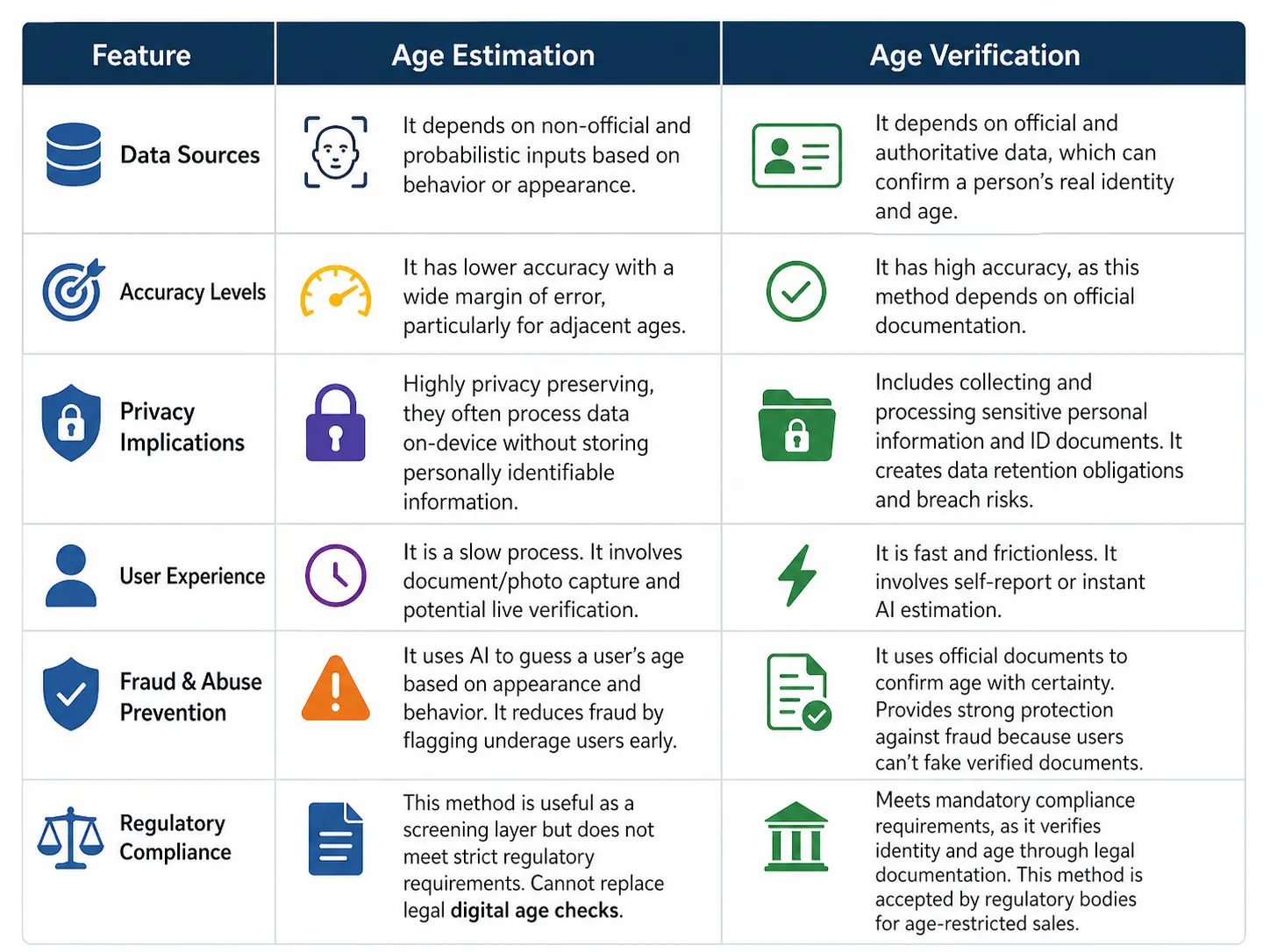
Key Differences: Age Estimation vs. Age Verification
Why Age Estimation Alone Fails to Protect Users
Age estimation tools help in initial screening, but they aren’t reliable enough to fully block underage access or meet legal compliance. As they rely on AI predictions rather than verified identity, they can be inaccurate and inconsistent across different users. This makes age estimation useful as a support tool but unsafe as the only protection method.
Manipulated by Minors
Age estimation uses visual cues, which can be tricked with makeup, lighting, filters, or even holding the camera at a certain angle. Minors can easily bypass the system by altering their appearance to look older.
In a digital environment, even uploading someone else’s photo can fool the AI. Without checking identity, the system cannot differentiate between the real user and manipulated inputs. This makes it unreliable to prevent underage access to restricted content.
Not Built for High-Crime Scenarios
Age estimation provides probability-based guesses and not verified proof. This makes it insufficient for industries like alcohol retail, online gaming, tobacco sales, or other regulated products.
Fraudsters or criminals can exploit AI loopholes to get access to restricted items. In high-risk scenarios like illegal purchases, fake identities, or money-related crimes, the system cannot establish accountability. Regulators also do not accept estimation as a secure method, which makes it legally weak.
Accuracy Gaps Across Populations
Age estimation models often show variance across genders, skin tones, ethnicities, and age groups. Some groups may appear younger or older to the AI, leading to incorrect classifications.
These accuracy gaps create fairness issues and inconsistent results for diverse customer bases. This may unintentionally allow minors while blocking legitimate adults. It creates both security and customer-experience problems.
Zero Link to Real Identity
Age estimation doesn’t verify who the user actually is, only how old they might look. As there is no ID, document, or biometric validation, the system cannot confirm real identity. This makes it impossible to track misuse, prevent repeat offenses, or link suspicious activity to an actual person. For regulated industries, identity verification is mandatory, making estimation alone insufficient for compliance and safety.
Why Age Verification Offers Strong User Protection
Age verification technology goes beyond simply estimating someone’s age; it provides a secure, compliant, and reliable method to confirm a user’s true eligibility. It safeguards both businesses and customers by ensuring that restricted products/services are accessed only by the right age group.
With strong digital identity checks, it reduces loopholes that minors, fraudsters, or bots might exploit. Overall, a robust age verification process creates a safe digital environment and builds trust in any platform offering age-restricted content or transactions.
Identity Assurance Prevents Bypass Attempts
Age verification confirms a user’s identity using reliable documents or digital authentication. This makes it far harder for minors to lie about their age. Unlike age estimation, it cannot be fooled by photos, angles, or manipulated inputs.
It prevents underage users from accessing restricted content or making illegal purchases. As a result, merchants and platforms can operate with confidence that their safeguards cannot be bypassed.
Protects Merchants from Legal Liabilities
Merchants selling age-restricted products face strict regulations, and failing to verify age can lead to hefty fines, legal actions, or license suspension. Age verification ensures full compliance by verifying the customer’s actual identity and age before any transaction.
This reduces the risk of legal problems and protects the business's reputation. By following the required guidelines, merchants show due diligence and avoid costly penalties.
Prevents Fraud, Bots, and Synthetic Identities
Age verification acts as a strong shield against fake accounts, bots, and synthetic identities often used for fraud. As it requires formal ID checks, it blocks users who try to exploit platforms with stolen details or artificially generated profiles. This strengthens the security of online transactions, reduces chargebacks, and maintains a clear, more authentic user base. Businesses benefit from improved trust and reduced financial losses.
Provides a Path to “Proof of Age” Without Storing Personally Identifiable Information (PII)
Modern age verification systems can confirm a user’s age without storing sensitive personal data, reducing privacy risks. These solutions verify age through encrypted checks or one-time validation tokens. This ensures that no sensitive information remains on the merchant servers. It protects users while helping companies stay compliant with privacy laws like the General Data Protection Regulation (GDPR) and California Consumer Privacy Act (CCPA). It delivers the right balance between safety, compliance, and user trust.
The Bottom Line
When it protects users and meets regulatory standards, age estimation simply isn’t strong enough on its own. It can be helpful as a first layer, but it cannot stop fraudsters, minors, or identity spoofing. Age verification, on the other hand, offers accuracy, compliance, and accountability that modern digital platforms require. As online risks continue to rise, businesses that adopt reliable age verification systems will stay safer, build trust, and create more responsible user experiences.




























Sign in to leave a comment.