Most failed AI projects didn't fail in the code. They failed in the six months before anyone wrote a line of it. A team picked a use case because it sounded impressive in a board meeting, skipped the hard questions about data and ownership, and handed the whole thing to a development squad with a deadline. The build was technically fine. The business impact never showed up.
This is the gap AI consulting services exist to close. Before development starts, someone needs to ask whether the problem is worth solving with AI at all, whether the data can support it, and who's accountable when the model gets something wrong. Skip that step, and you're not building AI; you're gambling with a bigger budget.
Why "Build First, Strategize Later" Keeps Failing
Development teams are good at shipping what they're told to build. They are not equipped to decide what should be built, and that's not a criticism; it's a division of labor problem.
When a company goes straight to an AI development company without a strategy phase, a few things happen predictably:
- The use case gets chosen for visibility, not ROI (chatbots and dashboards over the unglamorous workflows that actually bleed money)
- Data quality issues surface mid-build, not before it, turning a 12-week project into a 30-week one
- Nobody owns the governance question until legal or a client asks about it
- The model works in the demo and stalls in production because it was never mapped to how people actually work
None of this is a technology failure. It's a sequencing failure. Strategy has to come first because it's the layer that decides whether development is even solving the right problem.
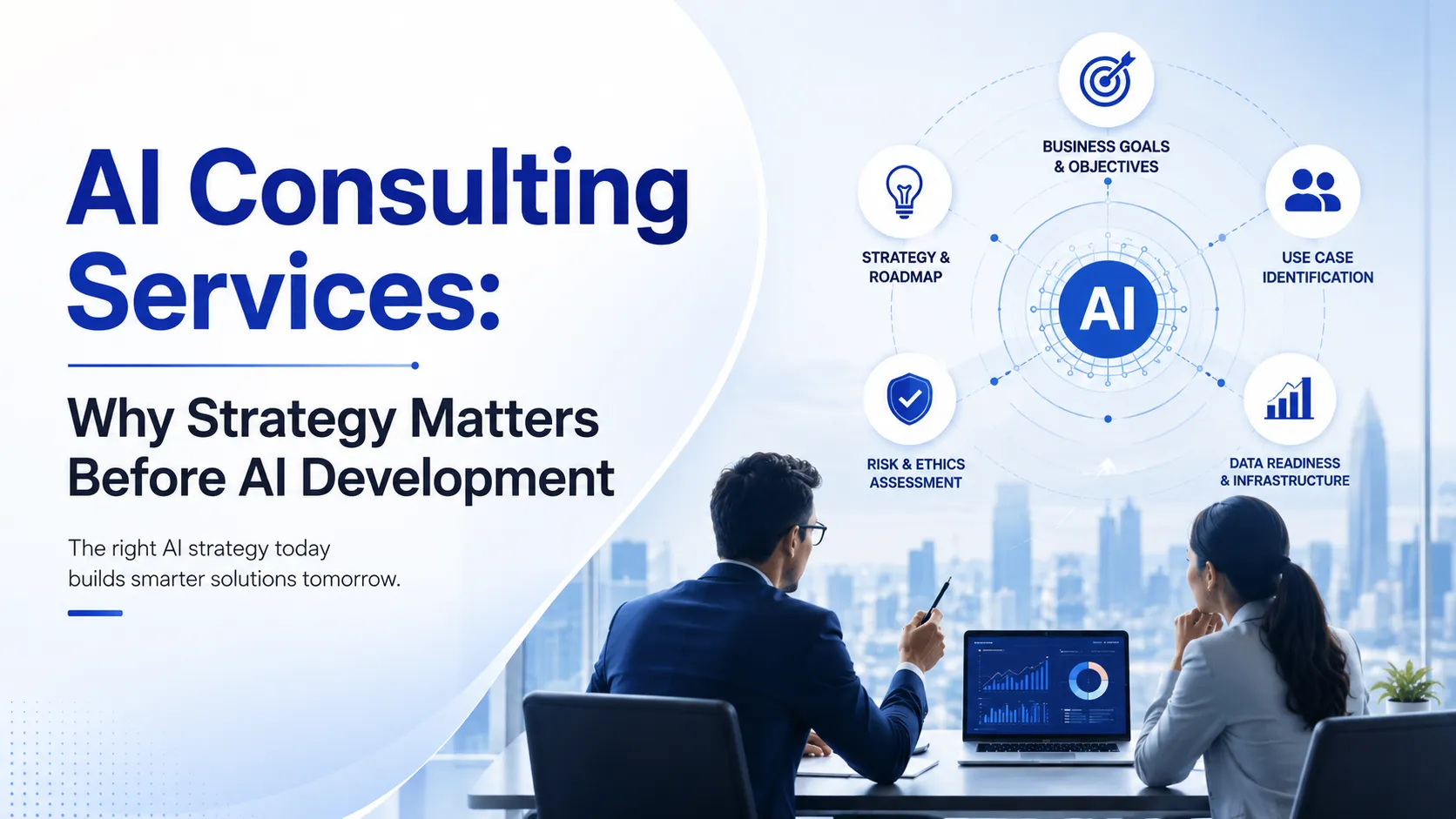
What AI Consulting Actually Covers
Good artificial intelligence consulting isn't a slide deck with a roadmap graphic. It's a working set of decisions that the development phase depends on.
Use Case Prioritization
Not every process is a good AI candidate. A solid AI consultation engagement scores opportunities against two things: how much value fixing them creates, and how feasible they are given the data and systems already in place. High value, low feasibility gets parked. Low value, high feasibility gets skipped too; it's not worth the distraction.
Data Readiness Assessment
An AI system is only as good as what it's trained on or grounded in. Consultants audit where the data lives, how clean it is, who owns it, and whether it's even legally usable for the intended purpose. This step alone kills more "shovel-ready" AI projects than any technical constraint does.
Architecture and Build vs. Buy Decisions
Should this be a fine-tuned model, an RAG pipeline over existing documents, or an off-the-shelf tool with an API? Getting this wrong means paying for infrastructure the use case never needed, or worse, under-building for a problem that required more control than a vendor tool could offer.
AI Governance and Consulting
This is the piece most companies bolt on too late. AI governance and consulting mean defining, before anything ships, how a model's decisions get reviewed, how bias gets tested for, and who signs off before a system touches a customer. It's not paperwork for its own sake — it's what stands between a company and a very public failure.
Why AI Governance Services Are No Longer Optional
A few years ago, governance was the section of the proposal nobody read closely. That's changed.
Regulatory frameworks like the EU AI Act, ISO 42001, and the NIST AI Risk Management Framework have made governance a compliance requirement in some markets and a competitive expectation in nearly all of them. Enterprise buyers now ask vendors for governance documentation before signing anything, especially in regulated industries like finance, healthcare, and insurance.
Reliable AI governance services generally cover:
- Model risk classification (what happens if this system is wrong, and how badly)
- Bias and fairness testing before and after deployment
- Human-in-the-loop checkpoints for high-stakes decisions
- Documentation trails that hold up under audit or client scrutiny
Companies that build this in from the strategy phase move faster later; they're not retrofitting compliance onto a system that was never designed to explain itself.
The Cost of Skipping the Consultation Phase
Teams that skip straight to development usually pay for it in one of these ways:
- Rebuild costs. Discovering a data or architecture problem post-launch is far more expensive to fix than catching it at the whiteboard stage.
- Adoption failure. Tools that don't map to real workflows get quietly ignored by the people they were built for.
- Compliance exposure. No audit trail, no bias testing, no clear ownership — all fine until a regulator or a client asks.
- Wasted vendor spend. Buying a platform sized for a use case that never got properly scoped in the first place.
None of these show up in a project's first sprint. They show up six to twelve months in, when the fix costs multiples of what the upfront strategy work would have.
How to Choose the Right AI Development Company
Not every AI development company runs a real strategy phase — some just want a signed statement of work. Before committing, it's worth checking for a few things:
- Do they ask about your data before they ask about your tech stack?
- Can they explain their approach to AI governance solutions without reaching for buzzwords?
- Will they tell you when a use case isn't a good fit for AI, or do they say yes to everything?
- Do they show you how success will be measured before the first sprint starts?
A consulting partner willing to slow a project down at the start is usually the one who gets it right the first time.
Strategy Isn't a Delay, It's Insurance
The instinct to skip straight to building comes from urgency, and urgency is understandable. But AI consulting services aren't a bureaucratic detour before the "real work" begins. The strategy phase is the real work; it's where the expensive mistakes get caught while they're still cheap to fix.
Companies that treat strategy and governance as inputs to development, not afterthoughts, end up shipping AI systems that survive contact with production. The ones that skip it usually find out why that step existed just later, and at a higher price.



























Sign in to leave a comment.