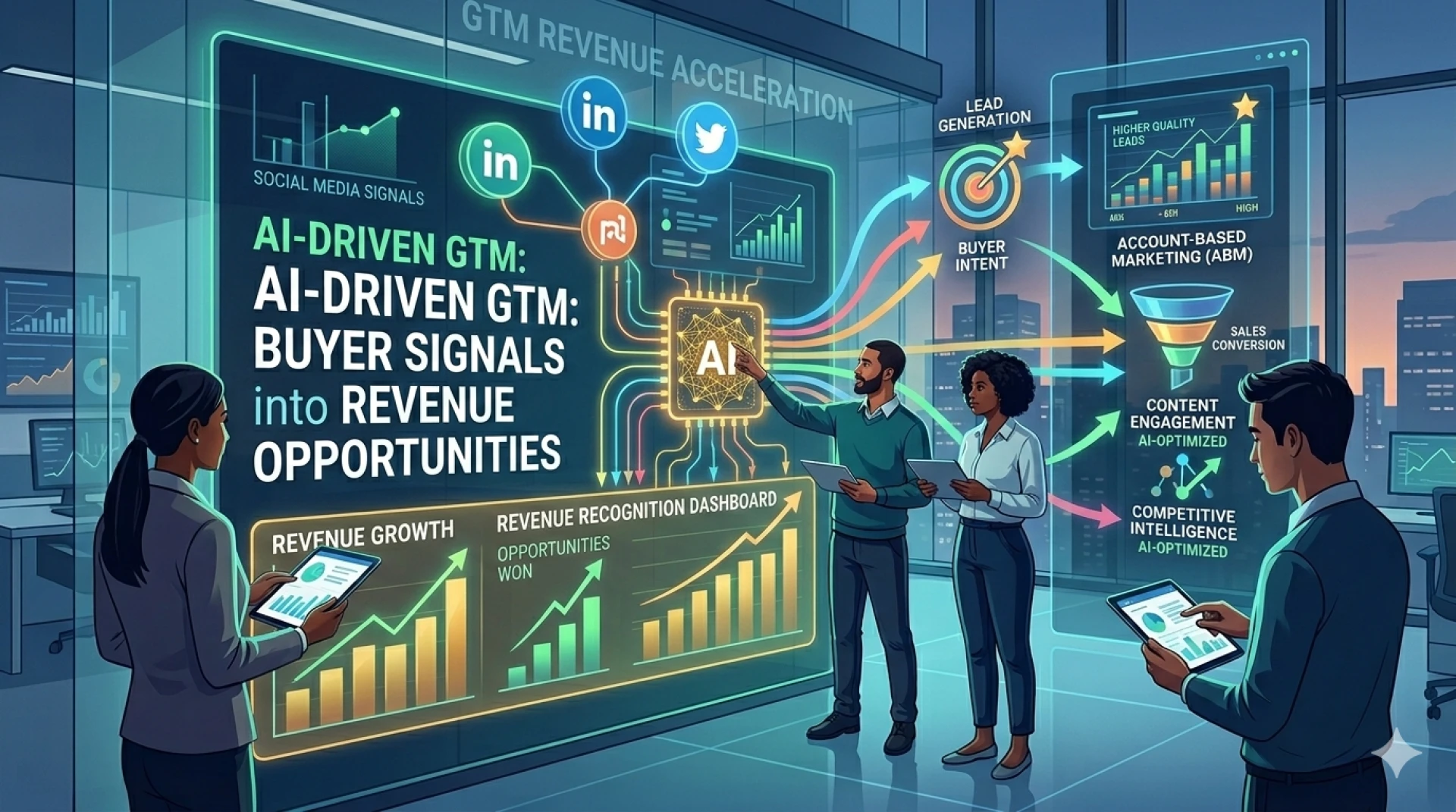

Go-to-market (GTM) strategy has always been about timing, targeting, and messaging. In the past, businesses relied heavily on assumptions static buyer personas, broad segmentation, and manual lead qualification. Sales teams worked long lists of prospects with limited insight into who was truly ready to buy. Marketing teams focused on generating volume, hoping some leads would convert.
Today, that model is rapidly evolving. Artificial intelligence is transforming GTM from a reactive process into a predictive engine. At the center of this shift is the ability to capture, interpret, and activate buyer signals. AI-driven GTM strategies are no longer about collecting data they are about turning behavioral signals into revenue opportunities.
The Explosion of Buyer Signals
Modern B2B buyers leave digital footprints across multiple channels. They visit product pages, download resources, attend webinars, engage with LinkedIn posts, compare competitors, and interact with ads. Each interaction provides a clue about interest and intent.
The challenge isn’t the absence of data it’s the overwhelming abundance of it. These signals are often scattered across CRM systems, marketing automation platforms, social media tools, website analytics, and third-party intent providers. Without intelligent analysis, valuable opportunities remain hidden inside disconnected systems.
AI changes this by aggregating and analyzing these signals in real time. Instead of treating every action equally, AI models identify patterns, correlations, and behavioral clusters that indicate genuine buying intent.
From Static Personas to Dynamic Intent
Traditional GTM strategies relied on predefined personas built around job titles, industries, and company size. While useful for segmentation, personas rarely reflect real-time buying behavior. A company may fit your ideal profile but have zero immediate interest in your solution.
AI-driven GTM introduces dynamic intent modeling. Instead of assuming readiness based on demographics, AI evaluates actual engagement behavior. For example, repeated visits to pricing pages, interactions with competitor comparison content, and engagement from multiple stakeholders within the same organization are strong intent indicators.
By shifting from static personas to dynamic intent signals, companies can prioritize accounts that are actively moving through the buying journey. This increases efficiency and reduces wasted outreach.
Predictive Account Prioritization
One of the most powerful applications of AI in GTM is predictive account scoring. Sales teams often manage hundreds of accounts simultaneously, making it difficult to determine where to focus efforts.
AI-driven systems analyze historical conversion data and current engagement signals to predict which accounts are most likely to close. These predictive scores update continuously as new signals emerge. If engagement increases, the account rises in priority. If interest declines, it drops.
This dynamic prioritization ensures sales representatives spend time on opportunities with the highest revenue potential. Instead of chasing cold leads, they engage warm accounts at the right moment.
Personalization Powered by Behavioral Insight
Personalization has become essential in B2B marketing, but generic personalization is no longer enough. Adding a first name to an email doesn’t create meaningful engagement.
AI-driven GTM enables contextual personalization based on real behavior. If a prospect downloads a guide on reducing customer churn, follow-up messaging can focus specifically on retention strategies. If multiple team members attend a webinar on automation, sales outreach can address operational efficiency challenges.
By aligning messaging with demonstrated interest, companies increase relevance and shorten sales cycles. Conversations feel timely and informed rather than intrusive.
Aligning Sales and Marketing Through Shared Intelligence
Misalignment between sales and marketing has historically limited GTM effectiveness. Marketing generates leads, sales qualifies them, and both teams operate with different data perspectives.
AI-driven GTM creates a unified intelligence layer. Both teams access the same real-time engagement data and predictive insights. Marketing can trigger campaigns based on specific buyer behaviors, while sales receives alerts when intent thresholds are reached.
For example, marketing might nurture accounts through targeted ads until engagement crosses a defined score. Once that threshold is met, sales is notified to initiate direct outreach. This coordinated process reduces friction and accelerates revenue generation.
Automating Action Without Losing Strategy
Automation plays a critical role in AI-driven GTM, but it must be strategic. Instead of relying on fixed timelines, AI systems trigger workflows based on behavioral signals.
Examples include:
- Sending follow-up emails after high-value content downloads
- Notifying sales when multiple stakeholders engage within a short timeframe
- Re-engaging dormant accounts when new activity appears
- Adjusting ad targeting based on content consumption patterns
This responsive automation ensures timely action without overwhelming prospects with irrelevant messaging.
Improving Forecast Accuracy
Revenue forecasting has traditionally relied on subjective pipeline assessments and rep feedback. AI-driven GTM introduces objective behavioral data into forecasting models.
By analyzing engagement trends across open deals, AI can identify which opportunities are gaining momentum and which are stalling. Consistent signal growth often correlates with higher conversion probability, while declining engagement may indicate risk.
This predictive visibility helps leadership teams allocate resources more effectively and make informed strategic decisions.
The Competitive Advantage of Signal Activation
Many companies collect buyer data, but fewer activate it effectively. The true power of AI-driven GTM lies not just in insight generation, but in execution.
Organizations that turn signals into action gain a measurable advantage. They engage prospects earlier, tailor conversations precisely, and reduce sales cycle friction. Instead of competing solely on product features, they compete on timing and relevance.
As more businesses adopt AI tools, differentiation will depend on how well they orchestrate and activate buyer signals across channels.
The Future of Revenue Operations
AI-driven GTM is not a temporary trend it represents a structural shift in how revenue teams operate. In the future, GTM strategies will revolve around continuous signal monitoring and adaptive engagement.
Rather than planning campaigns in isolation, companies will operate with always-on intelligence systems that detect demand in real time. Outreach, content delivery, and account prioritization will adapt dynamically based on live buyer behavior.
This evolution transforms GTM from a linear funnel into an intelligent, responsive ecosystem.
Conclusion
AI-driven GTM is redefining how businesses convert buyer signals into revenue opportunities. By aggregating data across channels, predicting intent, prioritizing high-value accounts, and enabling contextual personalization, AI empowers revenue teams to act with precision.
The companies that succeed in this new era will not be those that generate the most leads, but those that interpret signals most effectively. In a market where buyers control the journey, intelligence and timing are everything.
Turning buyer signals into revenue is no longer about guesswork. With AI-driven GTM, it becomes a measurable, scalable growth engine.




























Sign in to leave a comment.