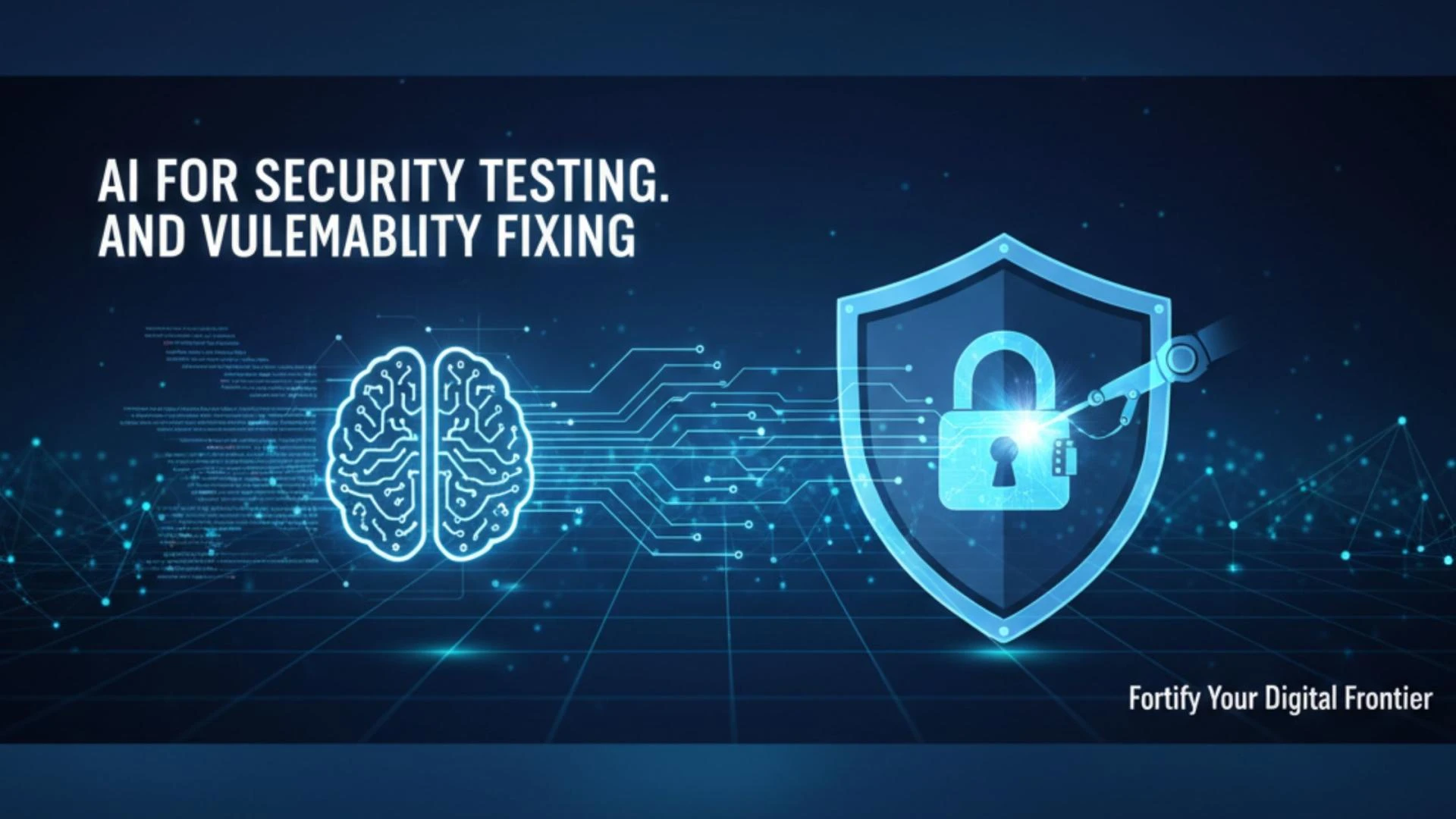

In recent years, security testing has begun to change in meaningful ways thanks to advances in artificial intelligence. What used to be a mostly manual and specialist-driven activity is increasingly becoming integrated into the normal software quality process. New tools are emerging that don’t just find vulnerabilities, but also propose and in some cases generate fixes. While human review remains essential, the result is that risky code is being identified and remediated faster and more broadly than before. Below we explore how this shift is happening, what it means for teams, what the benefits are, and what to watch out for.
How AI is being used in security testing
There are several ways AI is inserting itself into the vulnerability management lifecycle:
Detection of vulnerabilities at scale
With large-codebases, many dependencies, and continuous integration pipelines, there is simply too much surface for manual review alone. AI and machine learning algorithms are now being used to scan networks, code repositories, and runtime activity to detect anomalies, outdated libraries, misconfigurations, or code patterns that could indicate a vulnerability. Tools that perform AI-based vulnerability management highlight the ability to analyse large data sets and spot patterns faster than traditional methods.
Generation of targeted fuzzing inputs and deeper analysis
Fuzzing (bombarding programs with large numbers of unexpected inputs) has long been a security testing method. AI enhances fuzzing by generating more targeted inputs, by prioritising which parts of code to stress, or by analysing the results of fuzzing to find root causes. For instance, a benchmark called AutoPatchBench was introduced to evaluate AI-powered vulnerability repair systems in the context of fuzzing‐found bugs.
Proposing or even generating code fixes or remediation advice
The more advanced applications of AI in security go beyond detection: they propose specific code changes or pull requests to fix identified vulnerabilities. For example, tools by vendors are integrating large language models that provide remediation suggestions and even open pull requests to address package upgrades or code patches.
Integration into the full lifecycle and shifting left
Because AI powered detection and remediation suggestions can happen earlier, security testing is being brought closer to development rather than left until after release. By integrating into IDEs, CI/CD pipelines, and into the code review process, vulnerability management becomes less of an after-thought and more of a normal part of engineering work. Studies show that while the tools are promising they are still maturing in real-world use.
What this means for teams and quality processes
The involvement of AI in security testing has a number of implications:
- Speed and scale improve: Because detection and remediation suggestions can operate more broadly and quickly than purely manual efforts, teams can cover more code, more dependencies, more runtime behaviour. That means fewer surprises down-the-line and more consistent security checks.
- Lowering of barrier to remediation: When a tool can offer a suggested fix or pull request rather than just an alert, the “remediation friction” is reduced. The developer can review and merge rather than start from scratch figuring out what to do.
- Bringing security into normal workflows: With AI tools integrated into development environments, code reviews, and CI pipelines, security becomes part of the standard QA and engineering workflow rather than a separate specialised gate. That encourages “shift left” thinking: finding issues earlier when they are cheaper to fix.
- Better prioritisation: AI can help triage vulnerabilities, highlight which ones are high risk, or which patterns tend to cause issues. This helps teams allocate their time where it matters most rather than chasing low-impact alerts.
- Human plus machine collaboration: Most of the time, the workflow is still human in the loop. The AI may detect, propose, suggest or even fix—but humans review, approve, and take responsibility. This combination is powerful because it allows scale without losing judgement.
What to watch out for: the caveats and risks
Despite the promise, there are important caveats:
- False positives and irrelevant suggestions: AI models may identify “vulnerabilities” that are not exploitable in context, or may propose fixes that don’t properly solve the root problem. A study found that even professional developers using an AI tool for vulnerability detection and repair still faced high rates of false positives and non-applicable fixes.
- Trust and validation are crucial: Automatic code changes or fix suggestions must be validated. The fact that AI produces a fix is not enough — it must be correct for the specific codebase, must not introduce regressions, must follow the architecture and style of the project. One article warns that blindly trusting AI suggestions may leave remaining vulnerabilities.
- Data and context matter: AI works best when it has good data, good context about the codebase, dependencies, runtime behaviour, and the risk tolerance of the organisation. Without that context, suggestions may be generic or mis-aligned. Also training data for vulnerabilities is less plentiful than for general bugs.
- Security tools become targets themselves: As AI tools become more common, attackers will also use or target them. Organisations must ensure that AI-driven security solutions are themselves secure and properly integrated into overall risk management.
- Human oversight remains essential: Because AI is not yet perfect, human review and judgement remain vital. Tools assist but do not replace the need for skilled security engineers and developers who understand the architecture, threat models, and business context.
Practical advice: how to adopt AI-driven security testing responsibly
If your team is considering ramping up use of AI for vulnerability detection and remediation, here are some practices:
- Start with pilot projects: Select a less critical module or set of services to run an AI security tool and assess its fit. Monitor its output, check how many real issues it finds, how many false alerts, how many suggested fixes were useful.
- Integrate with your CI/CD and code review process: Embed AI-driven security scanning and fix suggestion early — for example in pull request checks, in the IDE, in pre-merge gates — so issues are caught as part of development rather than later.
- Define risk criteria and prioritisation: Not all vulnerabilities are equal. Make sure your tool supports or you build a process for prioritising vulnerabilities based on impact, exploitability and business risk.
- Ensure human review of suggested fixes: Build workflows so that AI suggestions are reviewed by a developer or security engineer. Encourage understanding of the fix rather than blindly applying it.
- Measure outcomes: Track metrics such as time to detect a vulnerability, time to fix it, number of vulnerabilities found per module, volume of false positives. Use these to refine your tool selection, workflow and training.
- Train your team and refine context: Provide developers and security engineers a chance to learn how the AI tool works, where it is strong and where it tends to mis-fire. Collect feedback and tune the tool’s config or rules accordingly.
- Consider the whole lifecycle: Vulnerability management is not just about scanning code. It includes supply chain dependencies, runtime monitoring, incident response, patching, observability. Ensure your AI approach connects with these.
The future: where this trend is heading
Looking ahead, the use of AI in security testing and vulnerability remediation is likely to grow. Some of the emerging directions:
- More autonomous remediation: As AI systems improve in correctness and context awareness, they may automatically apply patches (with review) or configure runtime safeguards. For example, an agent by DeepMind called CodeMender already upstreamed dozens of security fixes for open source projects.
- Better integration with developer tooling: IDEs, code editors, version control systems will include AI-driven security advice real-time, giving developers suggestions even before code is committed.
- Expanded use of fuzzing and runtime learning: AI will generate more and better test inputs, learn from runtime behaviour, monitor anomalies in production and feed that back into the testing cycle.
- More explainable and trustable AI: As security stakes are high, teams will demand models that provide confidence, rationale, traceability and auditability for their suggestions (for example “why this fix addresses the vulnerability”).
- Cross-team collaboration: Security becomes less siloed; AI tools blur the lines between QA, development, operations and security teams. The idea of “everyone is responsible for security” becomes even more practical.
- More open benchmarks and research: Benchmarks like AutoPatchBench help compare and improve AI systems for vulnerability repair in a standard way.
Conclusion
AI is transforming how software security testing and vulnerability fixing happen. Instead of being an after-thought or entirely separate specialist process, security is increasingly embedded into development, quality, and operations workflows. With AI’s help, teams can detect vulnerabilities earlier, prioritise them smarter, and even get suggested fixes that reduce time and effort. But this doesn’t mean humans can step away — oversight, context, validation and good processes remain key.
If your team adopts these tools thoughtfully — starting small, integrating into your workflow, measuring outcomes, and keeping human review in place — you can reap the benefits of faster, more efficient security testing. At the same time you avoid the risks of over-trusting AI or letting coverage gaps creep in. In short, AI is a powerful ally in vulnerability management. Used well, it strengthens your security posture. Used poorly, it may offer a false sense of safety.


























Sign in to leave a comment.