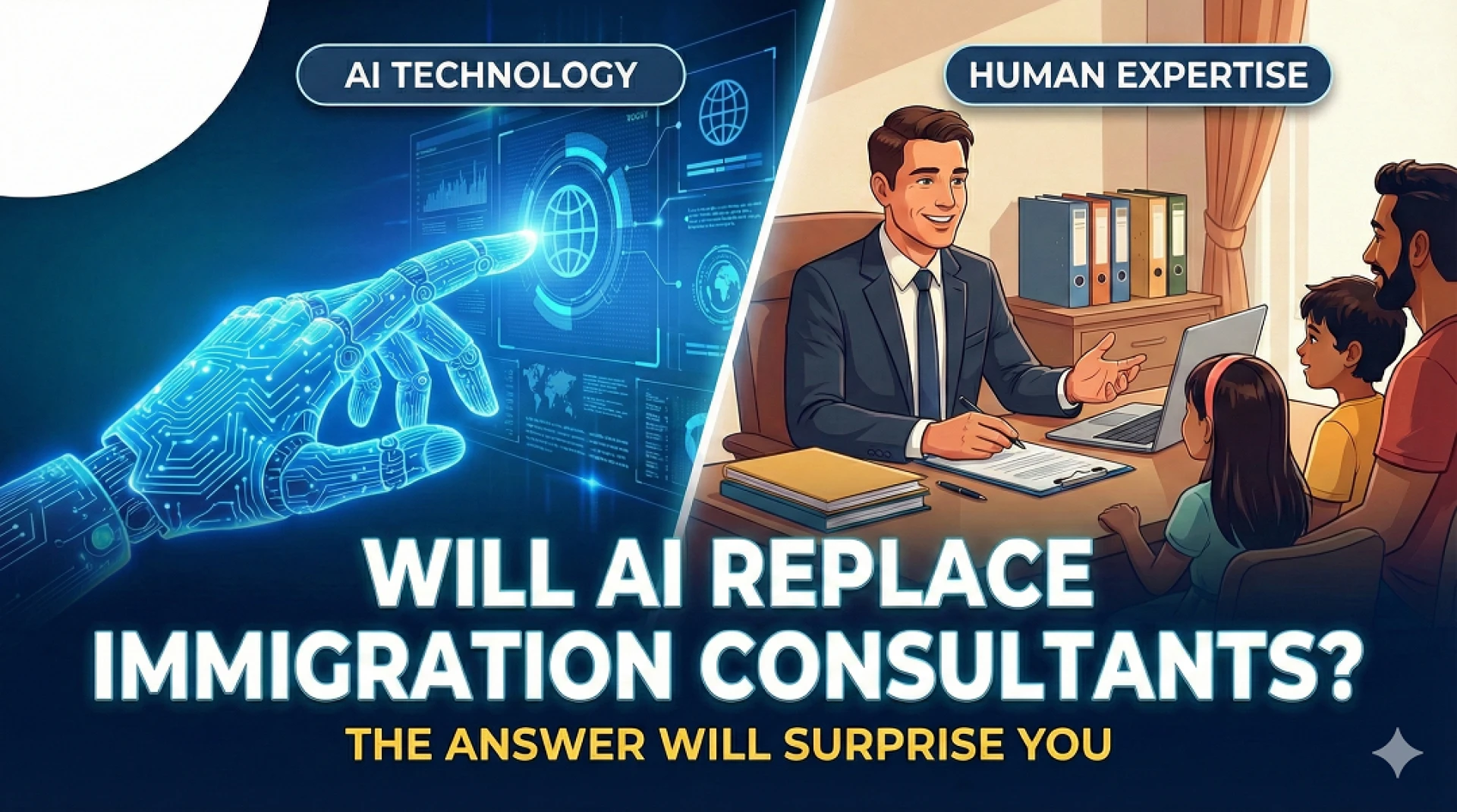

The immigration landscape is undergoing a seismic shift. As artificial intelligence permeates every sector, a pressing question emerges for millions of global aspirants: Will AI eventually make human immigration consultants obsolete? The answer is nuanced—AI will transform the industry dramatically, but complete replacement remains unlikely. Let's explore why.
The AI Revolution in Immigration Services
What AI Already Does Exceptionally Well
Today's AI-powered immigration platforms are handling tasks that once consumed countless consultant hours:
1. Document Processing at Scale AI systems can now scan, categorize, and verify hundreds of documents in minutes. Optical Character Recognition (OCR) combined with machine learning extracts relevant data from passports, bank statements, and educational certificates with 99%+ accuracy. This eliminates the tedious manual data entry that junior consultants traditionally performed.
2. Eligibility Assessments Sophisticated algorithms can cross-reference an applicant's profile against 1,000+ visa categories across 195+ countries instantly. By analyzing factors like age, education, work experience, and language proficiency, AI provides preliminary eligibility scores and suggests optimal pathways—something that previously required days of consultant research.
3. Predictive Analytics Machine learning models trained on historical approval/rejection data can now predict visa success probabilities with impressive accuracy. They identify red flags (like gaps in employment or insufficient financial evidence) before submission, reducing rejection rates by up to 40% in some implementations.
4. 24/7 Chatbot Support AI assistants answer routine queries about document checklists, fee structures, and processing times in 50+ languages, providing instant support across time zones without the consultant's hourly fees.
The Irreplaceable Human Element
Despite these advances, critical aspects of immigration consulting remain firmly in the human domain:
1. Emotional Intelligence and Empathy
Immigration is inherently emotional. A student facing a visa rejection isn't just dealing with paperwork—they're confronting shattered dreams, family expectations, and financial pressures. Human consultants provide reassurance, share success stories, and offer psychological support that AI cannot replicate. No algorithm can genuinely empathize with a refugee's trauma or a parent's anxiety about their child's study abroad plans.
2. Complex Case Strategy
While AI excels at straightforward cases, it struggles with nuanced situations: applicants with unconventional career paths, prior refusals requiring careful explanation, or cases involving legal ambiguities. Human consultants draw on experience to craft compelling narratives, anticipate officer skepticism, and build persuasive cases that transcend checklists.
3. Relationship with Authorities
Established consultants often have informal networks with embassy staff, understand unwritten local preferences, and can navigate bureaucratic nuances through personal rapport. AI lacks this relationship capital.
4. Ethical Judgment and Advocacy
When an applicant faces discrimination or unfair treatment, human consultants advocate fiercely, leveraging ethical arguments and legal precedents. AI operates within programmed parameters and cannot challenge systemic issues or make value-based judgments.
The Hybrid Model: The Best of Both Worlds
The future isn't AI vs. humans—it's AI with humans. Leading platforms are pioneering this synthesis:
AI-First, Human-When-It-Matters Routine tasks (document verification, form filling, eligibility checks) are automated. Complex cases, appeals, and emotional support are escalated to human experts. This model cuts costs by 60-70% while maintaining quality.
AI as a "Super-Assistant" Consultants use AI tools to research latest policy changes, generate draft letters, and simulate officer decision-making. This amplifies their productivity, allowing them to handle 5x more cases while focusing on high-value strategic work.
Case Study: Platforms Leading the Charge
Emerging solutions demonstrate this hybrid approach effectively. For instance, edvia.ai is building an AI-powered ecosystem that connects students with universities while automating initial eligibility screening and document preparation. By handling the heavy lifting of data processing, platforms like edvia.ai enable human advisors to focus on personalized counseling and complex case management—illustrating how technology augments rather than replaces expertise.
What the Data Says
A 2024 study by the International Education Association found:
- 73% of visa applicants prefer AI for initial consultations and document checks
- 89% insist on human review for final submission
- Consultants using AI tools reported 45% higher client satisfaction than those using traditional methods alone
- However, complex case approvals were 23% higher when handled by experienced human consultants vs. AI-only systems
The Road Ahead: 2030 and Beyond
By 2030, we can expect:
AI Will Dominate:
- Initial consultations and eligibility screening
- Document verification and fraud detection
- Real-time policy updates and compliance checking
- Multilingual customer support
- Predictive outcome modeling
Humans Will Continue to Lead:
- Complex case strategy and appeals
- Emotional support and crisis management
- Ethical advocacy and legal representation
- Building trust with anxious clients
- Navigating unprecedented scenarios
The Verdict: Evolution, Not Extinction
AI will not replace immigration consultants—it will replace inefficient consultants. Professionals who embrace AI as a collaborative tool will thrive, offering faster, cheaper, and more accurate services. Those who resist will be outcompeted by AI-augmented firms.
The sweet spot? A model where AI handles 80% of the transactional work, freeing human experts to deliver the empathetic, strategic, and advocacy-based value that machines cannot replicate. For applicants, this means affordable, accessible initial guidance through AI, with human expertise available for the moments that truly matter.
The future of immigration consulting isn't human or artificial—it's intelligently both.



























Sign in to leave a comment.