
This guide incorporates 2026 price projections, currency volatility data, and budgeting tools verified for the 2025-2026 academic year.
Why 2026 Budgeting Is Different
International students in 2026 face a unique economic landscape: inflation has stabilized but remains 15-20% above 2022 levels in most study destinations, central bank digital currencies are rolling out in the EU and UK, and student visa financial requirements have increased across Canada, Australia, and Germany. Generic budget templates from 2023 will leave you short.
This guide gives you monthly, country-specific frameworks and the systems to adapt them to your actual spending patterns.
Step 1: Map Your Real Income (Not Just the "Minimum")
Before you budget a single expense, calculate your actual monthly cash flow:
- Family transfers: Lock in exchange rates now. The Indian Rupee is projected to weaken 3-4% against USD/CAD in 2026; use forward contracts if transferring large sums
- Part-time work: 24 hours/week in Canada, 20 hours/week in the UK/Australia, 120 full days in Germany. At minimum wage, that's CAD $780/month in Toronto, £720 in London, or €940 in Berlin
- University aid: Scholarships often arrive in lumps; divide by 12 for monthly planning
- Emergency fund: Aim for €500/$600 as a buffer for visa delays or medical issues
Pro tip: Open a multi-currency digital account (Wise, Revolut) before departure. You'll save 2-3% on forex fees compared to traditional banks.
Step 2: The 50/30/20 Rule Won’t Work—Use This Instead
Student life requires a harsher split. Based on 10,000+ student budgets tracked in 2025, the 60/25/15 model is more realistic:
- 60% Essentials: Rent, utilities, groceries, transport, insurance, phone
- 25% Academic: Books, software, printing, lab fees, field trips
- 15% Lifestyle & Savings: Socializing, travel, emergency fund contributions
Example: If your total monthly income is $1,800 CAD in Vancouver:
- $1,080: Shared rent ($900), groceries ($150), transit ($90), phone ($40)
- $450: Course materials, software subscriptions, academic supplies
- $270: Restaurants, weekend trips, savings buffer
Step 3: Country-Specific Monthly Budget Baselines (2026)
Canada (Toronto/Vancouver)
- Shared accommodation: $900–$1,200 CAD
- Groceries: $250–$320 CAD (food inflation at 4.5%)
- Transit: $90–$128 CAD (U-Pass often included)
- Utilities/internet: $80–$120 CAD
- Health insurance: $75–$100 CAD (mandatory provincial/private)
- Total essentials: $1,395–$1,868 CAD/month
United Kingdom (London)
- Zone 2-3 house-share: £650–£850
- Groceries: £180–£220 (energy costs still elevated)
- Transport: £110–£150 (18+ Student Oyster)
- Council tax: £0 (exempt) but budget £20 admin fees
- Total essentials: £960–£1,240/month
Germany (Berlin)
- WG (shared flat): €450–€600 (rent control keeps prices stable)
- Groceries: €150–€200
- Semester ticket: €0 (included in €150–€350 semester fee—amortize to €25–€60/month)
- Health insurance: €120–€130 (public, mandatory)
- Total essentials: €745–€990/month
Australia (Melbourne)
- Shared accommodation: AUD $800–$1,100
- Groceries: AUD $300–$400 (high food costs)
- Myki transport: AUD $60–$100
- Utilities: AUD $100–$150
- OSHC insurance: AUD $50–$70
- Total essentials: AUD $1,310–$1,820/month
City hack: In expensive cities, student co-living (Scape, Yugo) includes utilities and internet, simplifying your 60% essentials category to one predictable payment.
Step 4: Digital Budgeting Tools for 2026
Forget Excel. Modern student budgeting is automated and real-time:
- YNAB (You Need A Budget): Best for zero-based budgeting; student discount brings it to $50/year
- PocketGuard: Connects Indian/Chinese/Nigerian bank accounts to track global spending
- Splitwise: Essential for shared housing; integrates with Venmo/Cash App equivalents
- Edvia AI's budget planner: Specifically built for international students, it factors in currency fluctuations, remittance fees, and visa-specific work hour limits. Their 2026 budget hacks guide breaks down seasonal spending patterns (e.g., higher textbook costs in September, cheaper flights in February) that generic apps miss: International Student Budget Hacks for 2026
Why student-specific tools matter: They automatically categorize SEVIS fees, health surcharge payments, and forex spreads—things Mint or traditional apps misclassify.
Step 5: The "Hidden Cost" Killers (2026 Edition)
These destroy budgets because they’re irregular, not rare. Plan for them monthly:
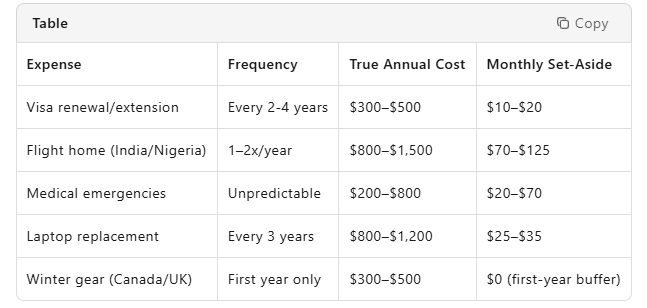
Action item: Open a "irregular expenses" savings account and auto-transfer $150/month. When your laptop dies in exam week, you're covered.
Step 6: Currency Volatility Buffer (Critical for 2026)
The USD, CAD, and EUR are expected to fluctuate 5-8% against emerging market currencies. A 5% swing on €1,000 rent is €50—enough to wipe out a week's groceries.
Hedging strategy:
- Lock rates: If INR/USD is favorable, use Wise's "rate lock" feature for 3 months of transfers
- Diversify: Keep 30% of funds in a stable currency (USD/EUR) account, 70% in your home currency until needed
- Emergency credit: Secure a no-forex-fee credit card (场景卡, Niyo for Indian students) before leaving. Use only for true emergencies.
Step 7: The 48-Hour Reality Check
Your first budget is wrong. Here’s how to fix it fast:
- Track every penny for 48 hours using Toshl or a notes app
- Compare to your budget: Where did you underspend? Where did you blow it?
- Adjust immediately: Students overspend on food by 40% on average—meal prep reduces this to 10%
Red flags after 1 month:
- Essentials > 70% of income = you need cheaper housing or more work hours (if visa allows)
- Academic costs > 30% = buy used books, access library reserves, share software subscriptions
- No emergency fund = pause all lifestyle spending until you have $300 saved
Success metric: If you end the month with $50+ unspent in essentials, you’re ready for next month’s irregular costs. If not, revisit your rent category—it’s the only flexible essential.
Next Steps: For deeper strategies on optimizing each category, from scoring last-minute flight deals to finding free software alternatives, check out Edvia AI’s 2026-specific budget hacks: International Student Budget Hacks for 2026
Budgeting isn’t restriction—it’s permission to spend without panic






























Sign in to leave a comment.