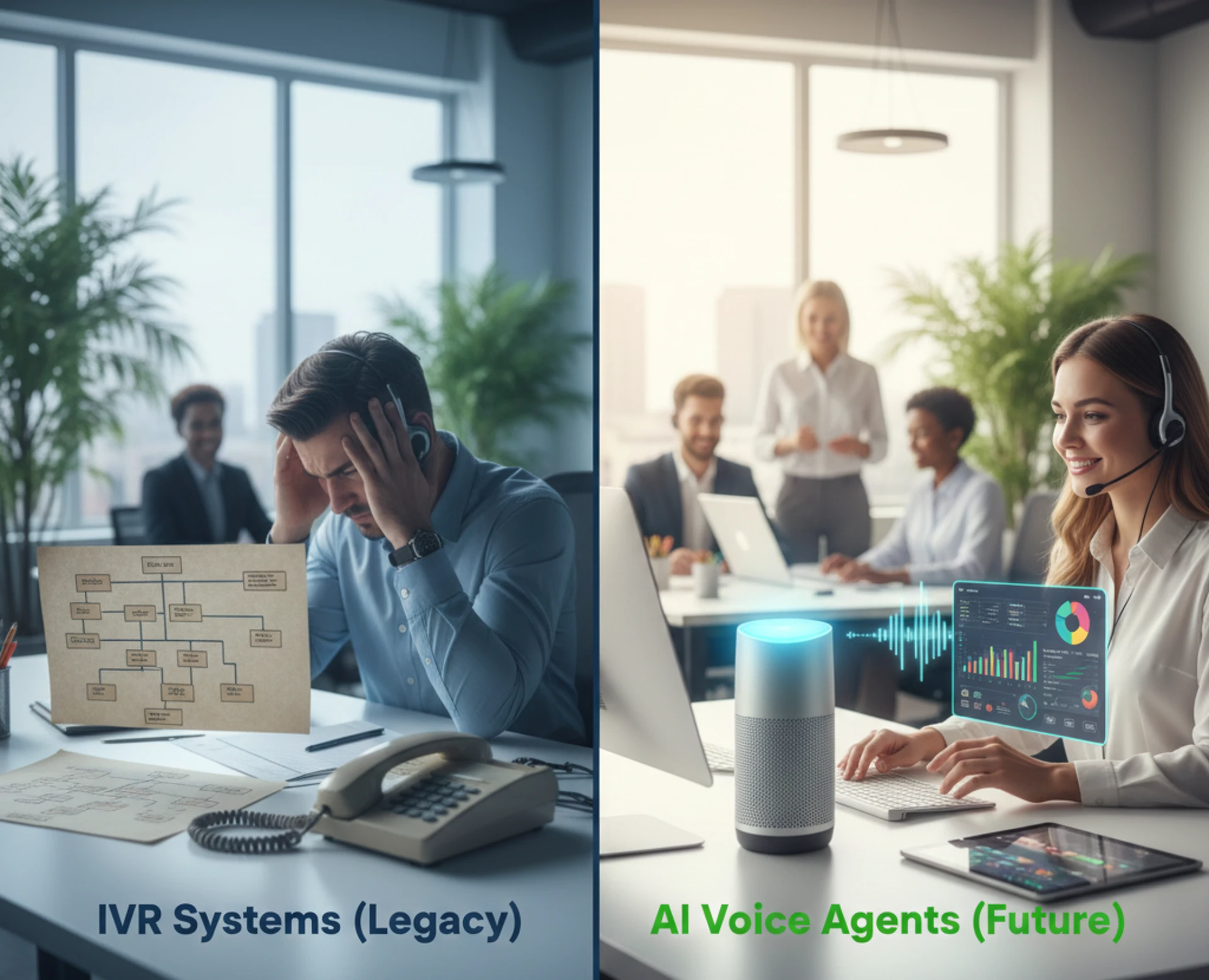

ai-voice-agents-vs-ivr-systemsWe all know the familiar dread: you call a company, and you are immediately trapped in an automated labyrinth. You press '1' for sales, '3' for support, and '9' to repeat the options, all while praying you do not accidentally get disconnected or routed to the wrong department. This cycle of frustration, powered by decades-old IVR systems, has long been the accepted pain of customer service. However, a significant technological shift is underway. Businesses are finally moving past rigid, touch-tone menus and embracing intelligent AI Voice Agents. These conversational powerhouses do not just listen for keywords; they understand intent, context, and even sentiment, fundamentally changing how customers interact with brands and demonstrating superior capability for CX improvement and operational efficiency.
IVR vs. AI Voice Agents: Understanding the Core Difference
To appreciate the superiority of AI, it is crucial to clearly define the technologies. The traditional IVR system operates on a simple, rule-based logic. It is a digital menu tree: if the customer presses 'A', they are routed to 'B'. It primarily relies on pre-recorded audio and basic speech recognition to process touch-tones or limited verbal commands. Conversely, an AI Voice Agent leverages advanced Conversational AI and Natural Language Understanding (NLU). Instead of following a rigid script, it learns from every interaction, using Machine Learning (ML) to process complex, multi-turn dialogue, understand slang, accents, and emotional cues. This difference transforms the interaction from a frustrating interrogation into a genuine, fluid conversation.
From Frustration to Fluidity: The CX Advantage
The most significant benefit of AI Voice Agents is the dramatic enhancement of the Customer Experience (CX). Traditional IVR systems are infamous for contributing to high call abandonment rates and low customer satisfaction scores (CSAT). When customers are forced to navigate a menu structure that does not match their specific, complex need, frustration mounts. AI Voice Agents, however, deliver a personalized experience by integrating seamlessly with a business’s Customer Relationship Management (CRM) system. They can recall a customer’s previous interactions, verify their identity conversationally, and immediately address specific issues like "Where is my order?" or "I need to dispute a charge" without requiring a single menu selection. Furthermore, AI agents use sentiment analysis to detect frustration or anger and can seamlessly escalate complex or emotionally charged queries to a human agent, providing the full context of the conversation, thus ensuring a smooth transition.
Scalability, Speed, and Cost: The Business Metrics That Matter
For businesses operating high-volume contact centers, the case for AI is compellingly economic. AI Voice Agents drive substantial improvements in operational efficiency across several key metrics:
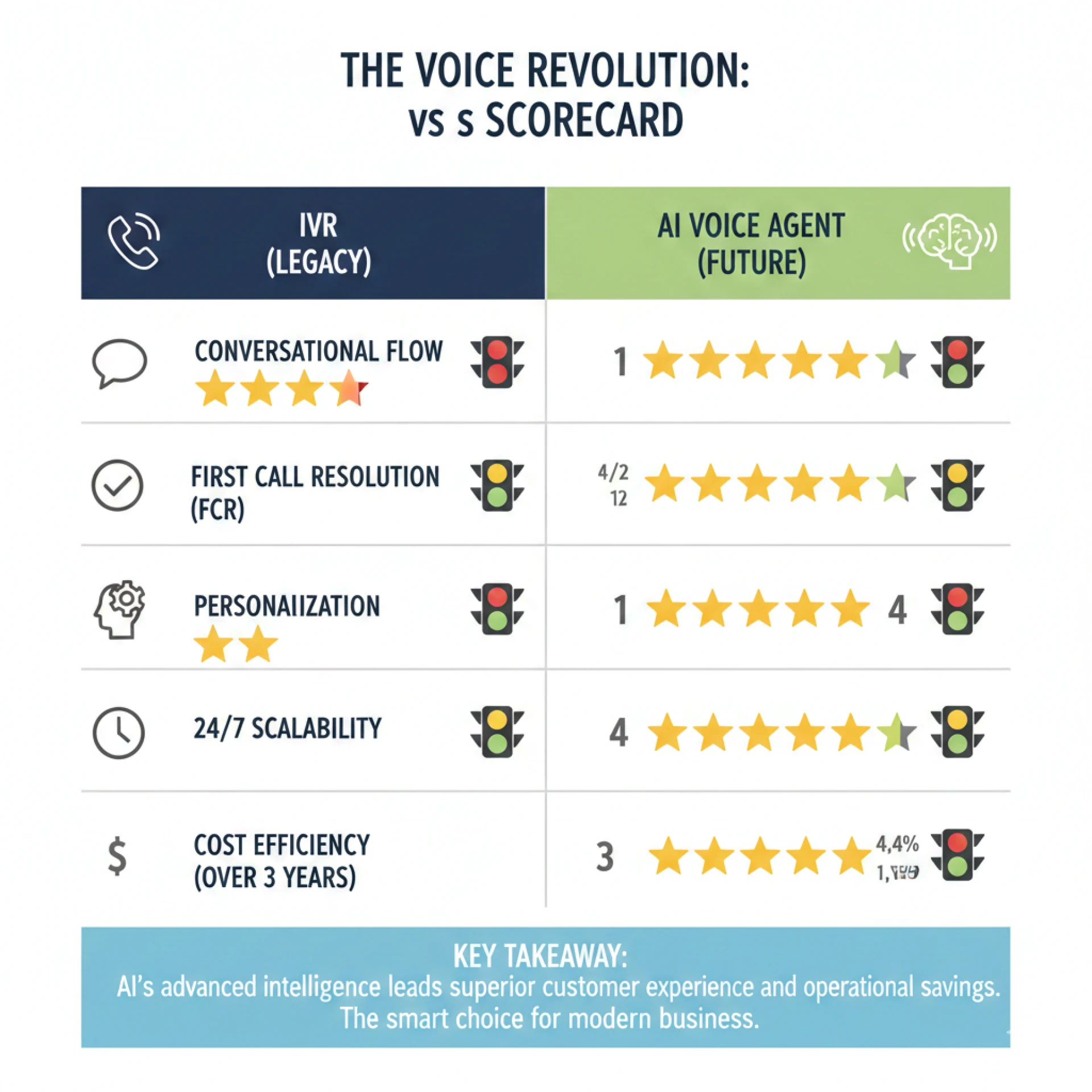
- Faster Resolution: By instantly understanding intent and accessing relevant data, AI agents drastically reduce the Average Handle Time (AHT). They can resolve simple and even moderate transactions—like address changes or checking account balances—in seconds.
- 24/7 Availability and Scalability: An IVR system can handle volume, but it cannot handle conversational complexity at scale. An AI Voice Agent can manage thousands of simultaneous, complex calls around the clock without agent burnout or long wait times, leading to massive cost savings on staffing and infrastructure.
- Superior First Call Resolution (FCR): Because AI agents can access and act on comprehensive customer data immediately, they are much more likely than IVR to resolve the issue on the initial contact, which is the single most important metric for customer satisfaction and reducing overall operational expenses.
Beyond Call Routing: Real-Time Data and Actionable Insights
One of the limitations of IVR is that it is primarily a routing tool. It collects basic data (which menu option was pressed) but provides little actionable insight. AI Voice Agents, in contrast, are powerful data engines. They provide real-time analytics on the 'Voice of the Customer,' including top-trending intents, common frustration points, and detailed sentiment scores. This intelligence allows organizations to refine business processes, identify product gaps, and continuously train the AI model for higher accuracy. This capability for continuous learning ensures the AI improves with every interaction, making it a powerful, evolving asset rather than a static piece of infrastructure.
Where AI Voice Agents Shine: Real-World Applications
While both systems handle basic tasks, AI's NLU and integration capabilities allow it to excel in tasks far beyond the scope of traditional IVR:
- Financial Services: Handling complex loan inquiries, securely verifying high-value transactions, or reporting fraudulent activity.
- E-commerce and Logistics: Providing hyper-specific order tracking details, processing returns, and assisting with complex product configuration.
- Healthcare: Scheduling, rescheduling, or canceling specific appointments with different doctors across multiple locations.
The Future is Conversational: Why the Switch is Inevitable
The evidence is clear: the future of high-quality, efficient customer service is conversational, intelligent, and powered by AI. Where traditional IVR systems offered a static solution that minimized human interaction at the cost of customer satisfaction, AI Voice Agents offer a dynamic, personalized solution that elevates the experience while simultaneously reducing operational friction and costs. By achieving faster, more personalized interactions, improving key metrics like FCR and AHT, and providing unparalleled real-time data, AI is not just an upgrade it is a competitive necessity. For any business serious about thriving in the modern experience economy, moving past the limitations of the IVR system and adopting intelligent Conversational AI is the defining choice for success.



























Sign in to leave a comment.