

A single spark in a Zone 1 atmosphere can trigger an incident that shuts down a UAE facility for weeks. That's the reality safety managers across Jebel Ali, Ruwais and Abu Dhabi's industrial belt live with daily. Standard CCTV, however rugged it looks, was never engineered to survive near flammable gases, vapours or combustible dust. Yet many sites still install it in classified zones, unaware of the liability this creates. Selecting the right hazardous-area camera isn't a paperwork exercise — it's a frontline safety decision. This guide breaks down what UAE facility managers and engineering teams actually need to know before specifying hazardous-area CCTV.

Understanding Zone 1 and Zone 2 in Practical Terms
For facility managers who aren't gas-safety specialists, zone classifications can feel abstract until you translate them into everyday operational terms.
- Zone 1 covers areas where an explosive atmosphere is likely to occur during normal operation — think loading bays at tank farms, compressor rooms or process skids handling volatile hydrocarbons.
- Zone 2 applies where an explosive atmosphere is unlikely under normal conditions but could occur briefly, such as near valve stations or secondary containment areas.
Your risk assessment, typically informed by DSEAR-style methodology and aligned with UAE HSE workplace safety standards, determines which zone applies to each area of your plant. Camera selection must follow that classification exactly — not the other way around.
Standard Industrial CCTV vs Certified Hazardous-Area CCTV
Conventional CCTV is designed to survive dust, moisture and vibration. It is not designed to prevent ignition. Hazardous-area cameras, by contrast, are built to contain any internal spark or thermal event so it cannot ignite the surrounding atmosphere. This is achieved through flameproof enclosures, controlled surface temperatures and certified cable entries — none of which feature in standard security-grade housings. Mixing the two categories on one site is one of the most common compliance failures inspectors encounter.
Gas, Vapour and Dust Risks — and What They Mean for Specification
Not every hazardous area presents the same risk profile. Refineries and offshore platforms typically deal with gas and vapour hazards, while grain, chemical or automotive paint-shop environments may involve combustible dust. Your camera's certification must match the specific substances present — gas group, dust group and temperature classification all need to align with your facility's documented risk register, not a generic "explosion-proof" label.
Reading Explosion-Protection Markings Correctly
ATEX markings look dense, but they communicate exactly where equipment can be installed. A typical marking includes the equipment group, category, atmosphere type (gas or dust), protection method, gas group and temperature class. Procurement teams should never accept a camera without full documentation showing these markings match the zone, gas group and surface temperature rating of the installation point. If a supplier can't produce a certificate, walk away.
Where Compact Mini Cameras Outperform PTZ Units
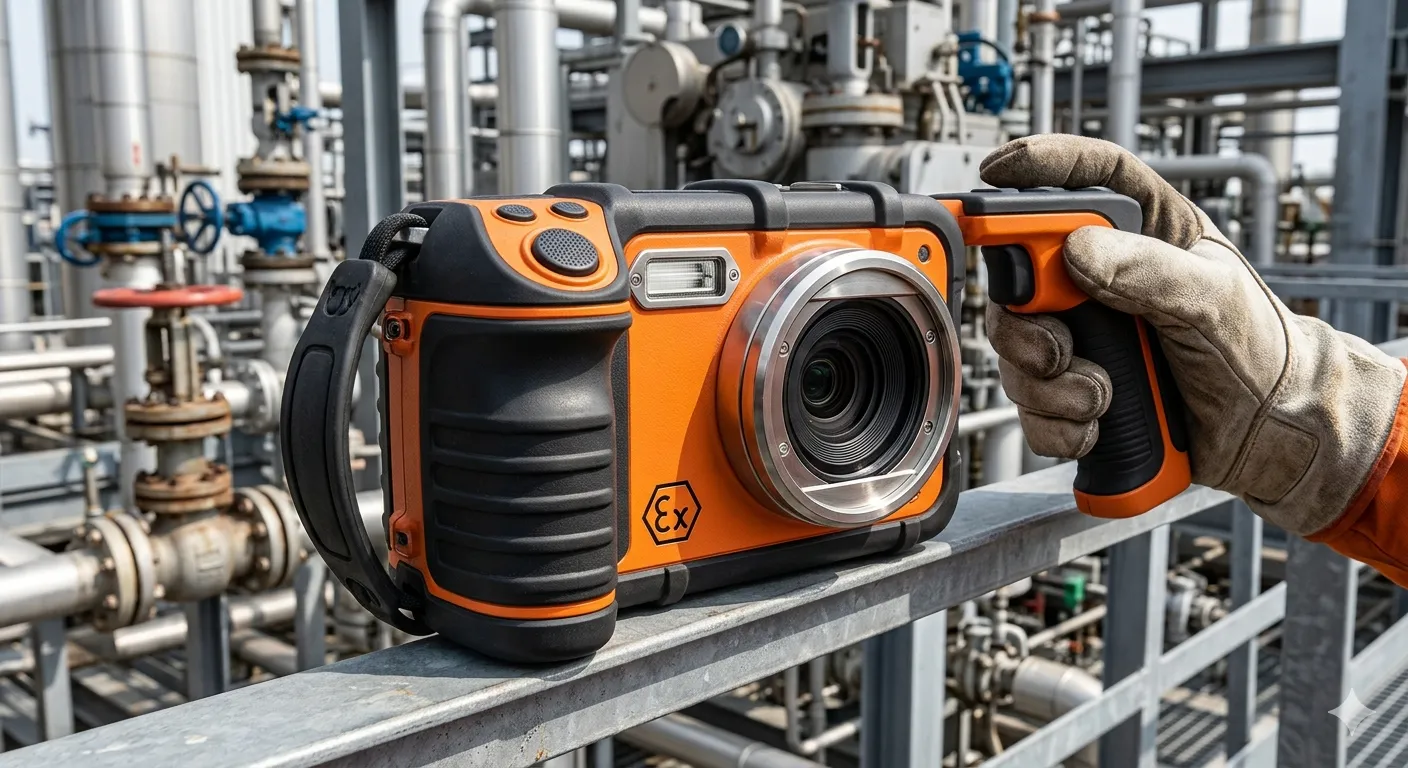
Traditional explosion-proof PTZ cameras are bulky, heavy and require substantial mounting infrastructure. That works in open process areas, but it fails around tightly packed equipment skids, pipe racks and congested production lines common across UAE manufacturing and automotive plants. A Compact Explosion Proof Mini IR Camera fits into spaces PTZ housings simply cannot reach — inside enclosures, between pipework runs, or mounted directly above confined workstations — without compromising certification integrity.
Why Compact Size Matters on Congested Industrial Layouts
Space constraints aren't cosmetic; they affect coverage quality. Oversized housings create blind spots around valves, junctions and walkways. A smaller footprint means:
- Easier positioning close to the actual hazard point
- Reduced obstruction of maintenance access
- Lower mounting-bracket engineering requirements
- Simplified integration into existing skid designs
For engineering teams retrofitting older UAE facilities, this flexibility often determines whether full-site coverage is even achievable.
IR Illumination for Shutdowns and Night Operations
Many hazardous-area incidents and near-misses happen during low-light conditions — night shifts, turnaround shutdowns, or poorly lit process areas. An Explosion proof IR Mini Camera with strong infrared range ensures operators maintain visibility without relying on supplementary lighting, which itself can introduce additional ignition-source considerations in classified zones. Reliable night vision isn't a convenience feature here; it's a control measure.
IP Rating, Temperature Range and Enclosure Build
Beyond explosion protection, your camera must survive the UAE's operating environment. Look for IP66 or IP67 ingress protection as standard, an operating temperature range that comfortably exceeds regional summer highs, and a corrosion-resistant enclosure — particularly important for coastal and maritime installations. Enclosure material (typically stainless steel or marine-grade aluminium) should be specified alongside, not instead of, the ATEX certificate.

Fixed Mini Cameras vs PTZ: Making the Right Call
PTZ units make sense where wide-area situational awareness is the priority — tank farm perimeters, for example. Fixed mini cameras are the better choice for targeted, high-risk points: a specific valve, a loading arm, a confined process line. If your objective is constant, unambiguous monitoring of one critical asset, a fixed unit typically delivers better reliability with fewer moving parts to certify and maintain.
A Pre-Purchase Checklist for HSE, Engineering and Procurement
Before signing off on any hazardous-area camera, confirm:
- Zone classification (1 or 2) matches the certificate
- Gas or dust group alignment with site risk assessment
- Temperature class suitable for the process area
- IP rating appropriate to environment (coastal, indoor, high-humidity)
- IR range sufficient for the installation distance
- Supplier can provide full ATEX documentation and local support
Common Mistakes in Hazardous-Area CCTV Selection
The most frequent errors include installing standard cameras in classified zones "temporarily," assuming one certification covers all gas and dust groups, and overlooking cable gland certification — a detail inspectors check closely. Working with an experienced Mini Explosion proof Camera supplier rather than a generic security vendor significantly reduces these risks.

SharpEagle ATEX Certified Explosion Proof Mini IR Camera
SharpEagle Technology's ATEX certified explosion proof mini IR camera is purpose-built for UAE Zone 1 and Zone 2 environments across oil and gas, maritime, warehousing and manufacturing sites. Key features include a compact flameproof housing suited to confined installation points, high-performance IR illumination for reliable night and shutdown visibility, robust IP66/IP67-rated construction, and full ATEX documentation covering gas and dust classifications. Its reduced footprint allows placement in locations where PTZ units are impractical, without any compromise on certified safety performance. For teams sourcing dependable hazardous-area CCTV, the product page details full technical specifications: SharpEagle Explosion Proof Mini IR Camera.
Conclusion
As UAE industrial sites expand and diversify — from offshore platforms to advanced manufacturing hubs — hazardous-area surveillance will only grow more critical to both safety compliance and operational continuity. Getting camera selection right the first time saves budget, audit headaches and, most importantly, prevents incidents. If your facility is reviewing its hazardous-area CCTV strategy, it's worth speaking with SharpEagle Technology's engineering team to match the right certified solution to your specific zone requirements.





















Sign in to leave a comment.