
Digital lending is changing from a process that simply moves paperwork online to an intelligent operating model that can coordinate data, decisions, workflows, customer communication, and servicing with far less manual effort. An autonomous lending system represents the next stage of this evolution. Instead of asking employees to move every application from one step to another, an autonomous platform can evaluate information, trigger workflows, connect with data services, apply lending policies, communicate with borrowers, and manage routine post-disbursement activities automatically.
For banks, NBFCs, fintech companies, microfinance institutions, and other regulated lenders, this shift can improve speed and consistency while helping teams focus on exceptions, risk oversight, customer relationships, and strategic decisions. The goal is not automation for its own sake. The goal is to create a digital lending journey that is efficient for lenders and understandable, transparent, and fair for borrowers.
Roopya provides a no-code unified lending infrastructure designed to connect origination, decisioning, disbursement, servicing, collections, and analytics in a single digital environment. Its autonomous lending approach uses intelligent agents and automation across standard lending workflows, while human oversight remains important for exceptions and responsibilities that require judgment or regulatory intervention.
What Is an Autonomous Lending System?
An autonomous lending system is a technology platform that can execute multiple stages of the lending lifecycle with minimal human intervention. It combines workflow automation, rules and decision engines, artificial intelligence, data integrations, document intelligence, communication tools, and loan management capabilities into a connected process.
A conventional lending workflow may require employees to collect documents, verify information, check credit data, calculate eligibility, route files for approval, prepare disbursement instructions, send repayment reminders, and follow up on overdue accounts. An autonomous system turns these activities into connected digital workflows. When a defined event occurs, the platform can evaluate the available information and automatically trigger the next appropriate action.
The word “autonomous” does not mean that a lender should remove governance or accountability. A well-designed system should make policies explicit, keep audit trails, apply permissions, identify exceptions, and allow authorized people to intervene. In practice, the most useful model is often autonomous processing for standard cases combined with human review for exceptions, complex credit profiles, fraud concerns, disputes, and other cases requiring judgment.
Why Autonomous Lending Matters for Digital Lending
Digital lending has created strong expectations for convenient applications, faster decisions, paperless documentation, and transparent servicing. However, putting a loan application on a website or mobile app does not automatically create an efficient lending operation. Behind the interface, lenders still need to collect reliable data, assess creditworthiness, satisfy KYC and consent requirements, make a responsible credit decision, disburse correctly, maintain loan accounts, and manage repayments.
Autonomous lending connects these layers. It reduces handoffs between teams and systems, limits repetitive data entry, and creates a consistent workflow. This can be particularly valuable when application volumes rise faster than operations teams can scale.
An autonomous platform can also support continuous operations. Digital workflows can operate outside branch hours, route applications based on predefined policies, and trigger borrower communications at appropriate points. This helps lenders design a more responsive customer experience without simply adding more people to every operational stage.
How an Autonomous Lending System Works
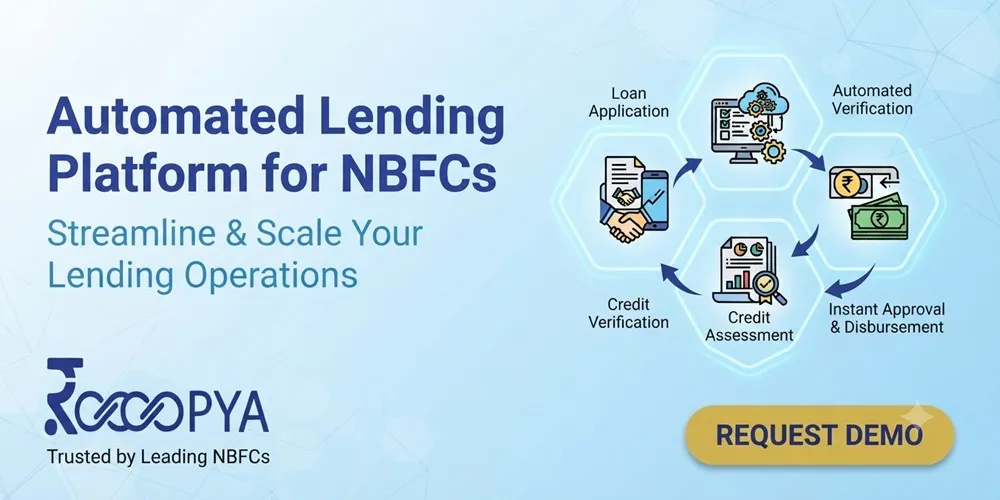
An autonomous digital lending journey can be viewed as a sequence of connected stages:
1. Lead capture and application: Borrowers can enter information through digital channels such as websites, mobile applications, partner journeys, or other supported interfaces. The system validates required information and creates an application record.
2. Eligibility and pre-qualification: Rules can evaluate basic criteria such as product eligibility, income thresholds, geography, loan amount, existing obligations, and other lender-defined conditions.
3. Digital KYC and document intelligence: Documents and data can be collected through digital workflows. OCR and intelligent extraction can help convert information from documents into structured fields, reducing manual entry and enabling cross-checks.
4. Data aggregation and verification: APIs can connect the workflow to credit bureaus, banking or financial data sources, identity services, fraud checks, and other permitted data providers. The system can consolidate relevant information for decisioning.
5. Credit assessment: A decision engine can apply the lender’s credit policy and risk rules. Depending on the lender’s model, the workflow can produce outcomes such as approve, reject, or refer for additional review.
6. Offer and consent: Eligible borrowers can receive appropriate loan terms and disclosures. Digital processes can capture required consent and maintain records of the interaction.
7. Approval and disbursement: Once all conditions are satisfied, the system can trigger downstream approval and disbursement workflows. Controls should ensure that disbursement occurs only when required checks are complete.
8. Loan servicing: After disbursement, the platform can maintain repayment schedules, payment status, interest calculations, communications, and account servicing workflows.
9. Collections and engagement: Automated reminders, digital payment links, communication workflows, and prioritization can support collections. Higher-risk or sensitive cases can be routed to authorized teams.
10. Closure and reporting: When the loan is repaid, the platform can complete closure workflows and retain relevant records. Analytics and audit trails help lenders monitor performance and compliance.
Core Components of an Autonomous Lending System
A strong autonomous lending architecture usually combines several capabilities rather than relying on one AI model.
AI and decisioning layer: This layer evaluates borrower information using configured policies, models, and decision rules. Explainability and governance are important when automated decisions affect access to credit.
Workflow orchestration: The workflow engine connects events, conditions, approvals, integrations, and actions. It determines what should happen next without requiring staff to manually coordinate every step.
Digital KYC and document intelligence: Automated extraction and validation can reduce repetitive document handling and improve data consistency.
API and data integration layer: Lending depends on multiple external services. A flexible integration layer helps connect credit, identity, financial, payment, fraud, communication, and other services as required.
Loan Origination System: The LOS manages the application journey, data capture, underwriting workflow, documentation, and approval processes.
Loan Management System: The LMS manages the account after origination, including schedules, repayments, charges, servicing, and portfolio information.
Collections automation: Digital communications and workflow-based collections help teams manage due and overdue accounts systematically.
Analytics and monitoring: Dashboards can provide visibility into application conversion, approval rates, turnaround time, portfolio performance, delinquency, and operational metrics.
Audit and governance: Automated actions should be traceable. Logs, role-based access, policy versioning, consent records, and exception handling are important for responsible deployment.
Benefits of Autonomous Lending for Banks and NBFCs
Faster processing: Automation reduces the time spent on repetitive checks, data movement, and manual routing. Standard applications can move through predefined workflows much faster.
Lower operational effort: When routine work is automated, teams can concentrate on exceptions and higher-value activities rather than repeatedly performing the same checks.
Consistent policy execution: A centralized rules engine can apply the same configured eligibility and decision policies to similar cases, reducing process variation.
Scalability: A digital workflow can handle growing application volumes without requiring a proportional increase in every operational team.
Better borrower experience: Faster status updates, digital documentation, automated communications, and convenient payment journeys can reduce friction.
Improved visibility: A unified platform can give management a clearer view of the lending funnel and portfolio, helping identify bottlenecks and risk signals.
Stronger process control: Automated workflows can enforce required steps and prevent an application from moving forward when configured conditions are not satisfied.
Continuous operations: Digital systems can support round-the-clock application processing and workflow execution, subject to integrations and configured operating policies.
More focused human oversight: People can spend more time on complex cases, fraud investigations, complaints, exceptions, and relationship management.
Autonomous Lending vs Traditional Digital Lending
Traditional digital lending often digitizes individual tasks while leaving the overall operating model dependent on human coordination. A borrower may apply online, but an employee may still download documents, enter data into another system, request a bureau report, calculate eligibility, seek approval, and manually initiate later steps.
Autonomous lending aims to connect these activities. The application becomes a state-driven workflow in which data, rules, decisions, and actions are linked.
The difference can be summarized as follows:
Traditional digital lending: digital application + manual coordination + multiple handoffs.
Automated lending: digital application + rules/workflows + reduced manual processing.
Autonomous lending: connected data + intelligent decisioning + automated actions + exception-based human oversight.
The right model depends on the lender, product, risk appetite, regulations, and operating requirements. Not every lending decision should be fully automated. The objective is to automate appropriate standard workflows while preserving meaningful controls and human intervention where necessary.
AI in Autonomous Digital Lending
Artificial intelligence can make autonomous lending more capable when it is used within clear policies and governance. Document intelligence can extract information from bank statements, identity documents, invoices, tax records, and other permitted documents. Machine learning can support risk assessment and anomaly detection. Natural language technologies can help power borrower communication and support.
AI can also assist with portfolio monitoring by identifying patterns that deserve attention. For example, a lender may configure models to flag unusual application behaviour, emerging delinquency patterns, or other risk indicators.
However, AI should not be treated as a substitute for responsible lending controls. Models require appropriate data, validation, monitoring, access controls, and periodic review. Lenders should understand how automated decisions are made and maintain processes for handling errors, disputes, and exceptions.
Compliance and Responsible Autonomous Lending in India
Autonomous lending technology must operate within the applicable regulatory framework. The Reserve Bank of India’s digital lending framework places responsibilities on regulated entities even when technology providers or Lending Service Providers are involved. RBI guidance has emphasized areas including borrower disclosures, creditworthiness assessment, consent-based data collection, privacy, grievance redressal, and appropriate handling of digital lending arrangements.
RBI’s Digital Lending Directions, 2025 also address areas including RE-LSP arrangements, borrower creditworthiness, disclosures, disbursal and repayment, cooling-off requirements, grievance redressal, and technology and data requirements. Lenders should therefore treat compliance as an integral part of system design rather than as an afterthought.
For an autonomous system, this means workflows should be designed to support required disclosures, consent records, data governance, auditability, access control, complaint handling, and other applicable obligations. The regulated entity remains responsible for its regulatory duties, even when technology is provided by an external platform.
Because regulations can change, lenders should obtain appropriate legal and compliance advice and configure their technology according to the requirements applicable to their specific products, entities, and partnerships.
How Roopya Supports Autonomous Digital Lending
Roopya is positioned as a no-code unified lending infrastructure for modern lenders. Its autonomous lending approach connects the lending lifecycle from origination through collections, with intelligent automation designed to reduce routine manual intervention.
For lenders, this can mean bringing application processing, KYC and document workflows, credit decisioning, communication, disbursement, repayment management, collections, and audit-related activities into a connected operating environment.
Roopya’s platform is designed for organizations such as NBFCs, banks, MFIs, fintech companies, and other lending businesses that want to modernize their lending stack without building every component from scratch. The platform’s website highlights a fast setup model and pay-as-you-use approach, which can be relevant for lenders seeking to experiment, launch new products, or scale existing operations.
The most important value of an autonomous platform is not simply that it uses AI. It is that the technology connects intelligence to action. A useful system should be able to receive information, evaluate it against policy, trigger the next step, record what happened, and route exceptions appropriately.
Key Features to Look for in Autonomous Lending Software
When evaluating an autonomous lending platform, lenders should look beyond an AI label. Consider whether the platform provides:
• Configurable credit policies and decision rules
• Digital application and onboarding journeys
• KYC, OCR, and document processing
• Secure API integrations
• Credit bureau and financial-data connectivity where permitted
• Automated underwriting workflows
• Offer generation and digital consent capabilities
• Disbursement orchestration
• Loan servicing and repayment management
• Automated borrower communication
• Collections workflows and payment links
• Role-based access controls
• Audit trails and reporting
• Exception queues and human-in-the-loop controls
• Monitoring and analytics
• Scalability and reliable infrastructure
• Data governance and security controls
• Support for regulatory and policy updates
The best platform is the one that fits the lender’s products, risk policies, technology architecture, compliance requirements, and operating model.
Use Cases Across Digital Lending
Autonomous lending can support several lending products and business models. Consumer lending can benefit from rapid application processing and automated servicing. MSME lending can use document intelligence and financial-data analysis to streamline assessment. Microfinance workflows can automate application and repayment communications while supporting field operations where needed. Embedded finance and partner-led lending can benefit from APIs and configurable journeys.
Co-lending models can also benefit from standardized origination workflows, data exchange, decisioning, and portfolio reporting, subject to applicable arrangements and regulatory requirements.
For established lenders, autonomous technology can be introduced gradually. A lender may first automate document processing and eligibility, then expand into underwriting, disbursement, servicing, and collections. This phased approach allows teams to validate workflows and controls before increasing the degree of autonomy.
Best Practices for Implementing an Autonomous Lending System
Start with a clearly defined lending journey. Map every step from lead capture to closure and identify which activities are repetitive, rule-based, data-driven, or dependent on human judgment.
Define policies before automating them. Automation can make a poor process faster, but it does not make it better. Credit rules, exception conditions, approval authorities, and escalation paths should be documented.
Use human oversight intelligently. Not every case should follow the same path. Configure exception queues for unusual, high-risk, incomplete, disputed, or otherwise sensitive cases.
Design for transparency. Borrowers should receive the disclosures and information required by applicable rules, and lenders should be able to reconstruct important decisions and actions.
Monitor outcomes. Track approval quality, delinquency, fraud indicators, turnaround time, customer complaints, operational failures, and model performance.
Secure the data. Use appropriate access controls, encryption, logging, retention policies, vendor controls, and consent mechanisms.
Review automation continuously. Lending products, regulations, customer behaviour, fraud patterns, and economic conditions change. Autonomous workflows should be monitored and updated rather than treated as set-and-forget systems.
The Future of Autonomous Digital Lending
The future of lending is likely to be increasingly connected, data-driven, and automated. AI agents may coordinate more parts of the lending lifecycle, while decision engines become more configurable and real-time data becomes more useful for risk assessment and servicing.
At the same time, trust will become more important, not less. Lenders will need systems that combine speed with responsible credit practices, strong security, clear disclosures, explainable processes, and meaningful human escalation.
Autonomous lending should therefore be viewed as an operating model rather than a single feature. The winning platforms will connect origination, risk, servicing, collections, customer communication, analytics, and governance in one coherent system.
For lenders evaluating this transition, the question is not simply whether AI can approve a loan. The better question is whether the complete lending journey can be made faster, safer, more consistent, measurable, and easier to manage. That is where autonomous lending systems can create lasting value.
Conclusion
An autonomous lending system for digital lending can transform how lenders originate, manage, and service credit. By combining AI, decision engines, workflow automation, APIs, digital KYC, document intelligence, loan management, communications, collections, and analytics, lenders can reduce repetitive manual work and build a more responsive lending operation.
The strongest approach is not “automation at any cost.” It is controlled autonomy: automate standard workflows, maintain clear policies, preserve auditability, protect borrower data, and route exceptions to qualified people.
Roopya provides a no-code unified lending infrastructure designed around this model. For lenders seeking to modernize their digital lending operations, an autonomous platform can provide the foundation for faster execution, scalable operations, and a more connected borrower journey.
Frequently Asked Questions
What is an autonomous lending system?
An autonomous lending system is a digital platform that automates multiple stages of lending, from application and KYC through decisioning, disbursement, servicing, and collections, with human oversight for exceptions and responsibilities that require judgment.
How is autonomous lending different from digital lending?
Digital lending moves lending processes into digital channels. Autonomous lending goes further by connecting data, rules, AI, workflows, and actions so that standard cases can progress with minimal manual intervention.
Can autonomous lending software be used by NBFCs and banks?
Yes. Autonomous lending technology can support banks, NBFCs, MFIs, fintech lenders, and other lending organizations, subject to their products, technology architecture, risk policies, and applicable regulatory requirements.
Does autonomous lending remove human employees?
Not necessarily. A responsible model automates routine cases and routes exceptions, complex cases, complaints, fraud concerns, and other situations requiring judgment to authorized people.
What role does AI play in autonomous lending?
AI can support document intelligence, risk analysis, anomaly detection, borrower communication, workflow decisions, and portfolio insights. Its use should be governed, monitored, and aligned with applicable policies and regulations.
Is autonomous lending compliant with RBI requirements?
Technology itself does not guarantee compliance. The platform and lending workflows must be configured to meet the requirements applicable to the regulated entity, product, and arrangement. RBI's digital lending framework places obligations on regulated entities even when LSPs or technology providers are involved.
What are the main benefits of autonomous lending?
Key benefits can include faster processing, lower repetitive operational effort, consistent policy execution, scalability, improved borrower experience, better workflow visibility, and stronger process controls.
What should lenders consider before choosing autonomous lending software?
Evaluate decisioning, integrations, KYC and document processing, LOS and LMS capabilities, collections, audit trails, security, data governance, analytics, scalability, exception handling, and the vendor's ability to support your compliance and operational requirements.
How does Roopya support autonomous lending?
Roopya provides a no-code unified lending infrastructure intended to connect origination, decisioning, disbursement, servicing, collections, and related workflows for modern lenders.
Can autonomous lending support collections?
Yes. Autonomous workflows can support due-date reminders, digital payment links, communication, prioritization, and escalation workflows, while sensitive or complex recovery cases can be routed to authorized teams.






















Sign in to leave a comment.