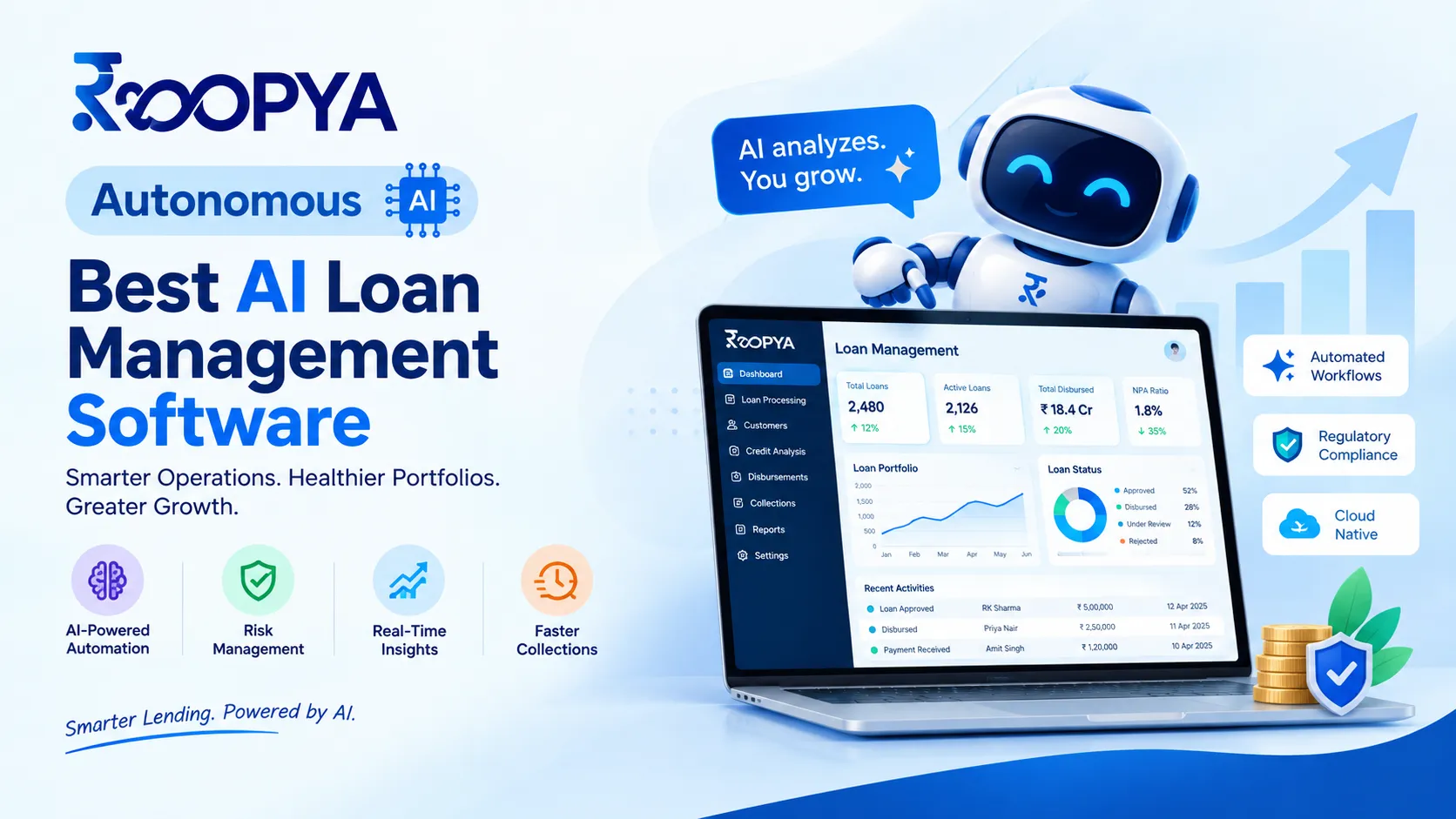

Loan management used to mean spreadsheets, manual EMI tracking and stacks of paper files. That era is over. In 2026, banks, NBFCs and fintech lenders are running their entire loan lifecycle — from origination through underwriting, disbursement, servicing and collections — on platforms that use artificial intelligence to make faster, more accurate lending decisions. The right AI loan management software does not just digitize old workflows; it rebuilds them, using machine learning models that score credit risk in seconds, automate document verification, flag delinquency before it happens and keep lenders compliant with RBI directions without a full-time compliance team chasing every rule change.
But “AI-powered” has become one of the most overused labels in lending technology. Nearly every vendor claims it. Few can actually show a lender the reasoning behind an AI-driven credit decision, or prove that their models reduce non-performing assets rather than simply speeding up approvals. Choosing the wrong platform is expensive: migrations are disruptive, contracts often run for years, and a system that cannot scale with loan volume or keep pace with RBI's evolving digital lending guidelines becomes a liability rather than an asset.
This guide breaks down what AI loan management software actually does, the features worth paying for, and a detailed, honest look at the platforms — including Roopya — that Indian and global lenders are evaluating in 2026. Whether you run a small NBFC disbursing a few hundred loans a month or a bank managing a multi-billion-rupee portfolio, this is meant to help you make an informed decision, not just point you to a demo request form.
What Is AI Loan Management Software?
Loan management software (LMS) is the system of record that governs a loan after it has been approved and disbursed — EMI scheduling, repayment tracking, interest accrual, restructuring, delinquency management, collections and closure. It is usually paired with, or built alongside, a Loan Origination System (LOS), which handles everything before disbursement: application intake, KYC, credit underwriting and approval workflows. Many modern platforms, including Roopya, now offer LOS and LMS together as a single lending stack, rather than forcing lenders to integrate two separate systems.
What makes a loan management system “AI-powered” is the layer of machine learning models sitting on top of these workflows. Instead of relying purely on static rules (“reject if credit score is below X”), an AI-driven system analyzes hundreds of data points — bureau data, banking transaction patterns, repayment history, and alternative data such as utility payments or GST filings — to produce a more nuanced risk score. The same AI layer typically extends into collections (predicting which borrowers are likely to default and prioritizing outreach accordingly), fraud detection (flagging inconsistent documents or suspicious application patterns) and portfolio analytics (surfacing early warning signals across an entire loan book).
In short: a traditional LMS tracks loans. An AI loan management system tracks loans and continuously learns from them, improving decisioning, reducing manual review, and giving risk and collections teams a head start instead of a rear-view mirror.
Why AI Matters in Loan Management Right Now
Two forces are pushing Indian lenders toward AI-driven platforms at the same time. The first is competitive pressure: newer, digital-first micro-lending platforms can disburse loans within a few days, while lenders still running manual or legacy processes often take four to six days for the same decision. Borrowers, especially in retail and MSME lending, increasingly choose whoever approves fastest. The second is regulatory pressure: RBI's digital lending guidelines are pushing NBFCs toward more transparent, auditable and borrower-protective processes, and a modern AI-driven LOS/LMS makes SMA classification tracking, NPA provisioning and bureau reporting far easier to get right than a spreadsheet-based process ever could.
The numbers back this up. Industry benchmarks cited by McKinsey and TransUnion suggest AI can cut loan approval time by roughly 30–50% and improve collections recovery efficiency by 25–40% when applied properly across the credit lifecycle. The global AI-powered fintech market itself is estimated at over $26.6 billion in 2026, growing at roughly 23% a year. In India specifically, NBFC credit is forecast to grow around 17% annually through FY35, compared to about 12% for traditional bank lending — a gap analysts largely attribute to AI-enabled efficiency in underwriting, collections and customer acquisition.
Importantly, the shift isn't about replacing loan officers or closing branches. Some of India's fastest-growing NBFCs are scaling AI adoption and their physical footprint at the same time — expanding digital onboarding while still growing branch networks — because AI removes the repetitive, low-judgment work (data entry, document checks, first-pass risk scoring) and frees people to focus on relationship-driven, higher-value lending decisions.
Key Features to Look for in AI Loan Management Software
Not every “AI-powered” claim delivers real value. When evaluating a platform, look past the marketing language and check for these specific capabilities:
- AI-driven credit underwriting with explainability. The system should score risk using bureau data, banking and cash-flow patterns, and alternative data — and be able to show the reasoning behind a decision, not just a black-box score. This matters for both compliance and for training loan officers to trust the model.
- End-to-end lifecycle coverage. Origination, underwriting, disbursement, servicing, collections and restructuring should live on one platform, or integrate tightly enough that data doesn't need to be re-entered at each stage.
- Automated KYC and document processing. OCR and machine learning should extract, verify and classify borrower documents — PAN, Aadhaar, bank statements, GST returns — in seconds rather than requiring manual review of every file.
- Fraud and anomaly detection. Look for models that flag inconsistent documents, duplicate applications or unusual application patterns before disbursement, not after a loan has already gone bad.
- Predictive collections. Rather than treating every overdue borrower the same way, the system should rank accounts by likelihood of default and recommend the right outreach channel and timing for each.
- RBI and regulatory compliance built in. Automated SMA classification, NPA provisioning calculations, audit trails, data localisation and bureau reporting aligned with current RBI master directions should be native features, not bolt-ons.
- Multi-product configurability. Personal loans, business loans, gold loans, vehicle finance, education loans and microloans each need different workflows, approval matrices and repayment structures — the platform should support this from a single configuration layer, not a custom build per product.
- Open API architecture. Strong, well-documented APIs and pre-built connectors for credit bureaus, core banking systems, payment gateways and KYC providers cut implementation time significantly.
- Borrower self-service. A portal or app where borrowers can track applications, view EMI schedules, make payments and access statements reduces inbound service load and improves collection rates.
- Real-time dashboards and portfolio analytics. Lenders need at-a-glance visibility into disbursement volumes, delinquency rates, vintage curves and portfolio quality — not a monthly report generated from exported spreadsheets.
- Deployment speed and scalability. Cloud-native platforms that can go live in days rather than months, and that scale with loan volume without re-platforming, reduce both cost and risk.
The Best AI Loan Management Software in 2026
Below is an honest look at the AI loan management platforms that banks, NBFCs and fintech lenders are actively evaluating in 2026 — spanning India-focused specialists and global enterprise players.
1. Roopya — Best for Indian NBFCs wanting a fast, AI-first LOS + LMS
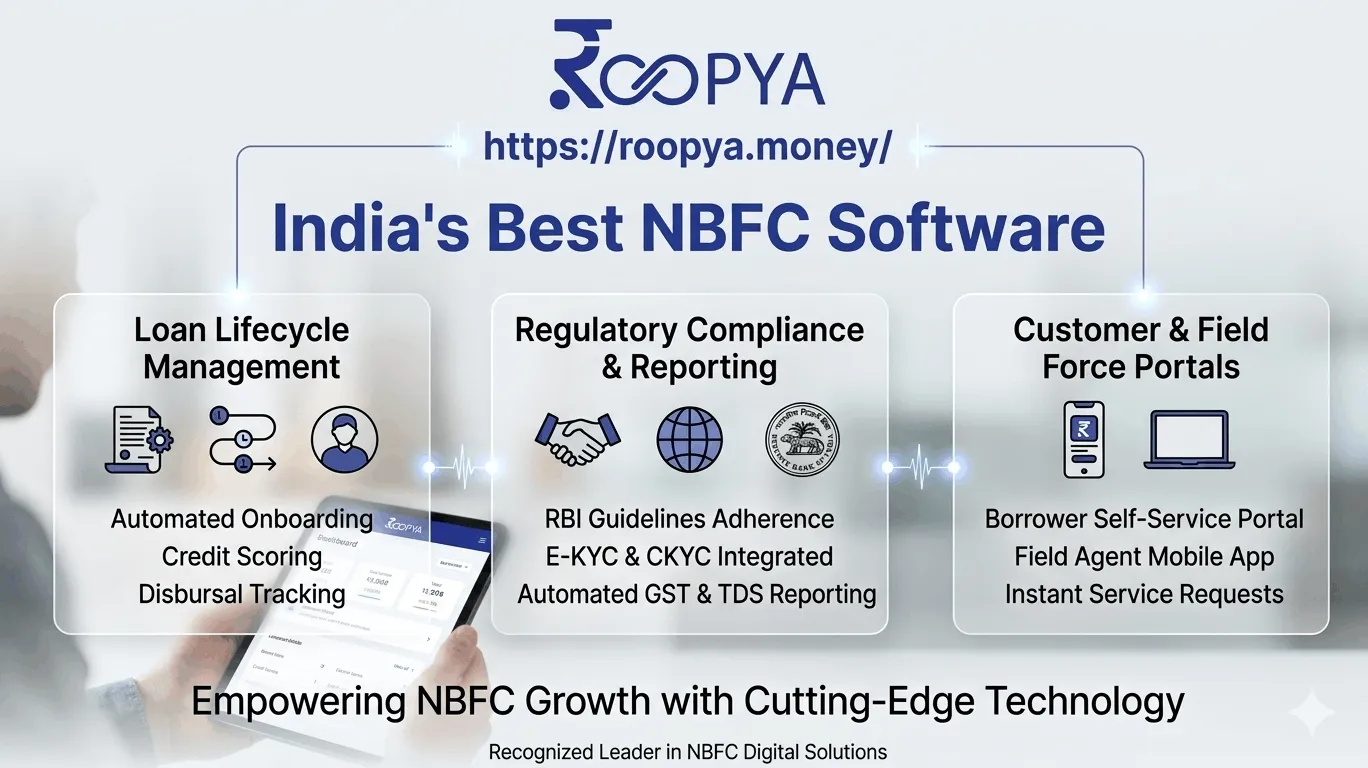
Roopya (roopya.money) is built specifically for the Indian NBFC and digital lending market, combining loan origination, loan management and collections in a single AI-first platform. It's designed for lenders who want to go live quickly — Roopya is built around onboarding in as little as five days with no setup cost — rather than committing to the months-long implementation cycles typical of legacy enterprise systems. Its AI layer covers underwriting, automated KYC and collections prioritization, and its LMS is built around India's regulatory environment, including SMA classification and NPA provisioning aligned with RBI master directions. Best for: NBFCs, fintech lenders and MFIs that want India-specific compliance handled out of the box, without sacrificing speed of deployment. Where it's still building out: as a newer, India-focused platform, it doesn't yet carry the multi-decade global enterprise footprint of players like Temenos or Finastra — which matters most for very large banks running lending as one module inside a much bigger core banking stack.
2. TurnKey Lender — Best for all-in-one lending automation
TurnKey Lender is a global fintech platform covering origination, servicing and collections with AI built into the underlying decisioning engine. It's a strong fit for lenders who want a single vendor across the full lifecycle rather than stitching together point solutions, and it serves banks, credit unions and alternative lenders internationally. Pricing is generally quote-based.
3. Finezza — Best for mid-sized NBFCs and mortgage lenders
Finezza focuses on risk analytics, fraud prevention and compliance, and is popular with mid-sized and regional NBFCs and mortgage lenders that need to support high-volume lending with strong audit-trail functionality. It supports configurable, multi-product workflows across personal, business, vehicle, gold, education and microloans, with 50+ pre-built integrations for bureaus, payment gateways and KYC providers.
4. Cloudbankin — Best for cloud-native deployment speed
Cloudbankin is a cloud-native LMS built specifically for NBFCs and fintechs, covering the loan lifecycle from application through underwriting, disbursement and repayment on one platform. Its dashboards give lenders real-time visibility into portfolio performance, and its API-first design makes it a reasonable fit for lenders that want fast integration with existing systems.
5. M2P Core Lending Suite — Best for banks and large NBFCs wanting an AI-native core
M2P's Core Lending Suite is positioned as a unified, AI-native lending core supporting secured, unsecured and microfinance products, built on over a decade of lending infrastructure experience and used by 300+ lenders in India. It's aimed at institutions that want embedded AI across every stage of the lifecycle rather than AI as an add-on module.
6. Mambu — Best for composable, API-first architecture
Mambu is a cloud-based, composable banking platform popular with teams that want to build lending products via APIs rather than adopting a rigid, monolithic system. It suits fintechs and digital-first lenders that expect to customize workflows extensively and integrate with a broader stack of best-of-breed tools.
7. nCino — Best for lenders already invested in Salesforce
nCino is a banking platform built on Salesforce, bringing lending workflows into a CRM that many institutions' teams already use daily. This tight CRM integration is its biggest differentiator — useful for relationship-driven commercial and SME lending — though it ties the lender fairly closely to the Salesforce ecosystem.
8. Axe Finance (Axe Credit Portal) — Best for global banks needing broad segment coverage
Axe Credit Portal automates the loan process from KYC through servicing, including scoring, automated decisioning and collateral management. Axe Finance works with large global banking institutions across retail, commercial, corporate, sovereign and microfinance segments, including Islamic and green finance — making it a strong option for lenders with a wide range of loan products across geographies.
9. Temenos — Best for banks wanting lending inside a full core banking stack
Temenos is best suited to institutions that want lending native to the same platform handling deposits, payments and customer data, rather than as a standalone system. It's a contact-sales, enterprise-grade product, generally a fit for banks pursuing broader core banking modernization rather than standalone NBFCs.
10. LoanPro — Best for US-centric consumer and commercial lenders
LoanPro is a widely used loan servicing platform in the US market, covering consumer, commercial and equipment lending with configurable workflows and strong API access. It's frequently shortlisted alongside enterprise players like Finastra and Mambu by lenders comparing lifecycle coverage and AI capability.
Quick Comparison
| Platform | Best For | Deployment | AI Focus |
|---|---|---|---|
| Roopya | Indian NBFCs wanting fast go-live | Cloud, ~5 days | Underwriting, KYC, collections |
| TurnKey Lender | All-in-one lending automation | Cloud | Decisioning across lifecycle |
| Finezza | Mid-sized NBFCs, mortgage lenders | Cloud | Risk analytics, fraud prevention |
| Cloudbankin | Fast cloud-native NBFC deployment | Cloud | Lifecycle automation |
| M2P Core Lending Suite | Banks & large NBFCs | Cloud | AI-native core across lifecycle |
| Mambu | Composable, API-first builders | Cloud / API | Custom AI via APIs |
| nCino | Salesforce-integrated lenders | Cloud (Salesforce) | CRM-linked workflows |
| Axe Finance (ACP) | Global banks, multi-segment | Cloud / on-prem | Scoring, decisioning, collateral |
| Temenos | Core-banking-integrated lending | Cloud / on-prem | Embedded in core banking |
| LoanPro | US consumer & commercial lending | Cloud | Servicing automation |
Emerging AI Lending Trends to Watch in 2026
A few trends are reshaping what “AI-powered” means for loan management platforms this year. The first is agentic underwriting — instead of a single risk score, some platforms now deploy AI agents that pull bureau data, screen documents for fraud, calculate policy ratios such as DSCR and LTV, and produce a full decision recommendation with reasoning attached, cutting what used to take days down to minutes. The second is Account Aggregator–powered underwriting, which remains one of the most underused opportunities in Indian lending: combining consent-based financial data sharing with AI models to underwrite thin-file borrowers who don't show up well in traditional bureau data. The third is a shift in collections from reactive to predictive — flagging accounts likely to default weeks before they actually miss a payment, rather than after.
For lenders evaluating platforms in 2026, the practical takeaway is to ask vendors specifically how their AI is used in each of these areas, rather than accepting “AI-powered” as a single checkbox. A platform that can show you a real decision, with the data and reasoning behind it, is a fundamentally different product from one that just runs a black-box score in the background.
How to Choose the Right AI Loan Management Software
There's no universal “best” AI loan management software — the right choice depends on loan volume, product mix, geography and how much of your lending stack you want from one vendor versus several. Before shortlisting anything, get clear answers to a few questions:
- What's your regulatory environment? If you're an Indian NBFC, RBI compliance — SMA classification, NPA provisioning, data localisation, bureau reporting — should be native, not a custom add-on you pay to build.
- Do you need LOS and LMS together, or just one? Lenders replacing an entire legacy stack often want both in one platform to avoid integration overhead; lenders with a working origination system may just need servicing and collections.
- How fast do you need to go live? Enterprise platforms tied to core banking systems can take months to implement; cloud-native, India-focused platforms often go live in days to weeks.
- How many loan products do you offer? If you run personal, gold, vehicle, business and microloans simultaneously, confirm the platform supports distinct workflows and approval matrices for each without custom development.
- Can you see the AI's reasoning? Ask any vendor to show you an actual AI-driven credit decision with the underlying reasoning attached, not just a score. If they can't, treat “AI-powered” claims with skepticism.
- What does migration actually involve? Ask for a realistic timeline and a reference lender who has been through it — loan data migration is the part most institutions underestimate.
- Is pricing transparent? Contact-sales, opaque pricing isn't automatically a red flag for enterprise deals, but get a clear cost structure (setup fees, per-loan or per-user pricing, minimum commitments) before signing.
Shortlist two or three platforms that clear these questions, run a proof-of-concept with real (anonymized) loan data if possible, and involve your risk, compliance and collections teams in the evaluation — not just IT. The system your collections team resents using every day will underperform regardless of how good its models are on paper.
Implementation Best Practices
Even the right software fails if it's implemented poorly. A few practices consistently separate smooth rollouts from painful ones.
- Migrate in phases, not all at once: move one loan product or one branch cluster first, validate that EMI schedules, interest accrual and NPA classification match your legacy system exactly, then expand.
- Keep a human-in-the-loop on AI decisions initially: run the AI underwriting model in “shadow mode” alongside your existing process for a few weeks before letting it make unassisted decisions, so your risk team can validate its outputs against real outcomes.
- Train collections and support staff early: the AI's predictive prioritization is only useful if the team acting on it understands why an account was flagged and trusts the recommendation.
- Set up compliance reporting before go-live, not after: confirm SMA classification, NPA provisioning and bureau reporting formats are validated against your last few regulatory filings before the new system becomes your system of record.
- Plan for API integrations up front: credit bureau, payment gateway and KYC provider connections are usually the longest pole in any implementation — start these conversations with your vendor on day one, not after core configuration is done.
Budget more time for change management than for the technical configuration itself. Most delays in LMS rollouts come from process and people, not the software.
Conclusion
AI loan management software has moved from a competitive differentiator to a baseline expectation for lenders operating in India's fast-growing NBFC and digital lending market. The platforms that win in 2026 aren't necessarily the ones with the loudest AI marketing — they're the ones that can show explainable credit decisions, keep pace with RBI's evolving digital lending guidelines, and go live fast enough to matter for a lender's current growth plans, not a five-year roadmap. For Indian NBFCs specifically, that combination — AI-driven underwriting, built-in compliance and rapid deployment — is exactly where platforms like Roopya are positioned, alongside established global players like TurnKey Lender, Mambu and Temenos for institutions with different scale or integration needs. Whichever platform you shortlist, test it against your actual loan products, your actual regulatory reporting requirements and your actual go-live timeline — not a vendor's demo environment. That's the only comparison that tells you whether it will work for your business.
Frequently Asked Questions
What is AI loan management software?
AI loan management software is a platform that manages the post-disbursement loan lifecycle — EMI scheduling, repayment tracking, delinquency management and collections — using machine learning to score risk, detect fraud and predict which borrowers need proactive outreach, rather than relying only on static rules.
What's the difference between a Loan Origination System (LOS) and a Loan Management System (LMS)?
An LOS handles everything before disbursement — application intake, KYC, credit underwriting and approval. An LMS takes over after disbursement, managing repayments, restructuring, collections and closure. Many modern platforms, including Roopya, combine both into a single system.
Is AI loan management software suitable for small NBFCs, or only large banks?
Cloud-native platforms built specifically for NBFCs, such as Roopya, Cloudbankin and Finezza, are generally designed for fast deployment and lower upfront cost, making them accessible to small and mid-sized lenders. Enterprise platforms like Temenos or nCino tend to suit larger banks with broader core banking needs.
How does AI improve loan collections?
AI models analyze repayment history and behavioral data to predict which borrowers are likely to miss a payment, then prioritize outreach — the right channel, timing and message — for each account, instead of treating every overdue borrower identically. Industry benchmarks suggest this can improve collection recovery efficiency by 25–40%.
Does AI loan management software help with RBI compliance?
Yes — platforms built for the Indian market typically automate SMA classification tracking, NPA provisioning calculations and bureau reporting aligned with current RBI digital lending guidelines, reducing the manual work and audit risk involved in regulatory reporting.
How long does it take to implement AI loan management software?
This varies significantly by platform. Cloud-native, India-focused systems can go live in a matter of days to a few weeks, while enterprise platforms tied to a broader core banking stack can take several months to implement.
How much does AI loan management software cost?
Pricing varies widely — some platforms use custom, contact-sales pricing based on loan volume or user count, while others advertise no setup cost with usage-based pricing. Always ask for a clear breakdown of setup fees, per-loan or per-user costs and minimum commitments before comparing vendors.
Can AI loan management software fully replace loan officers?
No. AI is best used to remove repetitive, low-judgment work — data entry, document verification, first-pass risk scoring — freeing loan officers and relationship managers to focus on complex, judgment-driven lending decisions. Several of India's fastest-growing NBFCs have scaled AI adoption and branch networks simultaneously rather than replacing one with the other.























Sign in to leave a comment.