
The real problem is not cooking, it is friction
I keep thinking about a small scene I saw after a conference talk on home technology: a chef on stage made a weeknight tomato soup in under 20 minutes, and the audience did not applaud the flavor first. They applauded the workflow. No searching for lids. No wrestling with dull blades. No standing over a pot forever. That reaction says something important about the modern kitchen. For beginners, the hardest part of cooking is often not skill. It is interruption. Tiny delays stack up until dinner feels larger than it is.
That is why a beginner’s guide to the best kitchen gadgets that save time should start with a simple question: what kind of time are you trying to save? Prep time? Monitoring time? Cleanup time? Decision time? A gadget that chops onions quickly may still be a bad buy if it creates five extra parts to wash. A multicooker may look expensive until you realize it replaces a rice cooker, slow cooker, and part of your stovetop routine. The best tool is rarely the flashiest one. It is the one that removes repeat friction.
Recent retail coverage captures that split between novelty and usefulness. AOL’s roundup of high-tech kitchen gadgets leans toward premium devices with strong review momentum, while MSN’s list of low-cost kitchen tools shows how many time savers are surprisingly cheap. Seen together, they point to a useful beginner lesson: speed in the kitchen does not belong only to expensive smart appliances. Sometimes it is a digital thermometer. Sometimes it is a bench scraper. Sometimes it is the right container shape.
The best time-saving gadget is the one you will use three times a week, not the one that impresses guests once a month.
If you are just building a kitchen toolkit, start there. Not with hype. With repetition. Which tasks make you sigh before you even begin?
How kitchen gadgets became workflow tools, not just accessories
Kitchen gadgets used to live in a strange category. They were gifts, impulse buys, late-night infomercial curiosities. Many still are. But over the past decade, the market has shifted in a more serious direction, pushed by a few forces that matter for beginners. First, more people learned to cook at home regularly during the pandemic years and never fully returned to pre-2020 habits. Second, food inflation made takeout and restaurant meals feel less casual. Third, small-appliance brands started selling not just convenience, but labor reduction measured in minutes, presets, and fewer dishes.
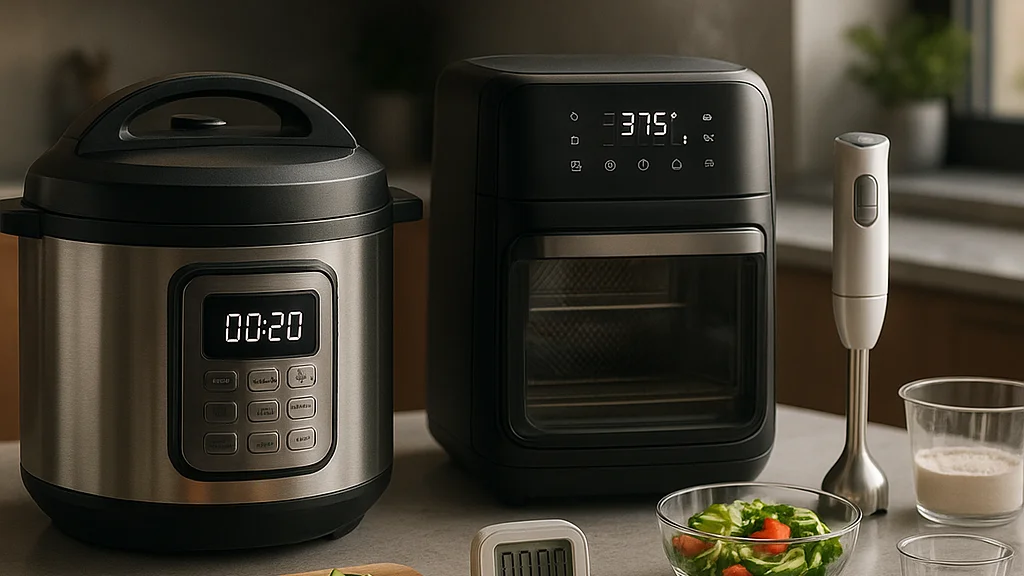
That shift shows up in product design. Air fryers moved from niche countertop machines to broad household staples because they reduced preheat and cleanup compared with a full-size oven for many tasks. Electric pressure cookers gained traction because they compressed long braises, beans, and stocks into realistic weeknight cooking. Immersion blenders became more common because they eliminate the transfer step that makes hot soups annoying and risky. These are not decorative changes. They target bottlenecks.
There is also a cultural change in how we talk about cooking competence. A beginner once felt they had to earn efficiency through knife skills alone. Now the conversation is more pragmatic. If a salad spinner gets greens washed and dried in one minute instead of ten, why pretend that hand-drying lettuce is morally superior? If a rice cooker produces consistent grains with almost no attention, why make rice the hard way on a Tuesday?
WriteUpCafe has covered this from several angles. Pieces like Top 8 Best Kitchen Gadgets That Save Time at Home and Time-Saving Kitchen Gadgets That Transform Cooking Efficiency both circle the same truth: efficiency is less about speed for its own sake and more about reducing mental load. That matters enormously for beginners, who are often juggling recipes, timing, and confidence all at once.
Good gadgets do not replace learning. They create enough breathing room for learning to happen.
That line may sound soft-edged, but I think it is exact. When the tool handles one repetitive task well, your attention can move to seasoning, doneness, and taste. That is where actual cooking ability grows.
The best beginner gadgets, ranked by the kind of time they save
Rather than sorting tools by trendiness, it makes more sense to sort them by the bottleneck they solve. Beginners often buy according to category names and end up with overlap. A smarter path is to identify where dinner gets slowed down. Below is the framework I recommend most.
1. Prep-speed tools
- Chef’s knife and pull-through-free sharpener strategy: A truly sharp knife is faster than most single-use choppers and more flexible. If budget allows, pair a decent knife with periodic professional sharpening or a trusted whetstone routine.
- Mini food processor: Useful for garlic, herbs, nuts, dressings, curry pastes, and small batches where a full-size processor feels absurd.
- Box grater or rotary grater: Faster than hand mincing for cheese, vegetables, and zest-heavy prep.
- Bench scraper: One of the cheapest time savers in any kitchen, especially for transferring chopped ingredients cleanly.
These tools shrink the front-end slog. They are especially helpful if you avoid recipes because the prep list looks long.
2. Hands-off cooking tools
- Rice cooker: A classic for a reason. It removes monitoring and delivers consistency.
- Multicooker or electric pressure cooker: Excellent for beans, stews, shredded meats, stocks, and grains.
- Slow cooker: Still relevant if you prefer morning prep and evening payoff, though less versatile than a multicooker.
- Air fryer: Strong for frozen foods, roasted vegetables, reheating, salmon, tofu, and quick crisping.
This category saves attention more than minutes. That distinction matters. A stew that cooks for 35 minutes unattended can be more valuable than a pan version that takes 25 minutes but demands constant presence.
3. Accuracy tools that prevent wasted time
- Instant-read thermometer: Arguably the most underrated beginner purchase. It prevents overcooked chicken, underdone fish, and endless cutting to check the center.
- Digital scale: Faster and more reliable for baking, but also useful for coffee, dough, portioning, and reducing dish use from measuring cups.
- Kitchen timer system: Whether built into a smart speaker or separate, a dedicated timer habit avoids the stop-start chaos that ruins multitasking.
Why include these? Because ruined food is lost time. Beginners often underestimate how much time they spend recovering from preventable mistakes.
What the numbers and reviews actually suggest
Consumer gadget coverage can be noisy, but patterns emerge when you read enough of it. AOL’s reviewed roundup emphasizes premium, review-backed products that justify their price through repeat utility, while MSN’s under-$15 list highlights a different truth: there is no clean correlation between cost and usefulness. Some of the best time savers in a kitchen are low-tech and inexpensive. That should be reassuring if you are starting from scratch.
Industry sales data over recent years, including widely cited reporting from market researchers and major retailers, has consistently shown strong consumer interest in air fryers, multicookers, and compact electric appliances. The reason is not mysterious. These tools answer the weeknight equation directly: less preheating, less monitoring, fewer pans, smaller portions handled efficiently. Air fryers in particular became mainstream because they solve a narrow but frequent problem very well. Reheating leftovers in an oven is slow. Pan-reviving them takes attention. Microwave texture is often disappointing. The air fryer sits in the middle and wins on convenience.
Still, beginners should be cautious about review inflation. A gadget may earn high ratings because it is fun to unbox, not because it saves time six months later. I tend to look for five signals:
- Does it replace at least one existing tool or step?
- Can it be cleaned in under three minutes?
- Does it work for more than one cuisine or meal type?
- Will it fit where you can reach it easily?
- Does it reduce uncertainty, not just labor?
That last point is subtle. A thermometer saves time because it ends guessing. A rice cooker saves time because it removes the need to hover. A food processor saves time only if setup and cleanup do not erase the gain. The beginner mistake is buying for theoretical efficiency rather than actual frequency.
For a broader perspective, WriteUpCafe’s Top 6 Best Kitchen Gadgets That Save Time and Best Kitchen Gadgets That Save Time in 2026: Efficiency Meets Innovation are useful companion reads because they illustrate the market split between foundational tools and newer feature-rich appliances. Read enough lists and one thing becomes clear: the best beginner setup is usually hybrid. One or two powered appliances. Several low-cost manual tools. A focus on repeat use.
Here is a practical way to think about value:
- If you cook rice, grains, or beans weekly, a rice cooker or multicooker often pays back in reduced effort quickly.
- If you roast or reheat small portions often, an air fryer can save both time and energy versus a full oven.
- If you cook proteins regularly, an instant-read thermometer may save more dinners than any appliance on the counter.
- If your prep always drags, a bench scraper, sharp knife, and mini processor may outperform trendier buys.
That may sound almost too plain. But beginner kitchens improve through plain things first.
What has changed in 2026?
The 2026 kitchen gadget conversation is a little more mature than it was a few years ago. The novelty rush around app-connected appliances has cooled, and buyers seem more skeptical of features that do not translate into daily usefulness. Brands are responding by emphasizing multifunctionality, easier cleaning, and compact footprints. That is not accidental. Counter space has become a sharper consumer concern, especially in urban apartments where every appliance must justify itself.
One noticeable development is the refinement, rather than reinvention, of familiar categories. Air fryers are now commonly designed with better basket geometry, viewing windows, dual-zone cooking, and dehydration or proofing modes. Multicookers continue to add guided programs, but the more meaningful upgrades tend to involve quieter steam release, safer lids, and improved sauté performance. Blenders and food processors are increasingly sold with narrower accessory kits because manufacturers have learned that fewer, better attachments often beat a drawer full of plastic.
There is also a stronger sustainability angle in 2026. Consumers are paying closer attention to appliance longevity, repairability, and energy use. Smaller cooking devices can reduce energy consumption for certain tasks compared with heating a full-size oven, though the exact benefit depends on the appliance and cooking style. That makes time-saving and energy-saving overlap more often than they used to. If you are roasting two portions of vegetables, a compact device can be both faster and less wasteful.
Another shift? Social video still drives gadget discovery, but there is more pushback against one-purpose tools. The old cycle of viral purchase, one-week enthusiasm, and cabinet exile is under more scrutiny. That is healthy. It pushes beginners toward durable categories: thermometers, scales, rice cookers, immersion blenders, modular storage, and a few genuinely versatile electric appliances.
What should a new buyer take from this 2026 moment? Buy into a cooking system, not a trend. Ask whether the gadget supports the meals you already want to make. Ask whether it reduces cleanup. Ask whether it earns visible countertop space. Those questions are more useful than any influencer demonstration, aren’t they?
A smart starter kit for different kinds of beginners
Not all beginners are the same, and this is where many buying guides become strangely abstract. A student in a studio apartment does not need the same setup as a parent cooking for four. Someone meal-prepping grains and proteins has different pressure points than someone learning basic soups and pasta. So instead of one universal list, I prefer a few starter profiles.
The tiny-kitchen beginner
If space is tight, prioritize stackable utility over specialized appliances. Start with a sharp knife, bench scraper, instant-read thermometer, mini food processor, and one compact cooker. For most people, that compact cooker should be either a rice cooker or a small air fryer, not both immediately. Which one depends on your habits. Do you eat grain bowls, lentils, and simple steamed meals, or do you reheat and roast more often?
The anxious beginner
If your main barrier is fear of messing things up, buy tools that reduce uncertainty. A thermometer, digital scale, timer, and rice cooker will do more for your confidence than a flashy smart pan. These tools create repeatable outcomes. That repeatability matters psychologically. You stop improvising under stress and start noticing patterns.
The batch-cooking beginner
If you want leftovers, a multicooker rises to the top. Pair it with quality storage containers and an immersion blender. Suddenly soups, beans, braises, sauces, and meal-prep grains become far less demanding. Cleanup also stays manageable because many recipes consolidate into one vessel.
Here is a useful starter budget ladder:
- Under $30: bench scraper, box grater, thermometer, measuring scale, salad spinner or collapsible colander
- $30 to $100: mini food processor, immersion blender, rice cooker
- $100 and up: air fryer, multicooker, higher-end blender if you make smoothies or soups often
The point is not to spend more. It is to spend in the order that removes your biggest bottleneck first. I have seen beginners transform their cooking with a $12 scraper and a $20 thermometer. I have also seen expensive appliances gather dust because they solved a problem the buyer did not actually have.
Begin with one frustration, one fix, and one month of honest use. Then expand.
That is slower than impulse shopping, yes. It is also how you build a kitchen that feels calm rather than crowded.
The gadgets beginners should skip, at least for now
This may be the most useful section, because saving time sometimes means refusing to buy things. Single-purpose tools can be charming, and I say that as someone who has absolutely been seduced by museum gift shop design logic in kitchenware form. But charm is not the same as utility. If a gadget only performs one narrow task that your knife or pan already handles well, it probably does not belong in a beginner kitchen.
Be cautious with dedicated avocado slicers, banana cutters, herb strippers with awkward profiles, oversized breakfast sandwich machines, and novelty choppers that promise speed but create fiddly cleanup. Also be skeptical of “smart” devices that require too much app setup for too little payoff. Connectivity can be useful for some appliances, but if the core function is weak, software will not rescue it.
Another trap is duplication. A beginner may buy a rice cooker, slow cooker, and multicooker within a few months, only to realize the multicooker overlaps with both. Or they may buy an air fryer toaster oven and then a basket air fryer without a clear reason. This is where a little patience saves money and cabinet space. Live with one device first. Notice what still feels slow. Then decide.
Skip anything that fails this quick test:
- Would I use this at least weekly?
- Can I clean it quickly?
- Does it save more time than it costs in setup?
- Would I miss it if I gave it away?
If the answer is no to most of those, move on. There is no prize for owning the most gadgets. The prize is dinner appearing with less stress and fewer dirty dishes. That sounds almost embarrassingly obvious, but the kitchen market has a way of making obvious things feel radical.
What to buy first, and what to watch next
If you are standing at the beginning, unsure where to put your money, I would build in layers. First layer: a sharp knife, thermometer, bench scraper, and digital scale. Second layer: one appliance that matches your eating pattern, usually a rice cooker, air fryer, or multicooker. Third layer: a prep helper such as a mini processor or immersion blender. That sequence gives you speed, accuracy, and hands-off capacity without overwhelming your space or budget.
For 2026 and beyond, I would watch three trends. One is the continued rise of compact multifunction appliances that are genuinely easier to store. Another is better design around cleaning, especially removable components and dishwasher-safe parts that do not feel flimsy. The third is a more grounded consumer attitude. Buyers are asking tougher questions now. How long will this last? Is it repairable? Does it save energy as well as time? Those are good questions. They push the market toward substance.
If you want a final round of comparison shopping, the internal guides at 2026’s Best Kitchen Gadgets That Save Time: Efficiency in Every Chop and Top 8 Best Kitchen Gadgets That Save Time at Home are worth reviewing alongside retailer and reviewer roundups. Cross-reading helps you separate recurring winners from one-off hype.
So what should a beginner remember? Buy for repetition. Buy for cleanup. Buy for confidence. The best kitchen gadgets that save time are not a badge of seriousness; they are a form of permission. Permission to cook on tired evenings. Permission to make one more thing from scratch. Permission to stop treating efficiency as a compromise. If a small tool gives you back 15 minutes and a bit of calm, isn’t that the whole point?

























Sign in to leave a comment.