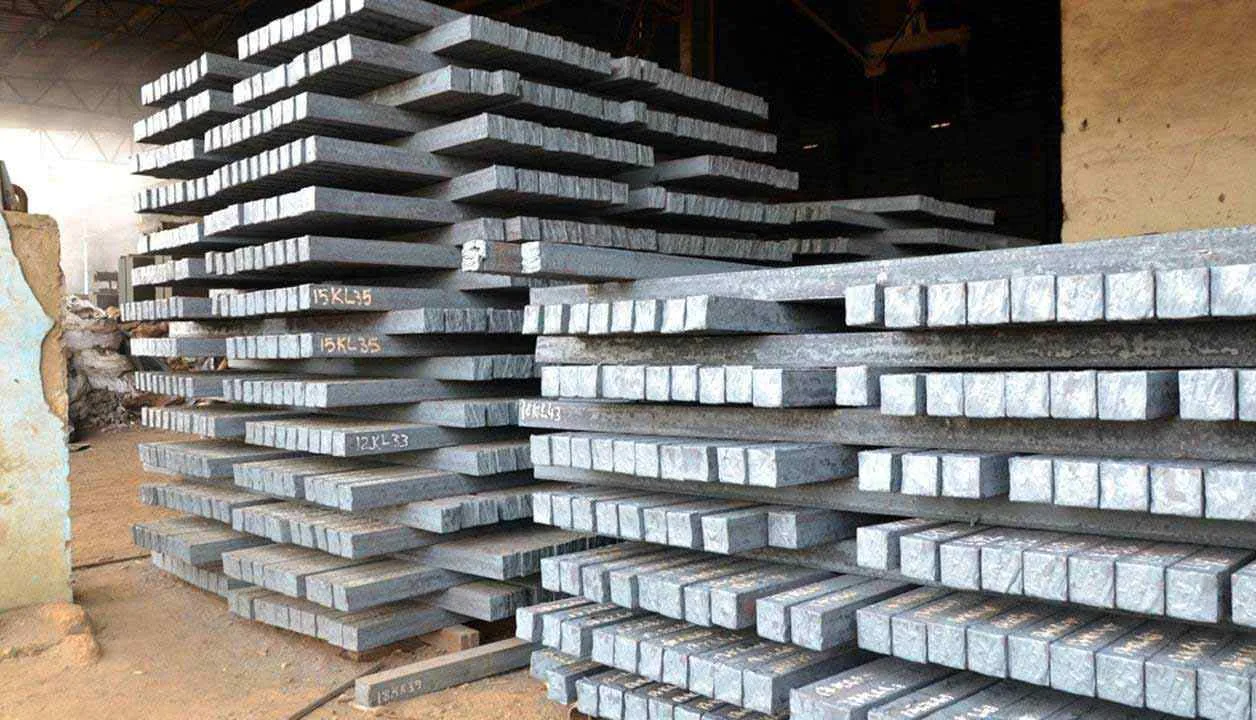

Before a bar, rod, pipe, or structural beam exists, a billet does. Stainless steel billets are the primary raw material feeding rolling mills, forging presses, and extrusion lines across construction, automotive, oil & gas, and engineering sectors. Because the chosen grade determines the final product's mechanical strength, corrosion behaviour, and service life, mastering the steel billet production process and understanding grade variations matters long before a purchase order gets raised. Sourcing the wrong grade costs more to fix downstream than any savings at the raw material stage.
What Are Stainless Steel Billets?
Stainless steel billets are solid semi-finished sections square or round produced for downstream rolling, forging, or extrusion. Two production routes dominate: continuous casting, where molten steel solidifies through a water-cooled mould, and hot rolling, which reduces cast stock to uniform sizes. Chemical composition and microstructure define everything. A billet with alloying inconsistencies introduces defects that survive into finished products. Manufacturers choose billets because they deliver uniform grain structure, predictable formability, and the throughput economics large-scale production demands.
Classification of Stainless Steel Billet Grades
Austenitic Stainless Steel Billets
Grades 304 and 316 dominate here, carrying 16–26% chromium and 6–22% nickel. Austenitic billets deliver the highest corrosion resistance among standard stainless families, cold-form without cracking, and weld cleanly which is why chemical pipework and food processing equipment consume large volumes.
Ferritic Stainless Steel Billets
Grade 430 uses chromium without significant nickel, cutting material cost while maintaining moderate corrosion resistance. Automotive exhaust systems and household appliances are the primary markets. These billets machine well and suit applications where deep-draw formability is not the priority.
Martensitic Stainless Steel Billets
Grades 410 and 420 are heat-treated to a surface hardness above 500 HV, suitable for cutlery blanks, pump shafts and wear-exposed components. Corrosion resistance is less than that of austenitic grades, and examination of the environment is necessary before specifying them.
Duplex Stainless Steel Billets
Grade 2205 holds a mixed austenite-ferrite microstructure delivering roughly double the yield strength of standard 304, while matching its corrosion resistance in chloride environments. Offshore pipework, desalination equipment, and pressure vessels consume large volumes of duplex billets.
Super Duplex Billets
Grades S32750 and S32760 add higher molybdenum and nitrogen, pushing pitting resistance equivalent numbers above 40. Subsea wellheads, deep offshore flowlines, and aggressive chemical service pull these grades where standard duplex starts to pit.
Manufacturing Process of Stainless Steel Billets
Melting & Refining
Scrap steel, ferroalloys, and alloying additions melt in an electric arc furnace above 1,600°C. An argon oxygen decarburisation converter then adjusts carbon and alloy content to target chemistry within tight limits.
Continuous Casting
Refined molten steel enters a water-cooled copper mould and solidifies progressively. This route delivers lower segregation than ingot casting, directly improving downstream formability and finished bar quality.
Hot Rolling & Shaping
Blooms pass through a rolling mill at 1,100–1,250°C, where successive roll stands reduce the cross-section to the target billet size. Tight dimensional control determines how cleanly the billet feeds forging presses or tube mills.
Cooling & Finishing
Controlled cooling after rolling prevents unwanted phase transformations that would harden the billet and cause cracking during subsequent processing. Surface grinding removes scale before final inspection.
Applications of Stainless Steel Billets
Construction Industry
Hot-rolled billets become reinforcing bars, structural sections, and fasteners for bridges and industrial facilities. Austenitic grades handle corrosive coastal environments; ferritic grades cover standard structural work where budget drives the spec.
Automotive Industry
Engine valve blanks, transmission shafts, and precision suspension components start as martensitic or duplex billets. Close billet tolerances reduce machining stock and cut cycle time on CNC turning lines.
Oil & Gas Industry
Seamless pipes, flanges, and valve bodies for high-pressure service roll from duplex and super duplex billets. Wall thickness consistency from the billet determines pressure rating a defective billet fails hydrostatic testing before reaching a wellhead.
Engineering & Fabrication
Round bars, hex bars, and flat bars for pumps, valves, and instrumentation fittings start from 304 and 316 austenitic billets, where machinability and surface finish consistency are what fabricators need most.
Aerospace Industry
Turbine shafts, fasteners, and structural brackets for aerospace start from billets with certified chemical composition and ultrasonic clearance. Martensitic and precipitation-hardening grades supply the strength-to-weight ratio aerospace structures demand.
Marine Industry
Propeller shafts, hull fittings, and seawater system components use duplex or super duplex billets to resist chloride pitting under continuous saltwater immersion a condition that degrades standard 316 within years.
Key Factors Affecting Billet Grade Selection
Grade selection starts with mechanical load requirements. Corrosion exposure defines chromium, molybdenum, and nitrogen needs. Heat treatment compatibility matters if the process involves hardening or annealing. Fabrication route forging, rolling, or extrusion determines how much ductility the grade must hold before processing. Compliance with ASTM A276 or ASTM A479 provides the contractual baseline. Cost-per-kilogram only makes sense evaluated against service life.
Benefits of Using High-Quality Stainless Steel Billets
Tight chemical and dimensional tolerances reduce surface defects in finished bars by keeping inclusion counts low. Consistent microstructure means one mechanical test result represents the full batch, cutting the risk of field failures. Better corrosion performance in the finished product traces directly to correct alloy composition at the billet stage. For large production runs, fewer downstream rejections cut total manufacturing cost more than any discount on billet price.
How to Choose the Right Stainless Steel Billets Supplier
Heat-traceable mill test certificates and ISO 9001 certification ensure that the supplier has control over what is happening in each batch. A supplier having austenitic, ferritic, duplex and super duplex grades can update specifications without changing suppliers mid-project. Test reports are supplied for chemical, mechanical properties and ultrasonic results, which enable the purchaser to qualify each heat prior to processing.
Quick Billet Selection Checklist:
- Grade meets the criteria of mechanical strength
- Corrosion resistant in the service environment
- Mill test certificate includes chemical & mechanical properties
- Dimensional limits are in line with downstream process requirements.
- ISO certification confirmed, ASTM standard compliance verified
- Critical applications approved for ultrasonic testing
Conclusion
Stainless steel billets underpin every finished steel product that carries a load, resists corrosion, or holds dimensional precision in service. Grade selection austenitic, ferritic, martensitic, duplex, or super duplex sets the ceiling on final product performance. From construction frameworks to offshore pipelines, the right billet grade chosen at the raw material stage determines whether the end component performs across its full design life. Source high-quality stainless steel billets from a certified supplier with full traceability and the technical depth to match material to application.























Sign in to leave a comment.