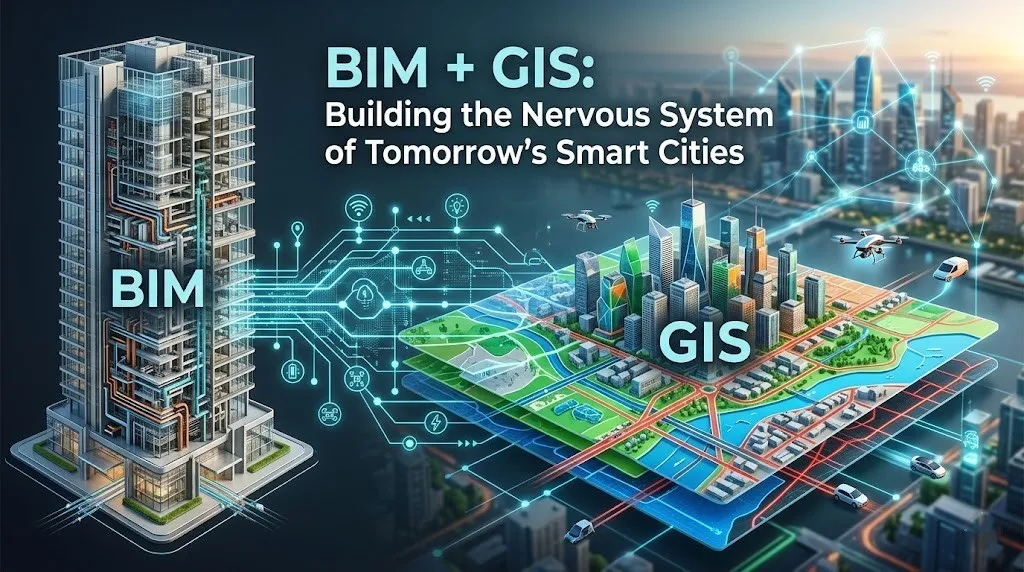

Have you ever wondered why, despite our "smart" gadgets, our cities still feel so fragmented? We have brilliant building designs and sophisticated city maps, yet they rarely talk to each other. Here’s a staggering reality: the global smart cities market is projected to hit $983 billion by the end of 2026, yet much of that value remains locked in data silos.
For years, the AEC industry treated Building Information Modeling (BIM) and Geographic Information Systems (GIS) as two different worlds. One focused on the "what" (the intricate details of a structure), while the other focused on the "where" (the larger geographic context). But as we move toward a future defined by digital twins and urban resilience, these two are finally merging to create the "nervous system" of our future metropolises.
The Convergence: Why "What" Needs "Where"
In the traditional workflow, a BIM model is like a high-definition photo of a person standing in a dark room. You can see every detail of the person, but you have no idea where they are or how they interact with their surroundings. By integrating GIS, we turn on the lights.
The integration of BIM and GIS allows AEC professionals to move beyond the building envelope. According to a 2025 Smart City Infrastructure Report, projects utilizing integrated BIM-GIS workflows saw a 15-20% reduction in operational costs by better predicting how structures interact with municipal utilities and environmental stressors.
- Micro vs. Macro: BIM provides the high-fidelity 3D geometry of assets.
- Geospatial Intelligence: GIS provides the environmental, social, and infrastructure layers—everything from flood plains to underground fiber optics.
When these layers talk, we don't just build buildings; we build ecosystems. For a deeper dive into why the construction future depends upon integrating GIS in BIM, it’s clear that spatial context is no longer a "nice-to-have"—it’s the foundation.
Powering the Digital Twin Revolution
We can't talk about 2026 trends without mentioning Digital Twins. The BIM market is expected to grow at a CAGR of 13.2% through 2034, and the engine driving this growth is the demand for real-time, living models of cities.
By feeding real-time IoT sensor data into a combined BIM-GIS interface, city managers can visualize traffic flow, energy consumption, and even structural health in one unified dashboard. In North America which currently holds a 32.6% share of the global smart city market this "nervous system" is already being used to manage aging infrastructure and optimize emergency response times.
"The shift in 2026 is moving from 'doing BIM' to orchestrating carbon, cost, and compliance through integrated data-centric processes." Industry Insight, AEC 2026 Forecast.
Actionable Takeaways for AEC Professionals
If you’re looking to stay ahead of the curve, here is how you can start bridging the gap today:
- Adopt Open Standards: Prioritize software that supports IFC (Industry Foundation Classes) and CityGML to ensure data can flow between BIM and GIS platforms without loss of detail.
- Focus on Data Cleanliness: Integration fails if the data is messy. Establish strict protocols for geospatial coordinates within your BIM execution plans (BEP).
- Think Lifecycle, Not Project: Use GIS to track the asset's impact on the environment long after the construction crew has left the site.
- Invest in Upskilling: The most valuable professionals in 2026 aren't just "BIM Managers"; they are Digital Integration Specialists who understand spatial analytics.
The Road Ahead: A Resilient Urban Future
As we look toward the horizon, the marriage of BIM and GIS is what will allow our cities to breathe and adapt. With climate change demanding more resilient infrastructure and urbanization putting pressure on resources, we can no longer afford to design in a vacuum.
By building this digital nervous system today, we aren't just making "smart" cities—we’re making sustainable, livable, and human-centered environments for the generations to come. The question isn't whether you should integrate; it's how fast you can start.



























Sign in to leave a comment.