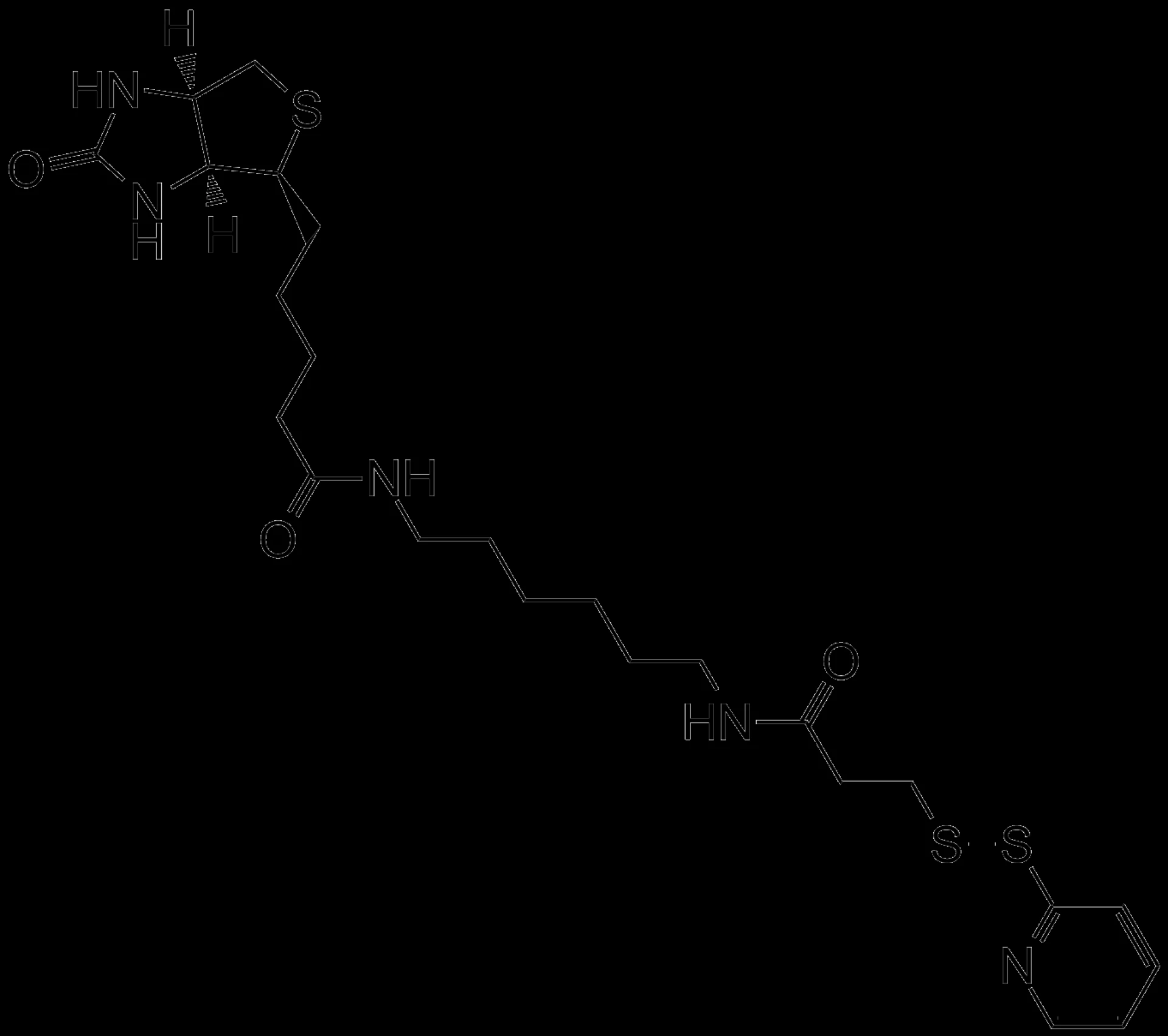

Biotin-HPDP is a sulfhydryl-reactive biotinylation reagent that forms a reversible disulfide linkage.
Biotin-HPDP is a sulfhydryl-reactive biotinylation reagent that forms a reversible disulfide linkage.Biotin-HPDP consists of a bicyclic Biotin ring structure, a 1, 6-diaminohexane attached to the side chain of biotin valonate, and a sulfhydryl reactive group at the end of the side chain[1]. It is used to label protein cysteines and other substrates that contain sulfhydryl groups.
After NEM alkylation, certain (but not all) residual free cysteine residues may react with biotin-HPDP, resulting in the coisolation of proteins containing such cysteine residues[2].
A kinetic study of the modification reactions that generate monothiophosphate disulfide linkages with either 5'-GMPS alone or 5'-GMPS-primed RNA as the substrate revealed that the second-order rate constants increased as the pH was decreased. For example, when the reaction pH was lowered from 8 to 4, the k2 value for the coupling reaction between N-(6-[biotinamido]hexyl)-3'-(2'-pyridyldithio)propionamide (biotin-HPDP) and GMPS increased 67-fold from 1.84 to 123 M(-1) x s(-1) [3].
References:
[1]: Bioconjugate Techniques , 2nd ed. By Greg T.Hermanson ?(Pierce Biotechnology, Thermo Fisher Scientific, Rockford, IL). ?Academic Press ?(an imprint of Elsevier): ?London, Amsterdam, Burlington, San Diego . 2008. ISBN 978-0-12-370501-3.
[2]: Zhou B, Wang Y, Yan Y, Mariscal J, Di Vizio D, Freeman MR, Yang W. Low-Background Acyl-Biotinyl Exchange Largely Eliminates the Coisolation of Non-S-Acylated Proteins and Enables Deep S-Acylproteomic Analysis. Anal Chem. 2019 Aug 6;91(15):9858-9866. doi: 10.1021/acs.analchem.9b01520. Epub 2019 Jul 11. PMID: 31251020; PMCID: PMC7451198.
[3]: Wu CW, Eder PS, Gopalan V, Behrman EJ. Kinetics of coupling reactions that generate monothiophosphate disulfides: implications for modification of RNAs. Bioconjug Chem. 2001 Nov-Dec;12(6):842-4. doi: 10.1021/bc0100612. PMID: 11716671.

























Sign in to leave a comment.