
Introduction
This guide explains how a beginner can build a first AI model in Python. It covers basic tools, data preparation, model training, and simple checks of results. Many learners follow a similar routine during an AI certification course in Bangalore because the steps are clear and practical. The same routine also supports lab work in an AI course in Bangalore.
Set up Python and basic tools
A beginner starts with Python installed on a system. The setup typically includes NumPy for numerical work, pandas for tables, and scikit-learn for models. Some learners write code in a notebook, while others use a simple script file. Both options work as long as the code runs without errors.
A small project folder helps keep files in order. One folder can hold data files, another holds code, and a third stores results. This structure keeps changes easy to track during an AI Certification course in Bangalore and daily practice in an AI Course in Bangalore.
Prepare and inspect the dataset
A model requires input values and a clear label. Input values describe each row, such as length, weight, or count. The label indicates the class or value the model must predict. Clean data simplifies training and prevents unexpected results.
Many beginners load data from a CSV file. Pandas reads the CSV into a table so a learner can view the first rows and check each column. Simple checks look for missing entries, text in numeric fields, and repeated rows. A learner fixes issues by dropping rows, filling values, or changing types. In many tasks inside an AI Certification course in Bangalore, these steps decide how well the model works later.
Some lessons use a built‑in dataset, such as the Iris flower data. This dataset has a small size and numeric features, so it helps learners focus on steps instead of data search. In that way, it matches early units in an AI Course in Bangalore.
Split data, train the model, and test
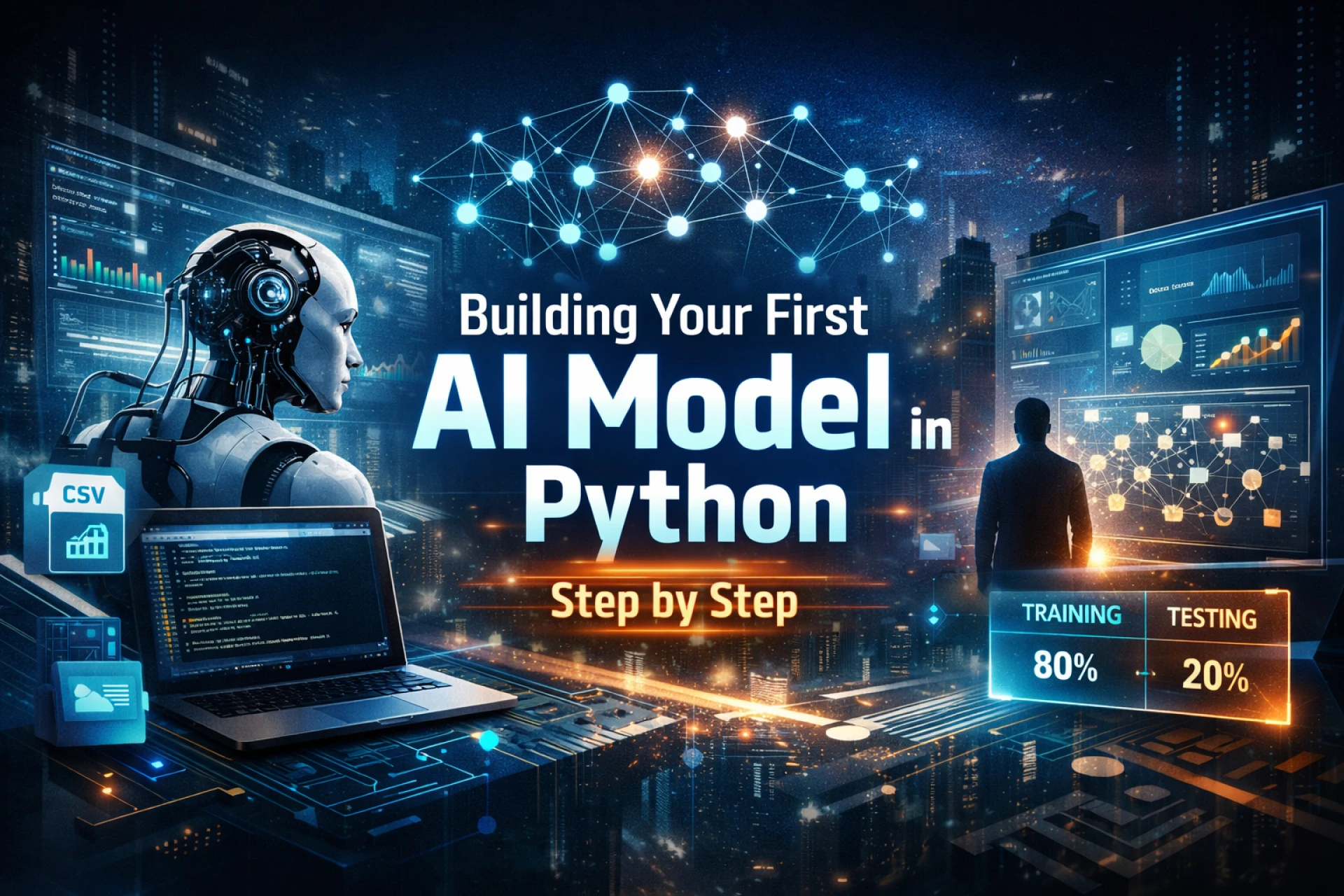
A model must be tested on new data. For that reason, a beginner splits the dataset into a training part and a test part. Many examples use a simple 80% for training and 20% for testing. This ratio keeps enough rows for learning and still leaves a set for checking.
Scikit-learn provides a helper function to perform this split. A learner sets a random seed so the split remains the same each time the code runs. This detail supports fair comparison when only one setting is changed at a time.
For many, logistic regression is the option of choice for a beginner project. It can simply classify, it trains quickly, and it is not long-code. A basic flow looks like this:
- Select feature columns and store them in X.
- Store the label column in y.
- Split X and y into training and test sets.
- Create a logistic regression model.
- Train the model with the training data.
- Predict labels for the test data.
- Measure accuracy by comparing true and predicted labels.
This flow appears often in an AI Certification course in Bangalore and in early units of an AI Course in Bangalore because it shows the full loop from raw data to a basic score.
Review results and improve the model
The first score acts as a starting point. A learner then checks where the model makes mistakes. If one class shows many incorrect predictions, the dataset may be imbalanced or noisy. A confusion matrix or a small table of errors can reveal these patterns.
Improvement works best through small changes. A learner might:
- Clean missing values with a different rule.
- Remove a column that adds noise.
- Scale features when numbers use very different ranges.
- Adjust one model parameter and run the code again.
Each change should produce a new score, allowing the learner to compare these scores. Simple notes about each run help during revision, especially when the work is part of an AI course in Bangalore. This habit also supports project checks during an AI certification course in Bangalore.
Conclusion
A beginner builds a first AI model in Python by setting up tools, preparing data, splitting it into training and test sets, training a simple classifier, and checking a clear metric. This direct process keeps each step manageable and allows small, steady improvements through controlled changes. Many structured programs, including an AI Certification course in Bangalore, use this process to give learners a stable base, and that base supports further progress in an AI Certification course in Bangalore.
























Sign in to leave a comment.